Prefer to do this by prompt? Connect iubenda to Claude or ChatGPT and set it up in the chat. See how it works
Aqui você aprenderá tudo o que precisa sobre nossa solução de gerenciamento de cookies:
⚙️ Take a look at this demo to see how the iubenda Privacy Controls and Cookie Solution works.
Introdução à Lei dos Cookies e à Política de Cookies
The ePrivacy Directive 2002/58/EC (or Cookie Law) was established to put guidelines in place for the protection of electronic privacy, including email marketing and cookie usage, and it still applies today.
💡A Lei dos Cookies se aplica não apenas aos cookies, mas, de forma mais ampla, a qualquer outro tipo de tecnologia que armazene ou acesse informações no dispositivo do usuário (por exemplo, tags de pixels, impressão digital do dispositivo, identificadores exclusivos, etc.). Simplificando, todas essas tecnologias, incluindo os cookies, são normalmente definidas como rastreadoras. No entanto, neste manual, os termos cookie(s) e rastreador(es) serão usados indistintamente.
You can think of the ePrivacy Directive as currently “complementing” the GDPR in a sense, rather than being repealed by it.
A rigor, se você usa cookies, deve levar em consideração o cumprimento da Lei dos Cookies antes de olhar para o GDPR. Isso porque a Lei dos Cookies é chamada de “lex specialis” no jargão jurídico , o que significa que ela prevalece sobre o GDPR.
Directives, generally speaking, set certain agreed-upon goals and guidelines in place with Member States being mandated to implement these directives into national legislation..
Os regulamentos, por outro lado, são juridicamente vinculantes para todos os Estados-membros, desde o momento em que entram em vigor, e são aplicados de acordo com as normas estabelecidas pela União.
With that said, the ePrivacy Directive is, in fact, going to be repealed soon by the ePrivacy Regulation. The ePrivacy Regulation is expected to be finalized in the near future and will work alongside the GDPR to regulate the requirements for the use of cookies, electronic communications, and related data/privacy protection.
Espera-se que o Regulamento mantenha princípios semelhantes aos da Diretiva, aplicando grande parte das mesmas diretrizes.
Quem está sujeito à Lei dos Cookies?
The implementation of the Cookie Law depends on the legislation under which the site/app operates.
Geralmente, a Lei dos Cookies será aplicada se:
- you or your users are based in the EU; and
- you use cookies or similar technologies on your site/app.
O que exige a Lei dos Cookies?
Under the Cookie law, organizations that target users from the EU must inform users about data collection activities and give them the option to choose whether it’s allowed or not.
Ou seja, se seu site/aplicativo (ou qualquer serviço de terceiros usado por seu site/aplicativo) usa cookies ou tecnologias semelhantes, você deve obter um consentimento válido antes da instalação desses cookies, salvo se forem isentos de consentimento.
In practice, you’ll need to:
- show a cookie banner/consent banner at the user’s first visit;
- implement a cookie policy that contains all required information;
- allow the user to provide consent. Prior to consent, no cookies — except for exempt cookies — can be installed.
Further information about Cookie Law
For further details on the Cookie Law, we invite you to read our documentation and the official statements from the country you might be affiliated with or targeting. Great guidance can be accessed through the Article 29 Working Party (which is a group comprised of various data protection regulators that aim to simplify Europe’s diversity):
Here are the links to each countries specific application of the ePrivacy directive:
- Belgium: Commission de la protection de la vie privée (French | Dutch)
- Czech Republic: Úřad pro ochranu osobních údajů
- Denmark: Guidelines on Executive Order on Information and Consent Required in Case of Storing and Accessing Information in End-User Terminal Equipment
- France: Commission Nationale de l’Informatique et des Libertés
- Germany: EC Communications Committee Working Document on implementation
- Greece: Η χρήση cookies στο διαδίκτυο
- Ireland: Guidance note on Data Protection in the Electronic Communications Sector
- Luxembourg: Commission nationale pour la protection des données
- Netherlands: Autoriteit Consument en Markt
- Spain: Agencia de Protección de Datos
- UK: Information Commissioner’s Office
What is the iubenda Privacy Controls and Cookie Solution?
The iubenda Privacy Controls and Cookie Solution allows you to manage all aspects of the Cookie Law, in particular:
- easily inform users via cookie banner/consent banner and a dedicated cookie policy page (which is automatically linked to your privacy policy and integrates what’s necessary for Cookie Law compliance);
- obtain and save cookie consent settings;
- automatically block scripts that may install cookies/trackers on the website until the user gives consent via the auto-blocking feature; and
- keep track of consent and save consent settings for each user for up to 12 months from the last site visit.
Você pode obter consentimento por meio de diverso mecanismos, incluindo a navegação contínua, a rolagem e/ou ações específicas de clique. No entanto, observe que as ações de consentimento permitidas podem diferir dependendo da legislação do Estado-membro.
Abaixo, você encontrará todas as etapas necessárias de utilização do iubenda a fim de garantir o cumprimento da Lei dos Cookies.
Como gerar uma política de cookies com o iubenda
- Go to the dashboard and select the privacy policy for which you want to generate a cookie policy (included in all plans).
- Click on Edit in “Privacy and Cookie policy”, you will notice a “Cookie Policy” box in the right column:

- Click on Activate cookie policy: your cookie policy will be generated automatically based on the configuration of your privacy policy.

How to add the cookie banner
Click on Generate now under Dashboard > [Your website/app] > Privacy Controls and Cookie Solution:
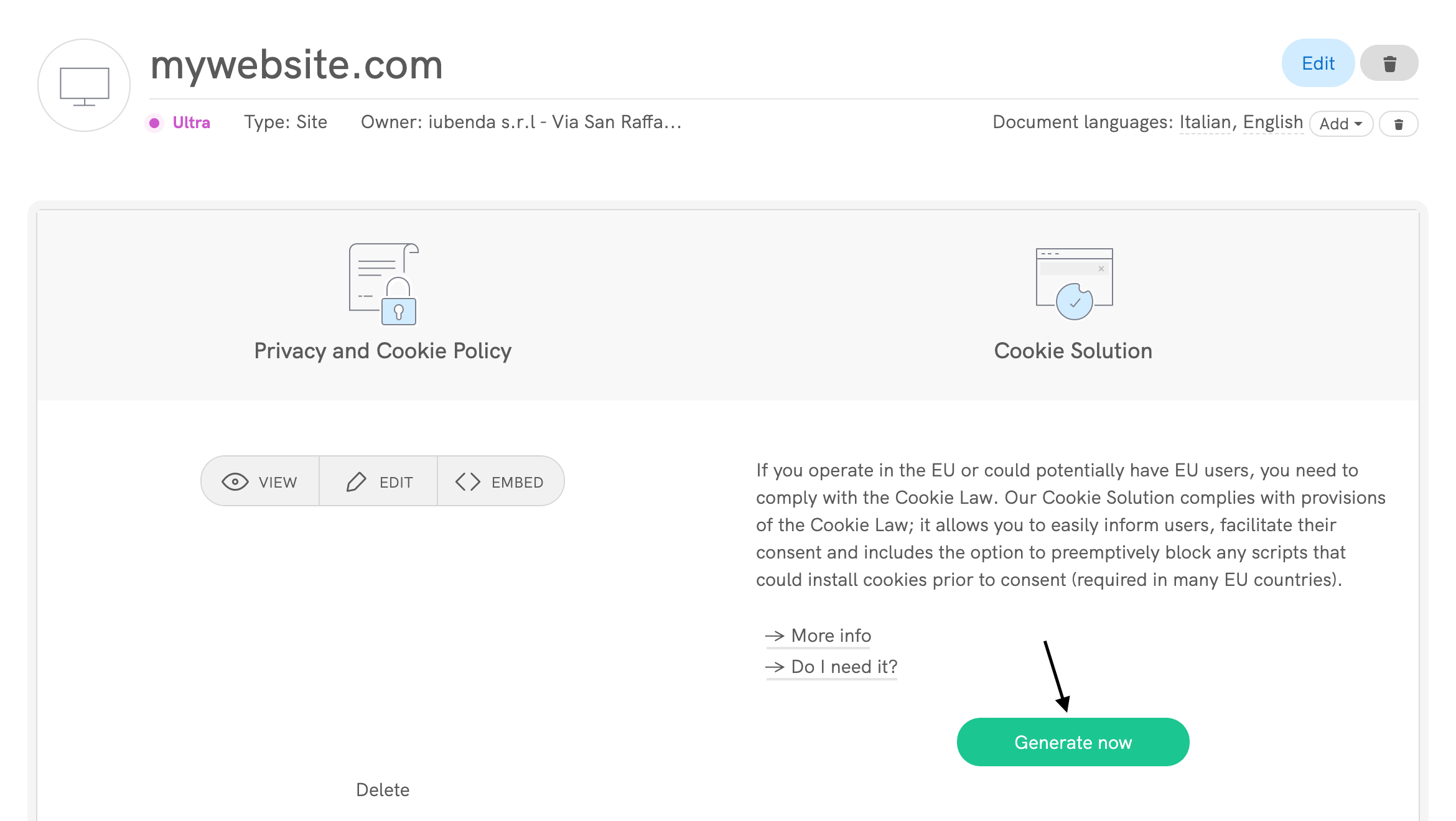
This will take you directly to the configuration panel of your cookie banner/consent banner:

Após salvar, você obterá um snippet de código semelhante:
Simply copy and paste it into the head tag of your website’s HTML as the first element. Alternatively, you can use one of our plugins: currently we have plugins available for WordPress, Joomla!, PrestaShop and Magento.

Important
Don’t use the code shown above, it’s just a sample code. Instead, use the code attached to your cookie policy, which you can obtain by following the steps listed above. For information on how to configure or customize the banner or to better understand how to access all of the available options, please read the documentation on the cookie banner/consent banner.
💡 Using advertising services?
If you rely on advertising vendors, you may need to enable the IAB Transparency and Consent Framework (TCF). The latest version is TCF 2.3, and it can be activated later without changing your banner layout. 👉 Learn more about enabling TCF 2.3 with iubenda.
Remote Configuration Feature
The remote configuration feature makes it easier to update your Privacy Controls and Cookie Solution settings by applying most changes directly to your website—no re-embedding needed.
What’s New?
With the latest update, the new snippet now includes all components of the Privacy Controls and Cookie Solution. This means every change in the banner, including Custom CSS, TCF tile, and US laws support, is automatically applied without re-embedding.
When saving your configuration, you’ll be notified if any changes still require re-embedding.
Please note:
- Users already using remote configuration (V1) will see a banner in their embedding section about the update.
- Legacy users can enable full remote configuration by selecting the “Enable Remote Configuration” checkbox in the configurator.

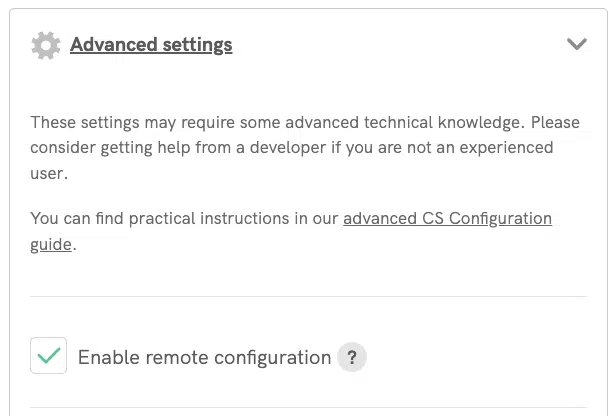
New configurations will have full remote configuration enabled by default.
Como solicitar consentimento apenas de usuários da UE
The Privacy Controls and Cookie Solution also allows you to indicate whether or not you’d like to apply GDPR protections to the following:
- All your users. In this case, consent will be requested to all users of your site. This is the default setting.
- Only your EU users. In this case, consent will be requested to EU users only.
Here’s an example: a US-based e-commerce site has different sections available to users in the US and in Europe. They want to apply GDPR protections (i.e. show the cookie banner/consent banner) to just their EU-based users.
This is possible by checking the Request consent to EU users only located in Privacy Controls and Cookie Solution > Edit > GDPR. Once you check this option (in code gdprAppliesGlobally:false), you’ll be able to automatically detect the user country (in code countryDetection:true).

Here’s the Privacy Controls and Cookie Solution snippet you’ll get:
If you choose to request consent to EU users only, but prefer to implement your own country detection system, you’ll have to set gdprApplies:false on pages where consent is not required.
Para obter mais detalhes sobre as configurações de coleta de consentimento, consulte nosso manual avançado.
Important
If you are EU-based, it is mandatory that you apply the protections to all users and not just users based in the EU.
Como e quando bloquear preventivamente códigos/cookies
According to the Data Protection Working Party, a European think tank and advisory body on data protection and privacy, few categories of cookies are exempt from the consent requirement. Therefore, all other codes that install or can install cookies must be preemptively blocked before consent is obtained.
Para obter mais informações e um manual técnico sobre como e quando bloquear códigos, consulte nossa introdução ao bloqueio prévio de scripts e o manual sobre a marcação manual.
How to store proofs of user preferences
In most cases, cookies may process personal data, and record-keeping requirements arising from the GDPR apply. Many Data Protection Authorities across the EU have therefore strengthened their requirements and aligned their rules on cookies and trackers with the requirements of the GDPR.
The Cookie and Consent Preference Log lets you store and manage GDPR proofs of your users’ consent preferences directly from the Privacy Controls and Cookie Solution. Integrate the feature with one click, and keep a verifiable record of every consent interaction.
How to access the Cookie and Consent Preference Log:
- If you’re on iubenda’s current pricing (all plans, including free): The Cookie and Consent Preference Log is already included in your plan. Go to Dashboard > [Your website/app] > Privacy Controls and Cookie Solution > Log to start viewing consent records.
- Legacy plan users: You need to upgrade to the 50,000 page views Privacy Controls and Cookie Solution plan or higher to activate this feature.
Not sure if you need the Cookie and Consent Preference Log? Take this 1-minute quiz to find out
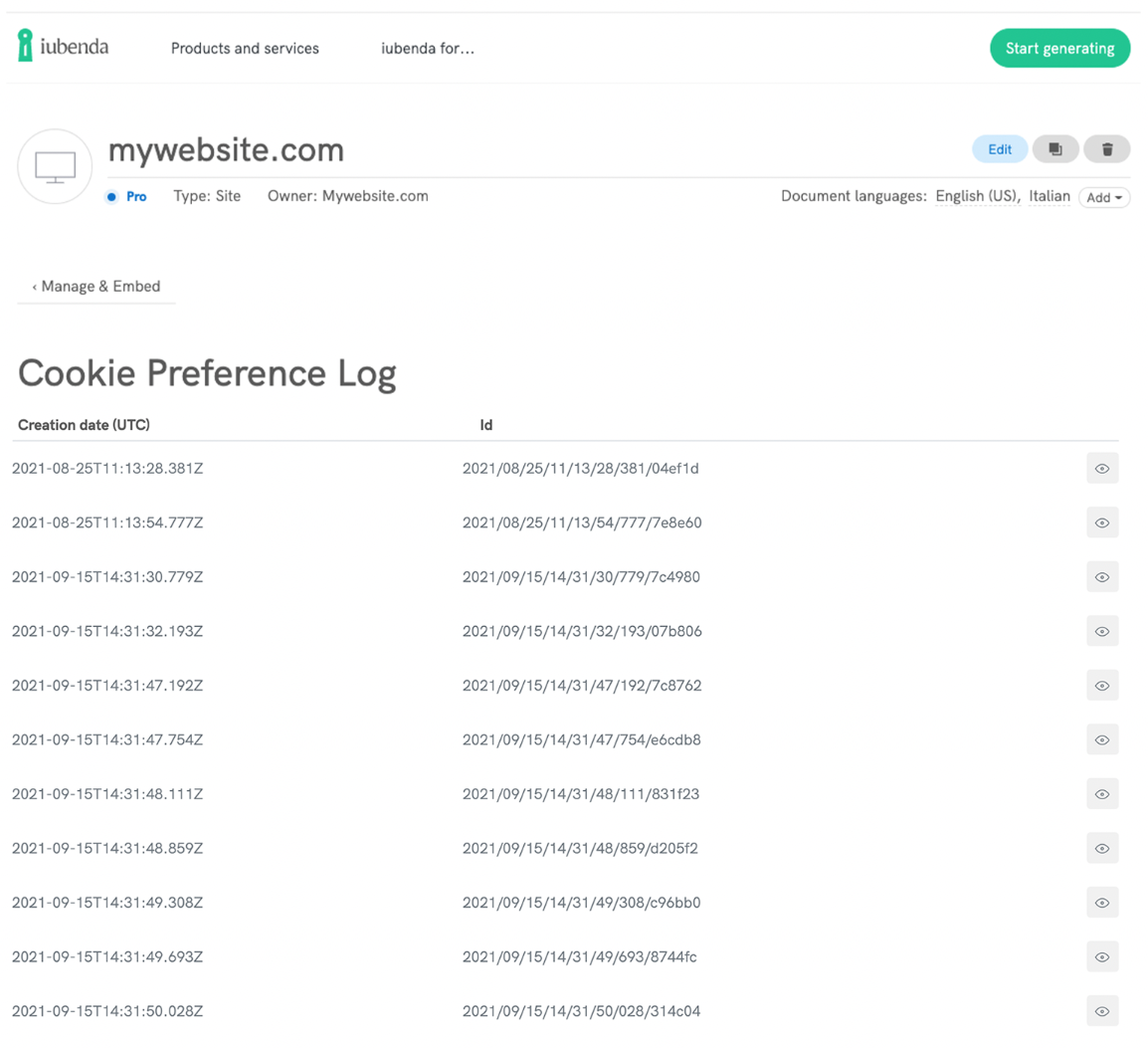
You don’t need to configure anything. Once activated, the feature is included by default within the Privacy Controls and Cookie Solution. Click on Log under Dashboard > [Your website/app] > Privacy Controls and Cookie Solution:

In this section, you can view and manage the logs of cookie preferences collected: