

TermsFeed generates legal documents and covers the basics of cookie consent. It works by asking you a series of questions and assembling a document from your answers, which is quick to start and hard to keep current.
This guide covers where that approach runs out, what to look for instead, and how five alternatives compare on coverage, method, and price.
Compare the best alternatives to TermsFeed: At a glance
| iubenda | Complianz | consentmanager | Termly | Osano | |
|---|---|---|---|---|---|
| Approach | Scanner-based, with recurring scans for cookies, trackers, and third-party services | Scanner-based; results pre-fill the setup wizard | Scanner-based, with integrated scanning and continuous monitoring | Scanner-based for cookies; legal documents still rely on questionnaires | Scanner-based, with scheduled scans for cookies, scripts, and trackers |
| Coverage | Consent, legal documents, accessibility, data subject rights, whistleblowing, and consent records | Consent, scanning, region-specific documents, consent records, and data request processing | Cross-channel consent, reporting, A/B testing, machine-learning optimization, and data subject rights | Consent, script blocking, consent logs, regional controls, and data subject request forms | Data subject rights, data mapping, privacy assessments, vendor risk, and preference management |
| All-in-one suite | Yes | No, WordPress and Shopify only | No, consent-led | No | No, privacy operations focus |
| Pricing transparency | Plans published openly, paid plans from €4.99/month | Plans published openly, paid plans from €59/year | Plans published openly, paid plans from €23/month | Plans published openly, paid plans from $10/month | No published pricing |
| Free plan available | Free plan available with everything you need to get started on a basic site | Free plan available | Free plan available | Free plan, capped monthly pageviews | No free plan published |
| Best for | Businesses of any size that want full compliance coverage in one place, without the enterprise price tag | WordPress and Shopify sites that prefer a native plugin | Enterprises and publishers that want to improve consent rates | Freelancers and small businesses that mainly need legal documents | Privacy teams that need vendor risk and data mapping alongside consent |
Common reasons businesses explore alternatives to TermsFeed
TermsFeed is a reasonable starting point. Three things tend to push teams to look elsewhere.
A questionnaire-based approach
Your documents are built from the answers you give, so they reflect your site as it was on the day you filled the form in. Add a new analytics tool or embed next month and nothing tells you the policy is now out of date.
Scanner-based platforms work the other way round: they read what is actually running on your site, and recurring scans flag changes as they appear.
Pricing structure
Documents are largely sold one at a time, so a business that needs a privacy policy, a cookie policy, terms and conditions, and a disclaimer pays per document. That adds up quickly against a single subscription that includes the set.
Scope stops at documents and basic consent
TermsFeed does the documents and a basic banner. Anything past that sits outside it, so each additional requirement means another product, another subscription, and another setup to maintain.
That matters more than it used to, because compliance is no longer only a privacy question. Requirements now extend into other areas of digital compliance, and which ones reach you depends on your business rather than on whether you were looking for them.
The cost of fragmentation
Running consent in one product, legal documents in a second, and accessibility or data subject requests in a third means three subscriptions, three logins, and three update cycles. Teams on that setup typically spend more than teams on one integrated platform, and the maintenance load grows every time a regulation changes.
Digital compliance has also stopped being only about privacy. Alongside the General Data Protection Regulation (GDPR) and cookie rules, requirements now reach areas such as accessibility and whistleblowing. Which of them apply depends on your size, sector, and the markets you sell into, and plenty of teams find they are in scope later than they expected. A platform that already covers the wider set turns a new requirement into a setting you switch on rather than another product you have to buy.
What to keep in mind when looking for the best alternative to TermsFeed
Here is what to check before you commit to a consent management platform or document generator.
A scanner-based approach
Prefer a platform that scans your live site and rescans on a schedule. A questionnaire captures a moment; a scanner captures the current state.
Fair and transparent pricing
Check whether documents are bundled or sold individually, and whether the price is published at all. Per-document pricing looks cheap for one policy and expensive for four.
Coverage beyond the basics
Documents are one obligation among several, and the others do not all come from privacy law. Platforms that already include the wider set save you assembling a stack later.
Documents a lawyer maintains
Templates age. Ask who updates the clause library, and how often.
The 5 best alternatives to TermsFeed in 2026
1) iubenda

iubenda is an all-in-one digital compliance suite used by over 150,000 customers worldwide, from solo founders to enterprises. It brings cookie consent, privacy and cookie policies, terms and conditions, accessibility, data subject rights, and whistleblowing management together on one subscription.
Privacy law keeps moving, and that breadth is the point: one platform covers the areas that would otherwise need three or four separate products, each with its own login, invoice, and update cycle.
The documents are also built from your live setup rather than a form. iubenda scans the site or app, identifies the services actually running on it, and generates the policy from what it finds, then rescans on a schedule to catch what you add later.
It is also built with marketing in mind rather than against it. Consent analytics show you what your consent rate actually is, and consent recovery works to win back consent that would otherwise be lost, which protects the data your campaigns depend on.
Pros
- All-in-one digital compliance suite on one subscription
- An in-house team of lawyers drafts and maintains the clause library
- Policies reflect what your site actually runs: the scanner detects the cookies, trackers, and third-party services in use, and generates the documents from that, rather than from a questionnaire
- Recurring scans flag new services as you add them, so the documents stay in step with the site
- Supports the major global privacy laws
- Google-certified CMP with support for Google Consent Mode v2
- Customizable legal document generation
- Easy integrations with WordPress, Shopify, Webflow, Google Tag Manager, and more
- Consent analytics and consent recovery help you see consent rates and recover consent that would otherwise be lost
- Lightweight script that supports fast page loads
- Flexible pricing based on the solutions you activate, so you don’t pay for more than you need
Cons
- The Terms and Conditions Generator is only available on paid plans
Pricing
- Free plan available with everything you need to get started on a basic site
- Paid plans start from €4.99/month
- Pricing scales with traffic, domains, and the solutions you activate
What people say
iubenda holds 4.7/5 on Capterra. Reviewers mention the peace of mind it gives smaller teams, the customer support, and the hours it saves on manual work.
How does iubenda compare to TermsFeed?
The core difference is method. TermsFeed asks you questions; iubenda scans your site to find the cookies, trackers, and third-party services actually running on it, then rescans on a schedule and flags what changed.
Scope is the other difference. Alongside documents and consent, iubenda covers data subject requests, accessibility, and whistleblowing, and the clause library behind the policies is drafted and maintained by an in-house legal team rather than assembled from a form.
Best for: businesses of any size that want full compliance coverage in one place, without the enterprise price tag.
2) Complianz
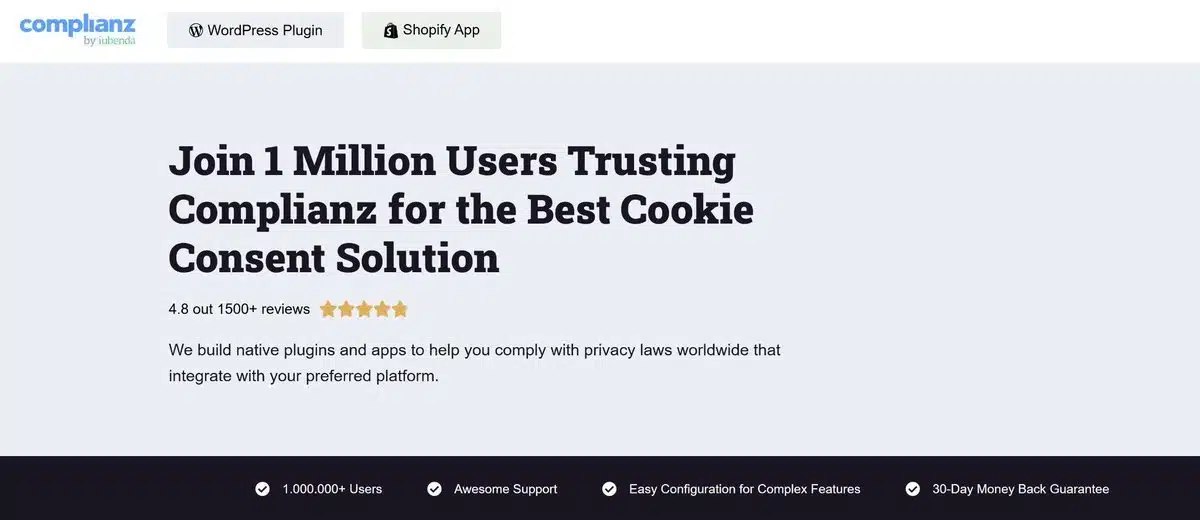
Complianz is a consent solution built specifically for WordPress and Shopify, with more than a million users on its native plugin. It scans for cookies, collects consent, blocks scripts, and generates region-specific legal documents, all from inside the CMS you already use.
A guided setup wizard uses the scan results to pre-fill your configuration, which makes it one of the quicker ways to get a compliant setup live on WordPress.
Pros
- Built natively for WordPress and Shopify
- Cookie scanner identifies and categorizes cookies and third-party apps
- Geolocation and region-specific consent settings
- Generates legal documents: privacy statements, cookie policies, impressums, and terms and conditions
- Google-certified with support for Google Consent Mode v2
- Consent statistics and A/B testing
- Highly customizable banners, optimized for page speed
- Terms and conditions come from a separate free Complianz plugin, which runs standalone or integrated with the main one
- 30-day money-back guarantee
Cons
- Not available outside WordPress and Shopify
Pricing
- Free plan available
- Paid plans start from €59/year, less than €5 a month
What people say
Complianz holds 4.4/5 on G2. Reviewers highlight the smooth WordPress integration, how easy it is to set up, and how light it is on page speed.
How does Complianz compare to TermsFeed?
Complianz gives WordPress and Shopify users considerably more than TermsFeed does: regional banners, script blocking, consent records, data request processing, Google Consent Mode v2, and consent statistics with A/B testing.
It is also scanner-based, so your setup reflects what is running rather than what you remembered to declare. The limit is platform reach: outside WordPress and Shopify it is not available.
Best for: WordPress and Shopify sites that prefer a native plugin.
3) consentmanager
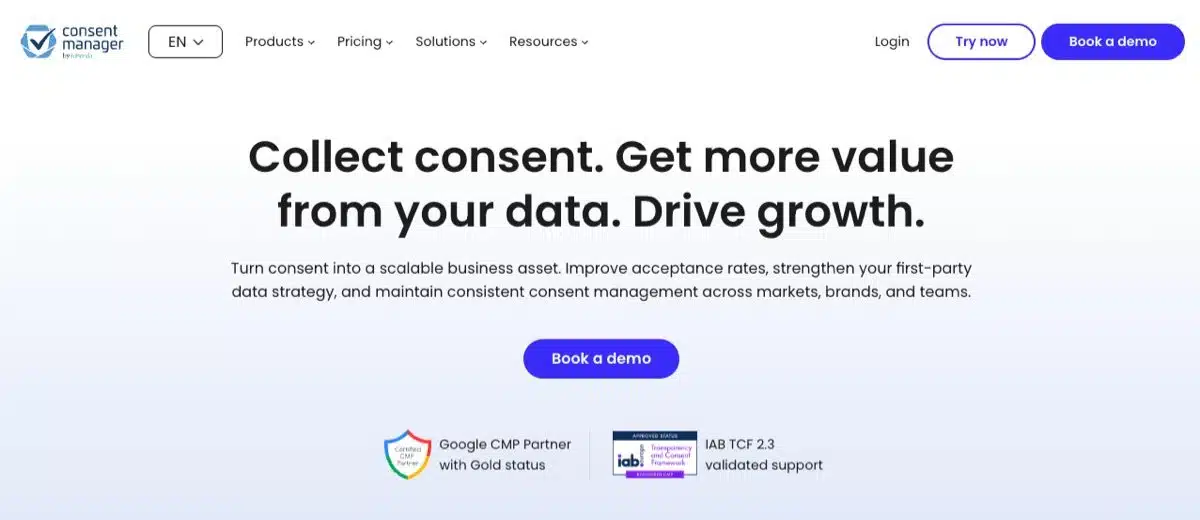
consentmanager is a Google-certified CMP built for enterprises, publishers, and businesses running multiple high-traffic websites. It covers websites, mobile apps, and connected TVs, and adds legal document generation and compliance monitoring alongside consent collection.
Its focus is turning consent into something you can actively improve. Built-in A/B testing and machine learning compare banner layouts, wording, and button positions, then send more visitors to the version that performs best.
Pros
- In-depth scanning identifies and classifies cookies, trackers, and vendors
- Continuous monitoring helps detect consent issues
- Built-in A/B testing and machine-learning optimization improve banner performance over time
- Detailed reporting and benchmark reports
- Over 200 design options for banners
- Works across devices, including desktop, mobile, apps, and connected TVs
- Compliance Monitor scanning spots gaps and gives you clear next steps
Cons
- Takes time to master, given the depth of configuration
Pricing
- Free plan available
- Paid plans start from €23/month
What people say
consentmanager holds 4.1/5 on Capterra. Reviewers describe it as straightforward once configured, good value for the range of solutions, and fast to run.
How does consentmanager compare to TermsFeed?
These two barely overlap. TermsFeed is a document generator with basic consent; consentmanager is a consent platform for enterprises and publishers, with A/B testing, machine-learning optimization, and reporting across websites, apps, and connected TVs.
If your problem is documents, consentmanager is more than you need. If your problem is consent at scale, TermsFeed was never going to solve it.
Best for: enterprises and publishers that want to improve consent rates.
4) Termly
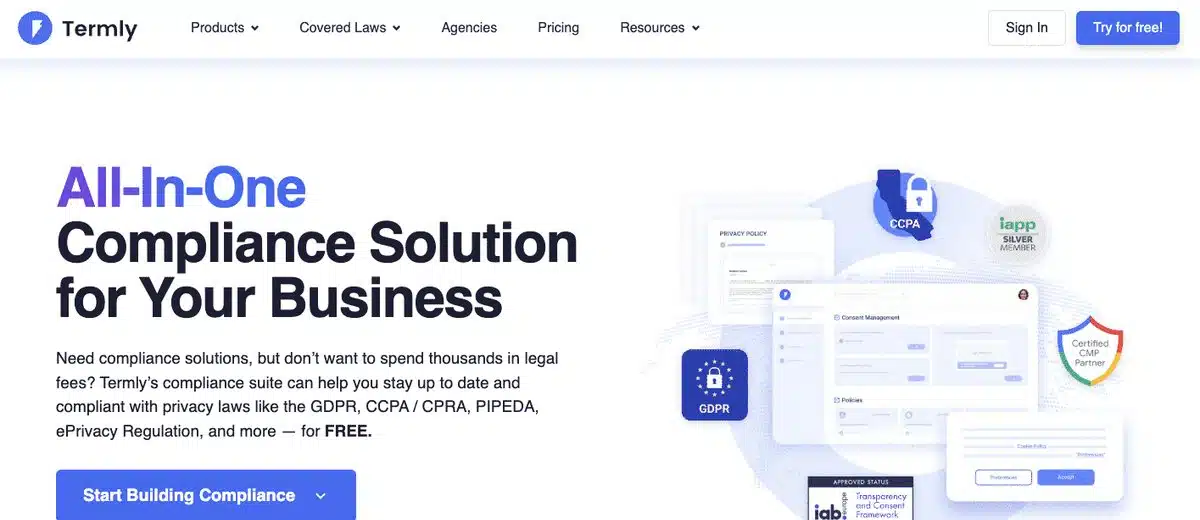
Termly is a lightweight CMP that began as a legal document generator. It produces privacy and cookie policies, terms and conditions, impressums, return and shipping policies, and more.
Pros
- Easy to set up and use
- An extensive range of legal documents
- Scanner-based for cookies
- Free plan with capped monthly pageviews
Cons
- Legal documents still rely on questionnaires
- Policies and banners offer limited customization
- No consent rate optimization
- Reviews mention slow support replies and slower page loads on larger sites
Pricing
- Free plan with capped monthly pageviews
- Paid plans start from $10/month
What people say
Termly holds 4.3/5 on Trustpilot. Reviewers call it easy to use and reasonably priced, while others mention difficulties with support and limits on customization.
How does Termly compare to TermsFeed?
Termly is the closest like-for-like swap: a comparable document range, bundled into a subscription rather than sold per document, plus cookie scanning and script blocking that TermsFeed does not match.
The catch is that Termly’s documents are still questionnaire-driven, so you inherit the same staleness problem. It is a better-value version of the same approach rather than a different one.
Best for: freelancers and small businesses that mainly need legal documents.
5) Osano

Osano is a privacy operations platform: cookie consent, data subject rights, data mapping, privacy assessments, and third-party vendor risk assessment, which tells you the privacy risk carried by the vendors on your site.
Pros
- Scheduled scans for cookies, scripts, and trackers
- Data mapping, privacy assessments, and preference management
- Third-party vendor risk assessment
- A “No Fines, No Penalties” guarantee of up to $500,000
Cons
- No published pricing
- Cookie classifications can be inaccurate
- Reviews mention slow support outside the United States
- Limited analytics
- Customization takes effort
Pricing
- No free plan published
- No published pricing
What people say
Osano holds 2.6/5 on Trustpilot. Reviewers say it helps them keep up with regulatory change, while noting that the analytics are limited and that support can be slow outside the United States.
How does Osano compare to TermsFeed?
Osano is aimed at a different buyer. Where TermsFeed serves a small site that needs a policy, Osano serves a privacy team that needs data mapping, assessments, and vendor risk on top of consent.
It publishes no pricing, so there is no way to compare cost without a sales conversation, and its document generation is narrower than TermsFeed’s.
Best for: privacy teams that need vendor risk and data mapping alongside consent.
Choosing the right alternative to TermsFeed
Four questions narrow the list quickly.
- Do you want documents that track your live site? Every option here scans for cookies. Only iubenda, Complianz, consentmanager and Osano move beyond questionnaires for the wider setup.
- How many documents do you actually need? Per-document pricing looks cheap for one and expensive for four. A bundled subscription flips that.
- Do you need accessibility, whistleblowing, or data subject requests? Only an all-in-one suite covers those without a second purchase.
- Do you want to see pricing without a sales call? iubenda, Complianz, consentmanager and Termly publish their plans. Osano does not.
If you need more than two documents and anything beyond consent, a bundled suite is almost always cheaper than assembling the same coverage one purchase at a time.
Frequently asked questions
What’s the best alternative to TermsFeed?
For breadth on one subscription, iubenda covers consent, legal documents, accessibility, data subject rights, and whistleblowing. For a like-for-like document generator at lower cost, Termly. For WordPress or Shopify, Complianz.
Why do businesses look for a TermsFeed alternative?
Three reasons come up most: documents are assembled from a questionnaire and go stale as your site changes, documents are largely priced individually, and there is little coverage beyond documents and basic consent.
Is a scanner better than a questionnaire for legal documents?
A scanner reads what is actually running on your site and can rescan on a schedule, so it catches the analytics tool or embed you added last month. A questionnaire records what you declared on the day you filled it in. Both produce a document; only one keeps track of changes.
Is there a free alternative to TermsFeed?
Yes. iubenda, Complianz, consentmanager, and Termly all offer a free plan. Termly caps monthly pageviews on its free tier, and Osano publishes no free plan.
More than a privacy policy
A privacy policy is one obligation. Cookie consent, accessibility, data subject requests, and whistleblowing are others, and buying them one document or one product at a time is how compliance budgets quietly grow.
iubenda brings them together on one subscription, scanner-based and maintained by an in-house legal team, with published pricing from €4.99/month. Start for free and see how much of your setup one platform can cover.