

If you have a website, app, or online store, then there’s one thing you need:
A privacy policy.
It’s how you show users what happens to their data and why they can trust you with it.
The challenge is getting it right.
Privacy laws expect more than a generic, copy-paste document. And while templates or AI tools may seem like a quick fix, they often miss the details that actually matter for your business.
That’s why many businesses turn to privacy policy generators.
In this guide, we compare 6 of the best privacy policy generators so you can find one that fits your business.
In short:
- Privacy policy generator comparison: At a glance
- What is a privacy policy?
- Do I need a privacy policy?
- What should a privacy policy include?
- What should you look for in a privacy policy generator?
- The best privacy policy generators
- Get your privacy policy right from the start
- Frequently asked questions
One difference worth knowing when you compare: iubenda is the only generator on this list your AI assistant can operate directly. Connect the connector to Claude or ChatGPT and the policy is generated by iubenda, from a scan of your live site, rather than written by the model. See how it works
Privacy policy generator comparison: At a glance
| iubenda | consentmanager | Complianz | Termly | TermsFeed | Enzuzo | |
|---|---|---|---|---|---|---|
| Approach | Tailored to your business by legal experts, with 2,400+ updated clauses | Tailored, clause-based generator connected to consent management | Tailored plugin-based generator for WordPress and Shopify | Template-based generator | Template-based generator with paid per-clause additions | Template-based generator focused on Shopify e-commerce |
| Multi-language support | Available in 27 languages | Available in 8 languages | Available in 40+ languages | Higher-tier plans only | Limited for privacy policies | Available in 23+ languages |
| Pricing | Free plan available, paid plans from €4.99/month | Paid plans from €23/month | Paid plans from €59/year (less than €5/month) | Limited free plan, paid plans from $10/month | Limited free plan, per-clause pricing | Limited free plan, paid plans from $9/month |
| Best for | Businesses of any size that want a lawyer-backed policy built around real operations, with broader compliance tools in one place | Businesses already using consentmanager for consent who want a connected policy generator | WordPress and Shopify stores that prefer an in-CMS plugin | Freelancers and small businesses comfortable with a templated policy | Businesses that prefer assembling clauses individually | Shopify-first stores wanting policies tied to their storefront |
What is a privacy policy?
A privacy policy, also known as a Privacy Notice, Privacy Agreement, or Privacy Page, is a document that explains how your business collects, uses, stores, and shares personal data.
If you run a website, app, or online service, you’re probably collecting some form of data. That might include names, email addresses, payment details, or browsing behavior.
Your privacy policy is where you explain what you collect and what you do with it. It also tells users what rights they have over their data and how they can exercise them.
What’s the difference between a cookie policy and a privacy policy?
A privacy policy and a cookie policy work together, but they serve different purposes.
A privacy policy explains the full picture. It covers what personal data you collect, how you use it, who you share it with, and what rights users have.
A cookie policy focuses specifically on cookies. It explains what cookies you use, what they do, and how users can manage them.
Do I need a privacy policy?
Yes, you do.
App stores and e-commerce platforms often require a privacy policy before you can publish or sell through their services.
And many global privacy laws require you to provide a clear, accessible privacy policy if you collect personal data. This includes regulations like the General Data Protection Regulation (GDPR), the California Privacy Rights Act (CPRA), and Brazil’s Lei Geral de Proteção de Dados (LGPD).
If you collect any kind of identifiable information, even something as simple as an email address, these laws expect you to explain what you do with it.
The key thing to remember is that these laws don’t apply based on where your business is located.
They apply based on where your users are.
So if your website or app reaches users in regions with privacy regulations, those requirements apply to you, even if your business operates elsewhere.
That’s why many businesses choose to align their privacy policy with the strictest applicable regulations. It helps cover multiple regions and avoid having to rework their policy as they grow.
Beyond legal expectations, a privacy policy plays a bigger role: it helps build trust.
When people understand how you handle their data, they feel more comfortable signing up, making a purchase, or sharing their information. Without that clarity, trust drops and hesitation creeps in.
And that can affect conversions.
What should a privacy policy include?
What your privacy policy needs to include depends on the laws that apply to your business.
That said, most privacy policies should clearly explain:
- Who you are and how to contact you
- What personal data you collect and how you collect it
- Why you collect that data
- Any third parties you share data with, including integrations or embedded tools
- Whether you transfer data internationally and what safeguards you use
- How long you store data
- What rights users have over their data and how they can exercise them
- How you’ll notify users about changes to the policy
- The date the policy is effective from
What should you look for in a privacy policy generator?
Luckily, you don’t have to write your privacy policy from scratch. Or spend a fortune on legal fees to put one together.
A privacy policy generator can help you create a solid document in far less time.
But not all generators offer the same level of quality or reliability. Here’s what to look for:
Built around your business, not a generic template
A good generator should guide you through relevant questions and build your policy based on your answers.
Whether you run a SaaS product, e-commerce store, or content site, your policy should reflect how your business actually collects and uses data. Templates often miss important details or include clauses that don’t apply to you.
Legal expertise behind the content
Your privacy policy needs to reflect real legal requirements. Look for generators that legal experts back, so you’re not guessing whether something important is missing.
Ideally, those legal experts should update clauses as laws change.
Coverage across multiple laws and regions
A strong generator should support major regulations like GDPR, CPRA, and LGPD, helping you address requirements across different regions as your audience grows.
A document you can update over time
Privacy laws change. So will your business. That’s why it’s important to pick a generator that helps you keep your policy up to date, whether that means editing it easily or receiving updates as regulations evolve.
Clear, easy-to-understand language
International regulations require privacy policies to be transparent and easy to understand. Look for a generator that produces clear policies your users can actually read, and avoid dense legal jargon.
Connected to broader compliance tools
A privacy policy is one part of digital compliance, alongside cookie consent, terms and conditions, data subject requests, and accessibility. Businesses running three or four separate compliance tools typically spend two to three times more than those using an integrated platform, and face more maintenance overhead as regulations evolve. A generator that connects to a broader compliance suite can save significant cost and effort over time.
The best privacy policy generators
1) iubenda
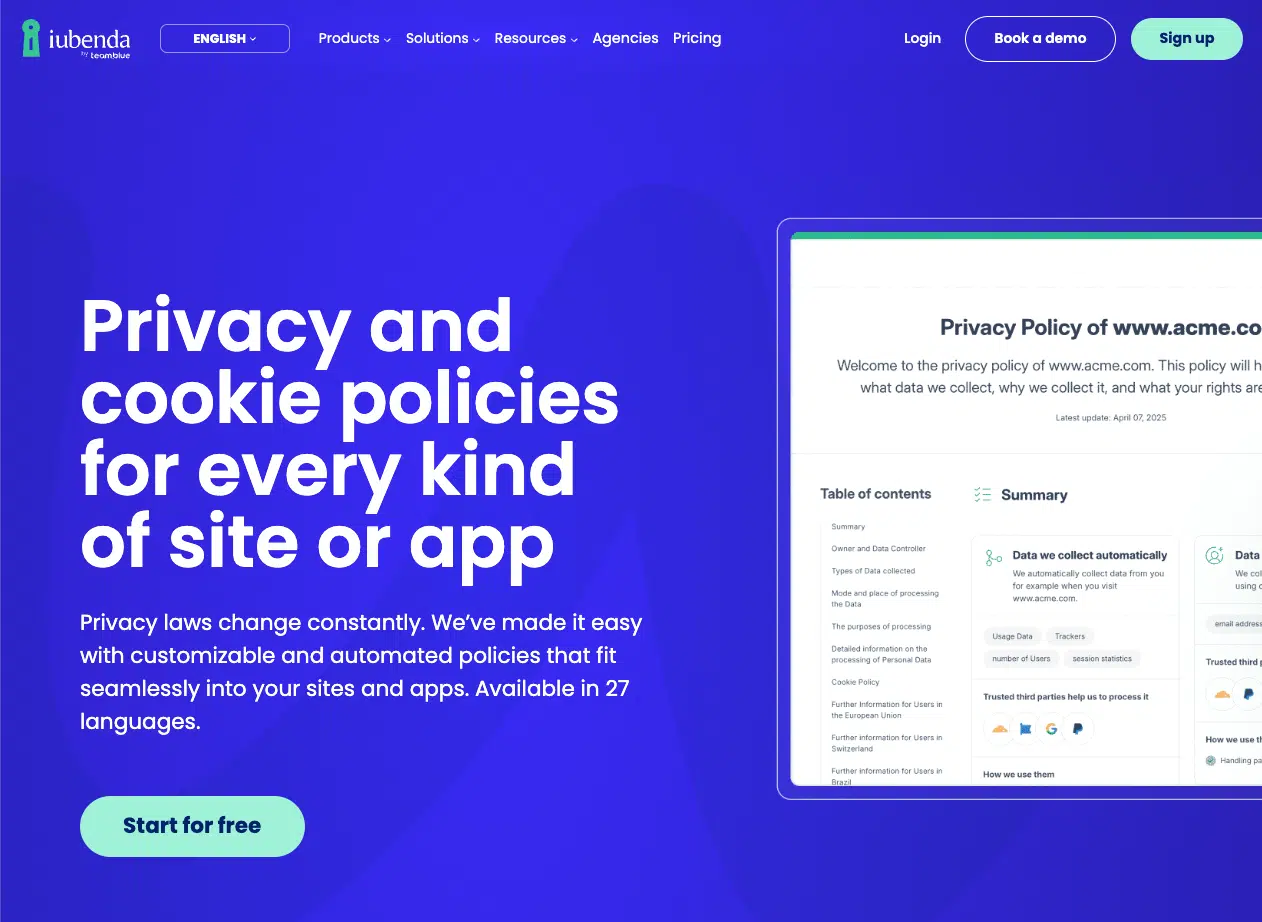
Reputation: 4.7/5 on Capterra; trusted by 150,000+ businesses worldwide.
iubenda is a digital compliance suite, meaning a single subscription can cover your privacy policy, cookie consent, terms and conditions, accessibility, and more. The privacy policy generator builds a document that reflects how your business actually works, based on the solutions you use, the data you collect, and the regions you operate in, rather than a fixed template.
Because the generator sits inside a broader digital compliance platform, you can manage your policies, consent, and other requirements in one place rather than juggling multiple solutions.
Best for
Businesses of any size that want a lawyer-backed privacy policy built around their actual operations, with access to broader digital compliance solutions in one place.
Pros
- A team of legal experts writes and updates 2,400+ policy clauses
- Available in 27 languages
- Coverage for major privacy laws including GDPR, CPRA, LGPD, and more
- Easy integration with websites, apps, and platforms
- Policies tailored to your specific services, solutions, and data processing activities
- Quick to generate and easy to update
- Scales from simple websites to more complex setups
- Comes with a wider suite of digital compliance solutions
- ISO 27001 certified, with security and data handling backed by independent audit
- Over 150,000 businesses worldwide use the platform
Cons
- Adding fully custom legal text requires a higher-tier plan, so businesses with simpler needs only pay for what they use
Pricing
- Free plan available
- Paid plans start from €4.99/month
What people say
People find iubenda easy and enjoyable to use and highlight how it’s quick to set up. Some users have found that the platform has saved them money.
2) consentmanager
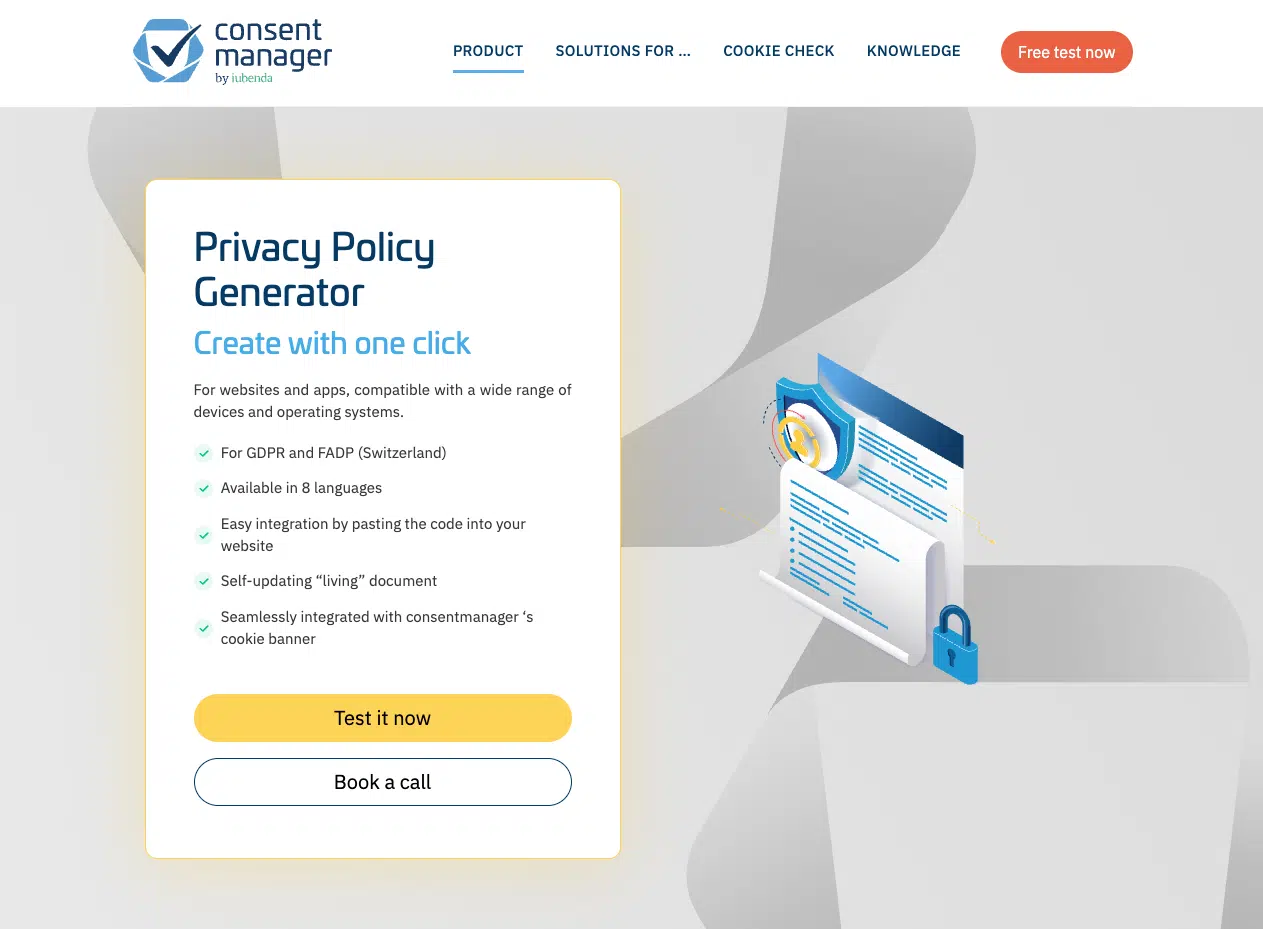
Reputation: 4.1/5 on Capterra; supports over 100,000 websites.
consentmanager offers a privacy policy generator designed to help businesses create a policy based on their specific data processing activities.
The solution guides you through a series of questions about your website or app, then generates a document that reflects your setup. It’s part of a broader platform focused on consent management, so it works alongside cookie banners and related solutions.
Best for
Businesses already using consentmanager for consent who want a connected privacy policy generator.
Pros
- Customizable clauses depending on how you collect and use data
- Supports up to 8 languages
- Covers major privacy regulations such as GDPR and the Swiss Federal Act on Data Protection (FADP)
- Generates policies based on your specific inputs rather than a single static template
- Can be used alongside consent management features
- Flexible enough for different types of websites and apps
- Easy to install and configure
Cons
- The privacy policy generator is included with higher-tier plans and available as an add-on for lower tiers, so pricing depends on which features you activate
Pricing
- Paid plans start from €23/month
What people say
Users find consentmanager’s solutions very fast and easy to implement, with strong overall functionality.
3) Complianz
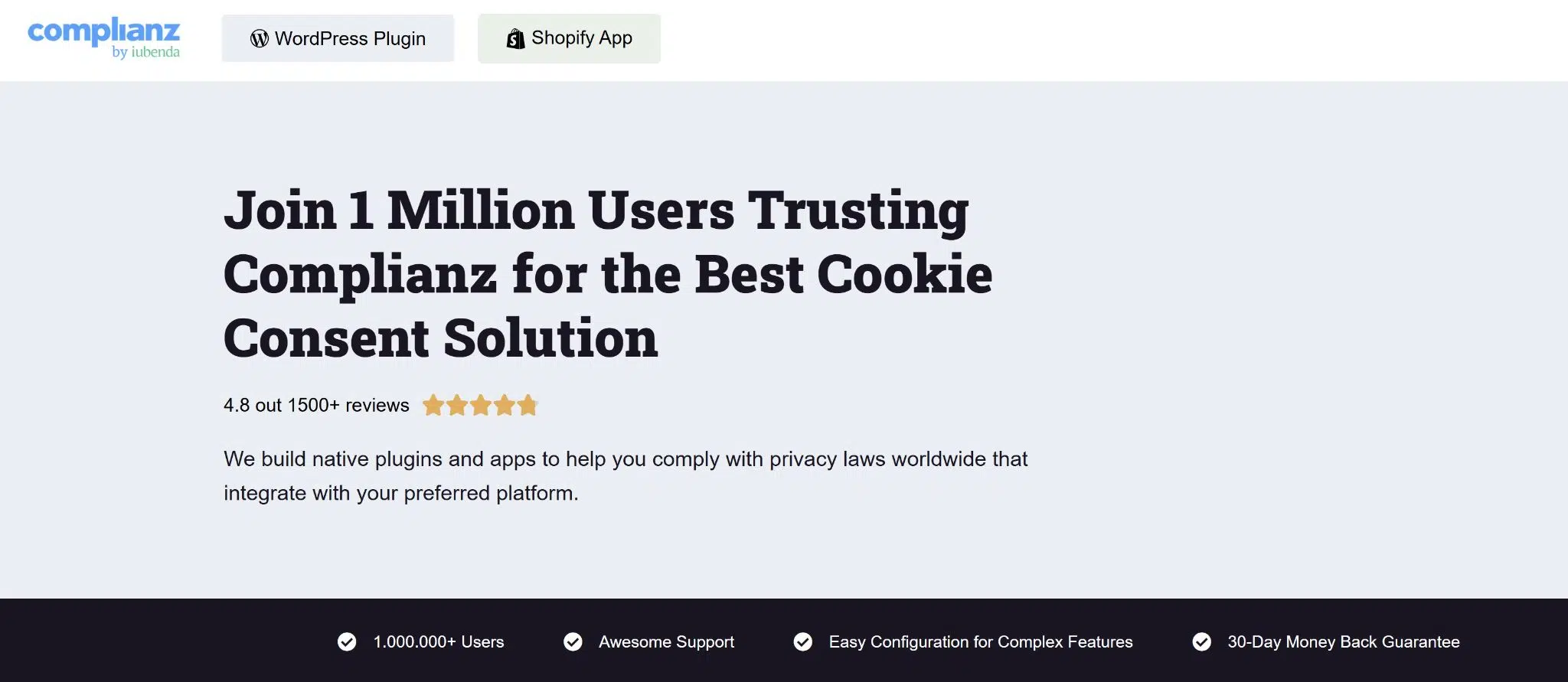
Reputation: 4.4/5 on Trustpilot; over 1 million users worldwide.
Complianz offers a privacy policy generator designed mainly for WordPress and Shopify users, as part of its broader compliance plugin.
It guides you through a setup process to generate a policy based on your website’s configuration. The solution works closely with the cookie consent features, making it a practical option if you want everything managed within your CMS.
Best for
WordPress and Shopify users who want an in-CMS plugin to manage cookie policies, privacy policies, and consent.
Pros
- Built specifically for WordPress and Shopify
- Regular updates to reflect changes in privacy laws
- Compatible with multiple regions and privacy laws, including GDPR and CCPA
- Supports over 40 languages
- Simple setup and configuration
- Comes with legal expert backing
- 30-day money-back guarantee
Cons
- Operates within Shopify and WordPress, so businesses on other platforms will need a different solution
Pricing
- Paid plans start from €59/year (less than €5/month)
What people say
Users find it easy to use and praise the automated approach to policy generation.
4) Termly
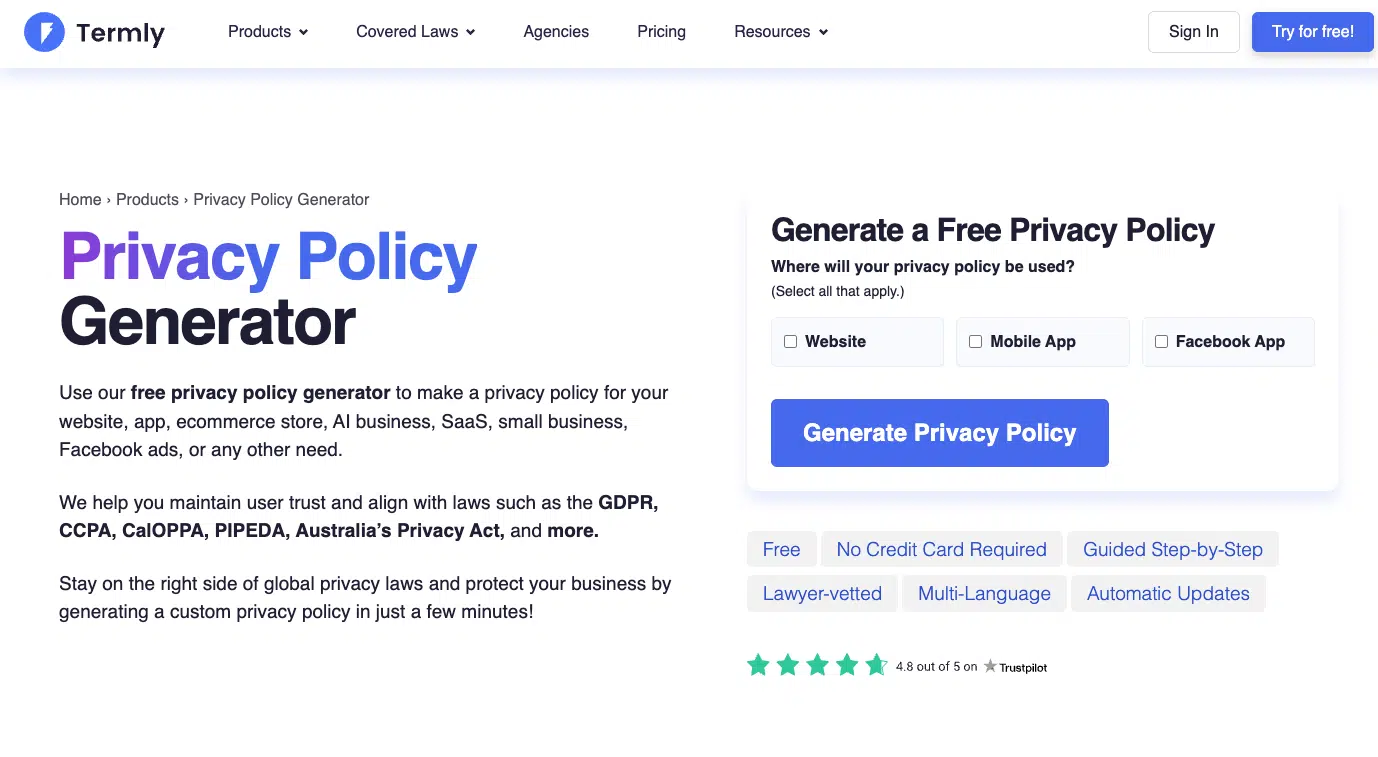
Reputation: 3.6/5 on WordPress.
Termly offers a privacy policy generator built around predefined templates. That makes it easy to get started, but it also means the final policy may not fully reflect how your business actually operates.
Best for
Freelancers and small businesses comfortable with a templated approach who need a basic privacy policy quickly.
Pros
- Quick to set up
- Easy to use, even without legal or technical experience
Cons
- Template-based generation means businesses needing tailored legal wording or specific operational details may find the output too generic
- Customization is more limited on lower-tier plans
- Multi-language policies are only available on higher-tier plans
Pricing
- Free plan available with limited features
- Paid plans start from $10/month
What people say
Reviews mention the platform is easy to use. Some users flag the limited number of policies allowed and feel the pricing-to-features balance could be better.
5) TermsFeed
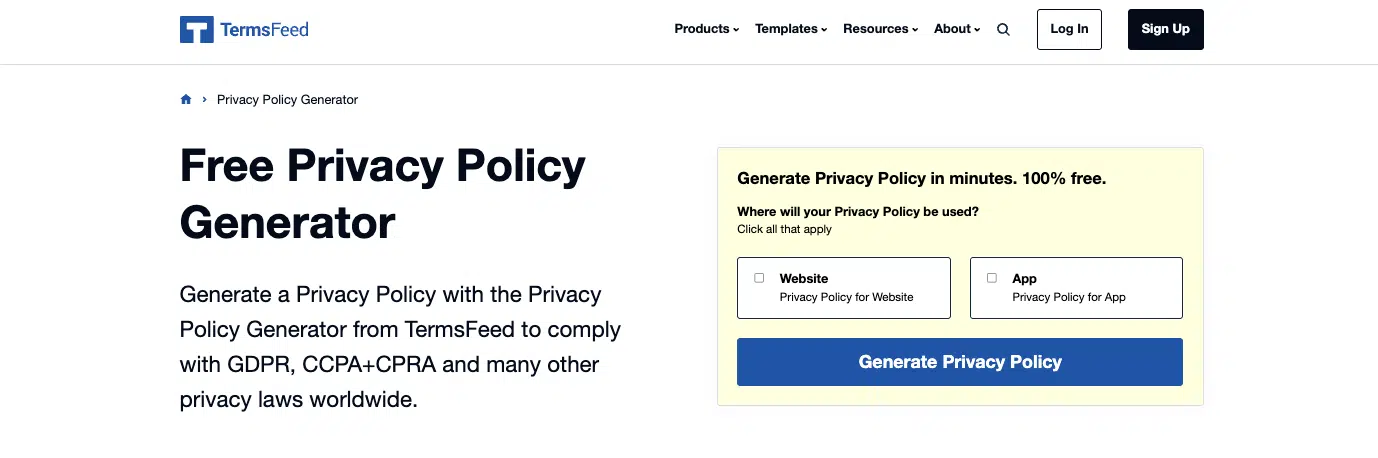
Reputation: 4.5/5 on G2.
TermsFeed’s privacy policy generator builds your document through a guided questionnaire. You select the clauses you need based on your business, and the platform generates a policy you can download. The most essential clauses aren’t included by default, so businesses tend to add them individually.
Best for
Businesses that prefer assembling a policy clause-by-clause and paying for individual additions as needed.
Pros
- Quick to generate a basic policy
- Offers a live editor for updates
Cons
- The model is per-clause, so total cost depends on how comprehensive your policy needs to be
- The free version covers a narrow scope of clauses
- Some reviews note that the platform doesn’t visibly position itself as legally backed in the way other generators do
Pricing
- Basic policy generation starts free
- Additional clauses and features priced individually
What people say
Reviews mention the platform is easy to use with good customer support. Some users note that the per-clause model can become expensive as policies grow.
6) Enzuzo
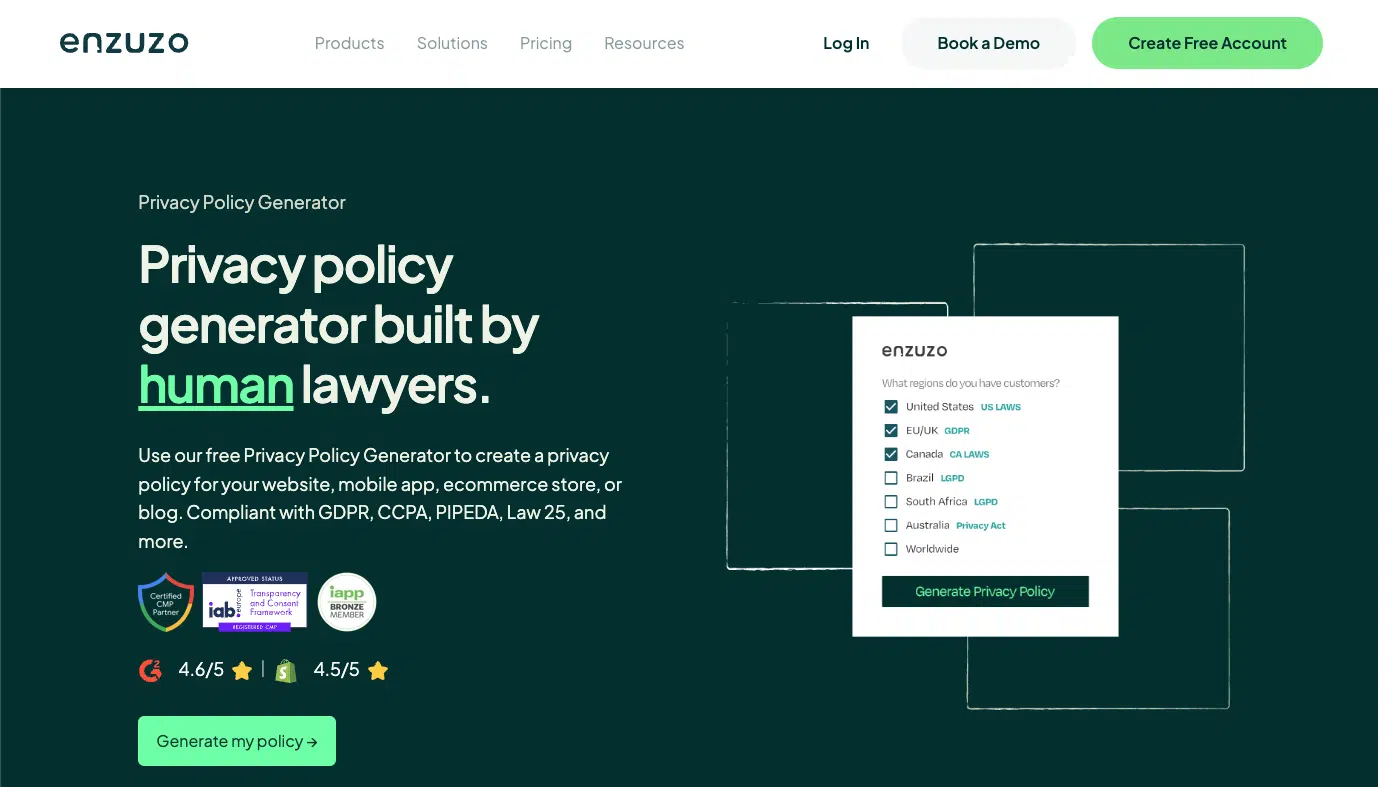
Reputation: 3.6/5 on Trustpilot.
Enzuzo offers a privacy policy generator aimed primarily at e-commerce businesses, with a focus on simplicity and integration with platforms like Shopify.
Best for
Shopify-first stores that want a simple privacy policy generator tied to their storefront.
Pros
- Clauses written and updated by a team of lawyers
- Works well with popular e-commerce platforms
Cons
- Customization options are narrower than some of the alternatives, especially for businesses needing tailored legal wording
- Some features and flexibility require paid plans
Pricing
- Limited free plan available
- Pricing starts from $9/month
What people say
Reviews mention how easy the platform is to use. Some users flag limited customization for privacy policies.
Get your privacy policy right from the start
A basic privacy policy generator might help you get something live quickly. But as your business grows and privacy laws evolve, a generic, static document can fall short.
A few diagnostic questions to guide your choice:
- Do you need a policy that reflects your actual operations, or is a generic template enough for now?
- Do you need legal expertise behind the content, or are you comfortable assembling clauses yourself?
- Will your policy need to scale across regions and languages, or stay simple?
- Is privacy policy generation the only compliance need, or do you also need cookie consent, terms and conditions, accessibility, and DSAR handling?
The best privacy policy generators adapt to your setup and help you keep everything aligned as things change. If you want a policy that grows with your business, rather than one you have to constantly fix or replace, it’s worth choosing a solution backed by legal expertise and designed to evolve over time, like iubenda for example.
iubenda lets you manage your privacy policy as part of a broader digital compliance suite, so you have everything you need to support compliance in one place.
With a solid privacy policy in place, you won’t just be ticking a legal requirement. You’ll be showing your users that you’re transparent and accountable, building the kind of trust that nurtures your business for years to come.
Frequently asked questions
What’s the best privacy policy generator?
The best generator depends on your operations, regions, and how much customization you need. iubenda offers lawyer-backed, tailored policies inside a broader compliance suite; Complianz suits WordPress and Shopify stores; consentmanager fits businesses already using its consent solutions. Legal backing and tailoring matter most for accuracy.
Are free privacy policy generators reliable?
Free generators can produce a basic policy quickly. Reliability depends on whether the platform tailors the policy to your actual operations, is backed by legal experts, and updates clauses as laws evolve. Generic templates often miss details that matter for accuracy and compliance.
Do I need a different privacy policy for each country?
Many businesses align their policy with the strictest applicable regulations to cover multiple regions. Strong generators support multi-language policies and update clauses as laws evolve in different jurisdictions.
Can I write a privacy policy myself?
You can, but it’s risky. Privacy policies have specific legal requirements that vary by region. A generator backed by legal experts reduces the chance of missing important clauses or using language that doesn’t meet regulatory expectations.