
If you run a publisher site, cookie consent is not a side quest. It’s tied to everything: ad revenue, audience insights, subscription growth, and the day-to-day reality of keeping your revenue up and your business running.
That’s why the European Commission’s “Digital Omnibus” proposal has been getting so much attention. The headlines can be dramatic (“cookie banners are going away”), but the real story is more practical: the Commission is trying to reduce consent fatigue by looking at how consent is usually collected and simplifying the legal requirements around it.
Below is what matters most for publishers, what the proposal promises, what’s still unclear, and why pay-or-ok models are likely to stay central either way.

The EU’s proposal in a nutshell
The Digital Omnibus proposal (published 19 November 2025) is the Commission’s attempt to simplify parts of the EU’s digital and privacy framework. One key shift: cookie-related rules, now part of the ePrivacy Directive, would move into the General Data Protection Regulation (GDPR), so businesses are not struggling to keep up with too many scattered legal requirements.
On cookie consent specifically, the proposal suggests:
- Consent still matters for marketing. Advertising, profiling, cross-site tracking, and most third-party analytics remain “opt-in” scenarios.
- Fewer repeated prompts. The proposal supports clearer banner standards (including making “Reject” as easy and visible as “Accept”) and limiting how often you can re-prompt after a refusal.
- A long-term push toward browser or OS-level choices. A new system was proposed: “machine-readable” consent signals, so a user could set preferences once at the browser level, and websites would need to read and apply them.
A lot of questions arose from the proposal and will probably find their answer in future publications by the European Commission around the topic. In the meantime, the proposal will continue its journey through the EU legislative process.
There will likely still be a series of legal and technical requirements for websites to handle, like informing users of their practices around data and privacy, blocking cookies when no consent is given, etc.
Why cookie consent is crucial for publishers
As a publisher, you sit in a different reality than many other website owners.
Your model is often some mix of ad-funded access, subscriptions (hard paywalls, freemium), or hybrids (memberships, logged-in experiences).
Cookie consent affects all of it, but the pressure point is usually advertising.
- If you can’t collect valid cookie consent where it’s required, you may lose the opportunity to serve ads altogether.
- If consent is partial, you may not be able to serve ads personalized to the user. It’s less probable for users to click.
- If the consent experience is too heavy, takes too much time to load, the user may go through your content before your high-value, above-the-fold ads display. It’s less probable for users to click.
All the above can have a high negative impact on your revenue.
That’s why, as a publisher, you should make sure to curate your cookie consent processes.
Consent processes are so important for you, and yet they’re a strong pain point for your visitors. The reality is that most people don’t want to decide about cookies. They want the article, the video, the recipe.
Repeating that same decision on every new site is a fast track to the frustration that the EU’s proposal targets: fewer repeat prompts, clearer UI expectations, and, eventually, more centralized preference signals.
A special exemption granted to media providers
Here’s the part you probably immediately noticed: a carve-out for “media service providers”.
In the proposal’s logic, if users are given the possibility to broadcast a global “reject tracking” signal from their browser, ad-funded media could take a hit.
In other words, if the user were to deny consent at the browser level to advertising, for instance, media providers would not be able to display ads, which is usually their main source of revenue.
So the proposal suggests that media service providers should not be obliged to respect those globally-transmitted signals (in view of the need to finance media through advertising) and could still ask for consent in the usual way, whether through a traditional banner, a pay-or-ok model, etc.
There’s a tricky nuance here to be aware of: media service providers would not have to respect global consent rejection signals set by users. This, of course, doesn’t mean that they would be exempt from general consent rules like informing users or letting them update their preferences through a banner. Only that the signal mechanism might not be binding the same way for that category.
Some publishing platforms may not be subject to this exemption.
At these early stages of the proposal, there is still some uncertainty around the boundaries and scope of the media service provider definition. Make sure to seek expert advice to understand if you wouldfall within the exemption.
Pay-or-ok model: why it won’t disappear
If you work in media, you already know the trend: pay-or-ok is everywhere. And the user behavior is predictable: “I’ll just consent, because I don’t want to pay.”
When the “free” option is funded by ads and tracking, many readers will choose it.
Paywall? Pay-or-ok? Here’s a quick refresher for those who are new to these terms.
A paywall controls access to content. Users must pay (or subscribe) to read, watch, or listen. In short: Pay to access content.
A pay-or-ok model links access to content directly to consent for tracking. Users can either pay (usually via subscription) or consent to advertising and tracking. Advertising revenue replaces subscription revenue for users who choose “ok.” In short: Pay with money, or pay with data.
We can argue that pay-or-ok doesn’t help reduce consent fatigue. The annoyance of the banner and making a choice is still there. In general, EU privacy discussions keep scrutinizing “consent or pay” models to make sure they are fair (consent is freely given).
Regulators pay attention to whether the user genuinely has a choice, how pricing and alternatives work, and whether pressure is applied.
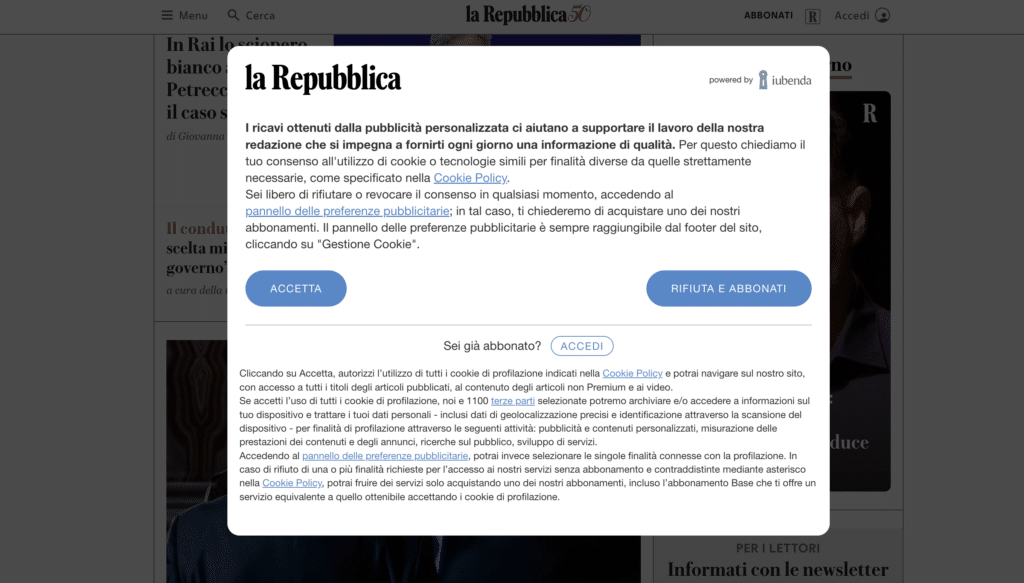
So even if the Omnibus proposal would give media service providers room not to honor global reject signals, pay-or-ok design will still be under a microscope. The question shifts from “can you show a banner?” to “is the choice fair, clear, and defensible?”
Subject to future clarifications of the media service provider definition, Consent Management Platforms may remain central for publishers as they would still need a reliable and compliant infrastructure to manage cookie release, consent walls, and pay-or-ok logic if it’s not done in-house.
What the proposal means for publishers now
The best you can do now is the following:
- Stay informed and monitor further developments, as this is just a proposal. It’s not law yet.
- Keeping your consent flows, preference handling, and internal documentation practices in check could help reduce future implementation effort.
Existing legal obligations still apply, and you don’t need to change anything because of the headlines. It’s a multi-year transition, and publishers will likely operate in a hybrid world for a long time.
Even if adopted, this won’t be a “flip the switch” moment. The legislative path is long, and clarifications will come in time. Requirements would start to take effect several months after entry into force.
Parts of the proposal have sparked some debate and will have to be addressed. For publishers, the biggest uncertainty is also the most basic: who counts as a “media service provider”?
Early commentary has already pointed out that this carve-out may be challenging to apply in practice and could be open to misuse. The exemption shouldn’t create a blanket legal basis for tracking and other marketing activities.
iubenda is an all-in-one, scalable privacy compliance infrastructure that can help you improve your marketing performance and grow confidently.
Our team works by your side to help optimize your consent rate and processes, to support your revenue growth.
Disclaimer: This article discusses a legislative proposal, not final law. The content reflects iubenda’s interpretation as of February 2026 and should not be relied upon as legal advice. Consult your own legal counsel for guidance specific to your business.