
It’s not new. Marketing teams need to work with data to gain insights into their users and how their activities are performing. Reliable analytics provide valuable information that could affect revenue.
That’s why the evolution of privacy regulations, or rules governing the protection of personal data, has reshaped how marketing teams operate.
According to IAB’s State of Data 2024 report, 82% of organizations say the makeup and structure of their teams have been impacted by legislation and changing data rules.
The default response is typically to focus more resources on legal teams or consultants. In this article, find out why consent management should matter more to marketers and how it can help boost their marketing performance.

Is your compliance tech stack holding your marketing team back?
That’s a problem worth examining.
The tools you use for consent management, generating privacy policies, and monitoring your setup don’t just affect your legal exposure but also your opt-in rates, analytics accuracy, brand trust, and your ability to run campaigns with reliable data. Those are marketing outcomes. And they deserve a marketing approach to what is seen as “compliance tools”.
Most marketing teams didn’t deliberately build their compliance stack. They assembled it piece by piece in response to regulation:
– an outdated privacy policy, drafted by a legal professional once or through an online template,
– a cookie banner and cookie policy when the ePrivacy came into force,
– legal text that hasn’t been updated or optimized with your processes in mind.
This is the patchwork stack, and it creates friction at every turn.
The hidden cost of a fragmented compliance setup
Think about consent rate as a marketing metric, because that’s what it is. Every percentage point of missed opt-in is a user you lose insight into.
On top of that, if you don’t properly comply with industry best practices such as the IAB’s Transparency and Consent Framework, your ability to attribute campaign performance or track conversions is affected. A poorly configured or underperforming consent banner makes that worse, and it’s a problem that sits squarely in the marketing team’s lap.
Lastly, the privacy landscape continues to evolve. With a fragmented stack, each change triggers a manual chain: understand the regulation, assess the impact across tools, update each separately, and verify consistency across environments. That’s time your team isn’t spending on core marketing activities.
Manual coordination between tools means:
- slower response when something changes,
- duplicated work: your marketing team builds a consent flow, your legal team checks it against the policy doc, your development team deploys it, and then the cycle repeats every time a regulation shifts or a new market comes into scope.
Invest in all-in-one compliance tools for your marketing growth
IAB’s research states that one of its four key focus areas for adapting to a privacy-aware ecosystem is to optimize your company technology stack for efficiency by identifying overlapping functionality and evaluating whether tools can be consolidated and simplified.
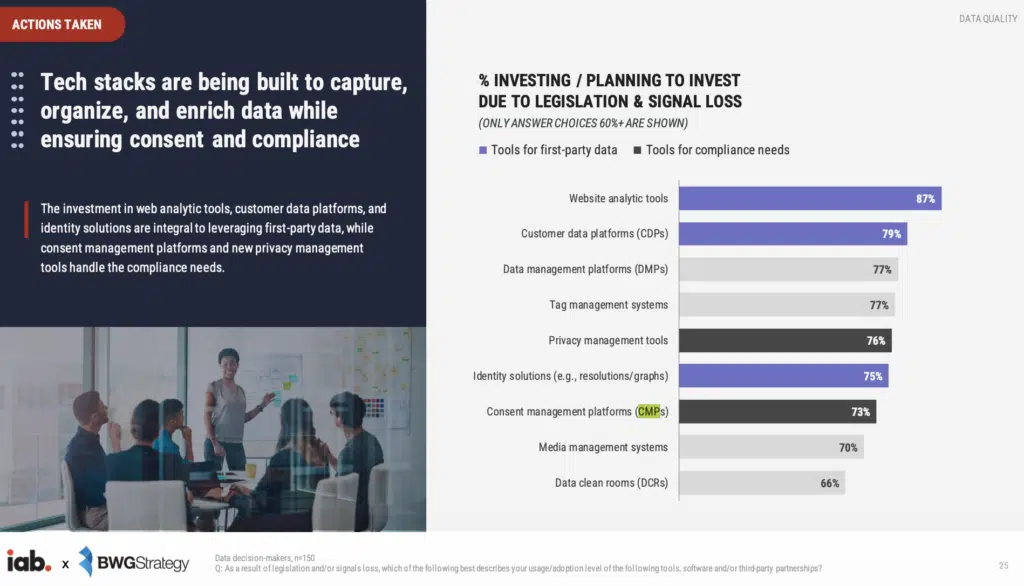
Meanwhile, Think with Google research on privacy-forward marketing makes the commercial stakes clear: people are willing to share their data when they can see the value and trust the company. Your ability to deliver that experience depends on the tools for managing consent and transparency.
Tanneasha Gordon, Data & Digital Trust Leader at Deloitte, declares for Think with Google:
“Today’s digital privacy landscape offers a tapestry of opportunities and technologies to those willing to adapt […]. Marketing leaders should consider empowering their teams to invest in privacy-first solutions and experiment with technologies […]. Find the right partners, establish processes, and innovate with privacy-preserving technology.“
Reduced complexity as a competitive edge
One connected platform means one configuration, one dashboard, one update when laws change. Your marketing and legal teams share the same source of truth, cutting the back-and-forth that delays launches.
Fewer tools mean fewer failure points and no risk of a touchpoint being out of sync with another.
Reallocate resources into your compliance infrastructure
When privacy is managed in one place, every hour recovered is an hour your team can spend building core marketing activities.
Andreea Mandeal, our Chief Marketing Officer at iubenda, has seen this play out firsthand:
“Speed comes from handling compliance early. Teams that ‘stay agile and fix it later’ almost always end up slowing themselves down with rework, blocked launches, or emergency legal reviews, and that’s coming from experience. When consent, privacy, and compliance are built in from day one, product, marketing, and growth teams can move faster with confidence. You test more, ship more, and scale without hitting invisible walls. Getting it right upfront saves time, money, and rework later.”
The companies adapting fastest are investing in training, not just tools. According to IAB, 63% of organizations are now training staff on first-party data collection, and 54% on privacy compliance and privacy-preserving technology.
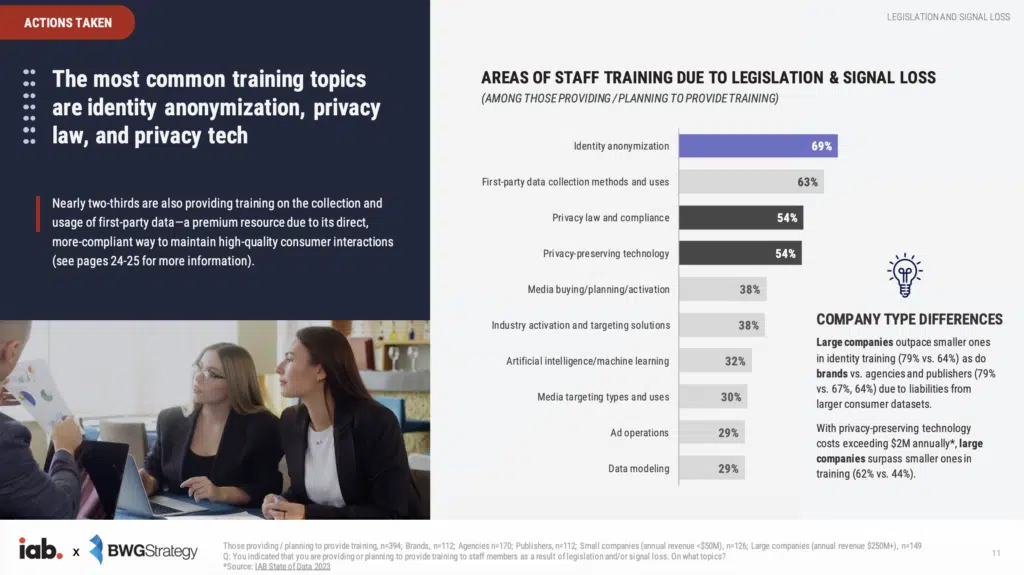
Marketing teams that build this literacy internally move faster. Knowing how consent works, which data you can use, and how regulations affect your measurement setup reduces the dependency on legal review cycles. You also get to understand what you can test or improve to get a better consent rate, for instance.
Use compliance tools that offer performance-related features
Regulation isn’t settling down. A platform that handles it well also comes with marketing features most teams overlook. Your banner is a legal obligation, but also a conversion surface.
Compliance tech comes with features that directly impact your performance, for example:
- Consent rate analytics: Track opt-in rates by page, geography, and device. Understand where you’re losing users before they even engage with your content.
- Banner A/B testing: Test copy, layout, and timing to improve opt-in rates. A better-performing banner means a larger measurable audience.
- Geo-targeted consent flows: Serve different banner experiences and languages by region based on local regulations, without rebuilding your setup each time.
- Regulatory updates without the sprint: When laws change, the platform updates. Your team moves on.
Trusted solutions built for the long term
Not all privacy tools are built the same way. When evaluating options, look for signals that a platform is complete and designed for durability, not just current requirements. The platform should:
- stay ahead of where the market is going, not just where it is today. E.g., a provider with IAB’s Transparency and Consent Framework (TCF) is on top of requirements for advertising in Europe and building to stay there,
- cover what marketing teams need to manage in one place, like consent and preferences management or records, related analytics, legal document management like privacy policies or terms. These tools work together, which means updates are consistent and your team manages everything from one dashboard.
For marketing teams that want to move fast, improve opt-ins, and measure in a reliable and privacy-friendly way, the right compliance infrastructure is the foundation.
Consent management is a marketing performance question because the compliance tools that manage data practices and user consent to marketing activities like content personalization or tracking play a key role in your opt-in rate, ad serving, brand trust, or first-party data strategy. These aren’t only compliance outputs but marketing metrics.