

Skip the template: connect iubenda to Claude or ChatGPT and ask it to draft your terms and conditions for your business and market. See how it works
In short
Looking for a Terms and Conditions template? We’ve got you covered. We’ll even go over exactly what Terms and Conditions are and what they should include. Let’s dive in!
A Terms and Conditions agreement is a legally binding document that lets you set the rules users must follow when using your website, mobile app, or services.
In the sections below, we’ll break down what to include, where to display it, and give you a free Terms and Conditions template to get you started.
TERMS AND CONDITIONS GENERATOR
Generate your Terms and Conditions
Simple templates are often not enough to protect your business and intellectual property.
Terms and Conditions are legally binding documents, so having a customizable, professional document is important.
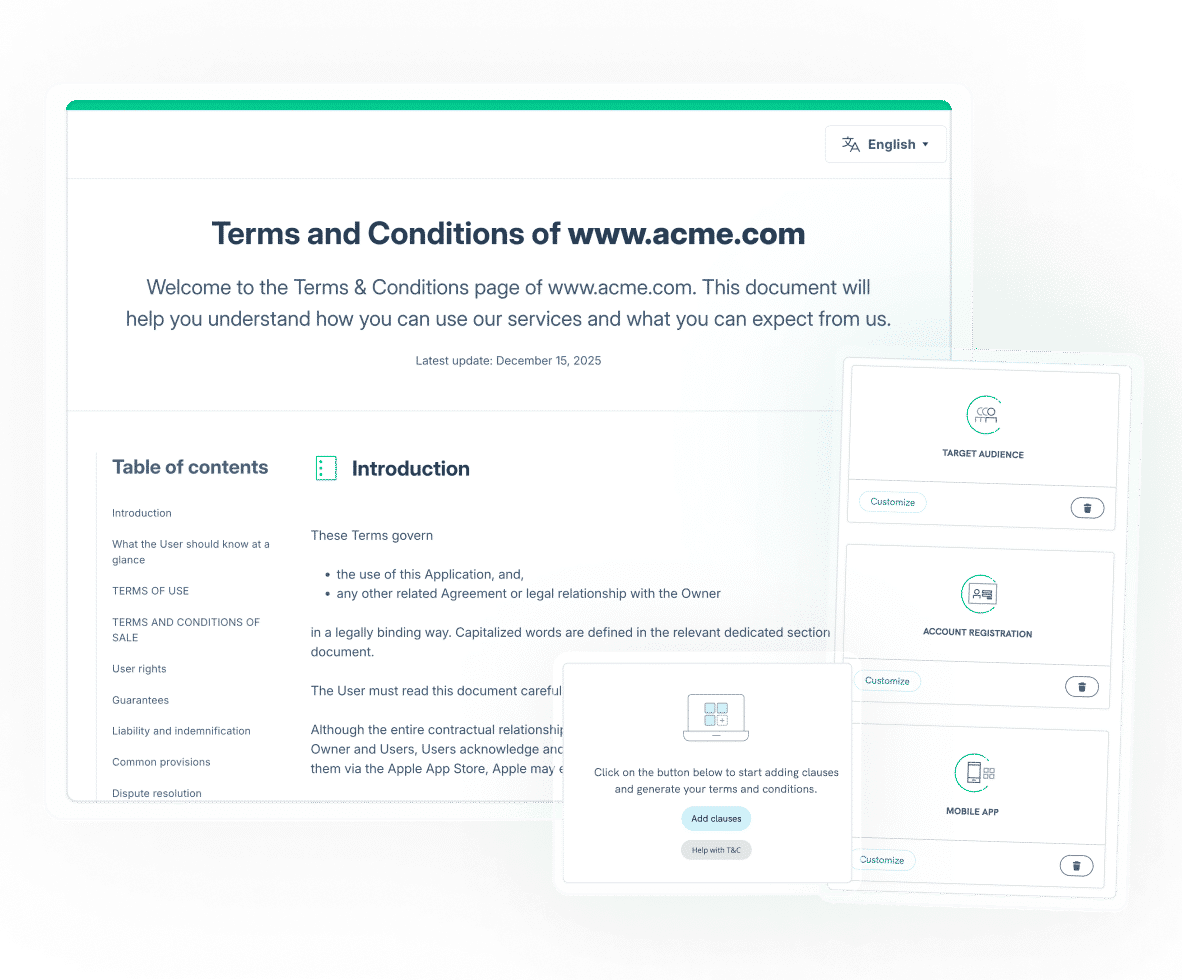
Try our generator with our 14-day money-back guarantee
In this article, you’ll find:
- What is a Terms and Conditions Agreement?
- Am I legally required to have Terms and Conditions on my website?
- Reasons to have a Terms and Conditions document
- What information should I include in my Terms and Conditions?
- Terms and Conditions examples
- What is the best way to display Terms and Conditions?
- How to enforce Terms and Conditions agreements
- Download our sample Terms and Conditions template for your website
- Read these Terms and Conditions template tips
What is a Terms and Conditions Agreement?
Terms and Conditions (T&C) – also known as Terms of Service, Terms of Use, or End User License Agreement (EULA) – represent a contract between you, the provider of a service, and your users.
They’re a legally binding document that lets you set your rules, within applicable law. For example, they can define how users interact with your product or service, how your original content can be used, and when accounts can be cancelled or suspended.
Am I legally required to have Terms and Conditions on my website?
Unlike the privacy policy, a Terms and Conditions document is not always required by law. But we can only recommend it! And here’s why.
Terms and Conditions are meant to protect you and your business. They help you handle problems before they arise and give you a legal ground to stand on if your product or service is ever challenged. Without one, it’s much harder to protect yourself.
In fact, it is considered standard practice for every business, from a blog to an ecommerce store, to protect against potential liabilities.
They are particularly crucial in cases of e-commerce stores because they contain legally required information related to conditions of sale and disclosures on methods of payment, shipping, delivery, withdrawals, and cancellation conditions etc.
Operating an e-commerce? Not sure what legal documents you need on your site? Check out this guide.
Reasons to have a Terms and Conditions document
Limitations of liability
Terms and Conditions can protect your business interests and restrict liabilities for things like:
- the scope of your services such as payment and delivery schedules,
- in case of malfunctions of your website/app,
- inaccuracies and errors,
- viruses, product damage…
Protection from abusive behavior
A limitation of liability clause only holds up if it’s correctly worded for the jurisdictions where your customers are. A clause drafted for one market may not be enforceable in another, and a gap here could leave you exposed. Find out what a limitation of liability clause is in the article here.
This can range from:
- Setting rules on how users should interact with each others on a blog’s comment section for example, what they can and can’t post.
- Avoiding having your content copied and protecting your intellectual property rights (logos, content). This is essential from a copyright perspective.
Disclaimers
Your document usually contains legal statements that outline the rights, responsibilities, and obligations of the parties involved in a particular agreement or transaction. It also outlines governing and applicable laws such as federal or state laws. This is important if legal issues arise.
Further to that, another typical disclaimer usually states that the information provided is not guaranteed to be accurate or complete, and that the user of the information assumes all risks associated with its use.
Do you really need Terms and Conditions?

Find out now, it takes 30 seconds!
What information should I include in my Terms and Conditions?
While the full content may vary based on the particulars of your business, your Terms and Conditions should at least include the following:
- Identification of the business
- Description of the service that your site/ app provides
- Information on risk allocation, liability, and disclaimers
- Warranty/Guarantee information (where applicable)
- The existence of a withdrawal right (if applicable)
- Safety information, including instructions for proper use (where applicable)
- Terms of delivery of product/service (where applicable)
- Rights of use (if applicable)
- Conditions of use/purchase (eg, age requirements, location-based restrictions)
- Refund policy/exchange/termination of service and related info
- Info related to methods of payment
- Any additional applicable terms
What are the basic terms and conditions?
Despite how simple they appear, Terms and Conditions Agreements are meant to meet complex and highly specific scenarios. However, there are some basic clauses that most agreements should have.
In short, Terms typically contain copyright clauses, disclaimers and terms of sale, allow you to set governing law, list mandatory consumer protection clauses, and more. Keep reading for the full list on what your document should at least/at its most basic include.
How do I create a free terms and conditions?
To create a free Terms and Conditions document, you have different options such as free online generators or templates. You can also get a general look by studying your competitors’ Terms.
Customizable templates are sometimes made available by some platforms for free, while other websites provide free downloadable templates you can edit. Our own article has a free sample template you can use to get started.
In fact, given that this document is quite complex in nature, it needs to be written very carefully. Using free templates and generators has limits because they may not include all the clauses you need or match your specific business processes and model.
What is the best way to display Terms and Conditions?
The best way to display Terms and Conditions is via a static link to your site’s footer, so the document is easily accessible and always visible. In fact, a proper document won’t do your business any good if no one sees it! You need to make sure it is easy to find and placed in a prominent location.
Other options where to display your document are in a menu like the “About” or “Legal” sections of a mobile app, in sign up forms (“Create account” page during the account creation process), or checkout forms.
Terms and Conditions examples
1. Full iubenda Terms and Conditions example
The document below is a example of a Terms and Conditions document. Click on the button below to see the example:
Terms and Conditions Example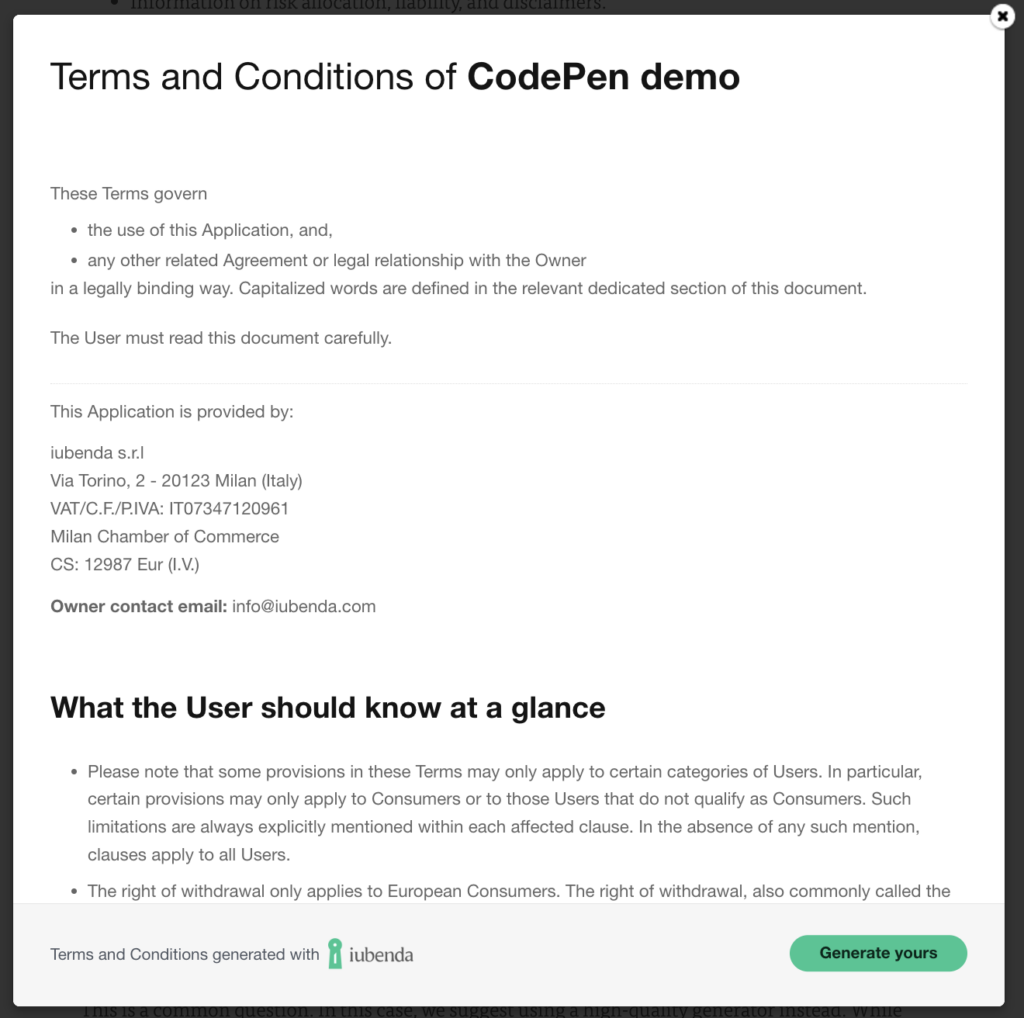
2. LinkBuilder
LinkBuilder, a link building agency, uses iubenda-generated Terms and Conditions in their footer, along with their other privacy documents. They have a button called “Terms” on which users can click, and the legal document opens on another tab.
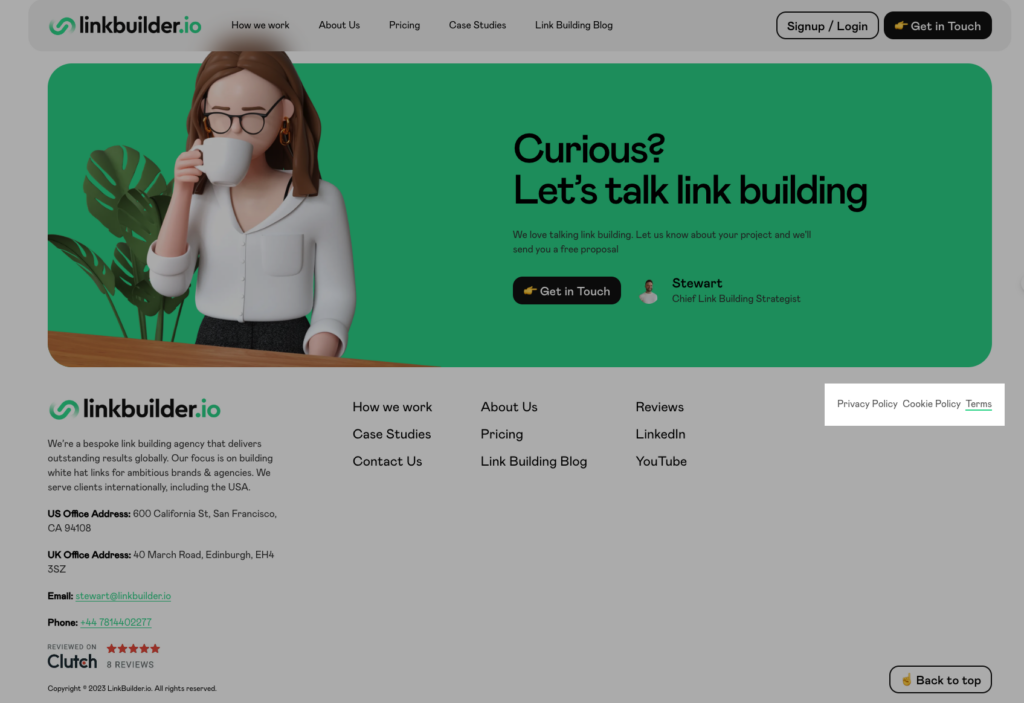
You can find their full Terms and Conditions at this link.
3. Barton Perreira
The independent brand Barton Perreira also has a button in their footer called Terms and Conditions, on which the user can click. A modal window opens up (which means the user stays on the website) and shows the Terms and Conditions.
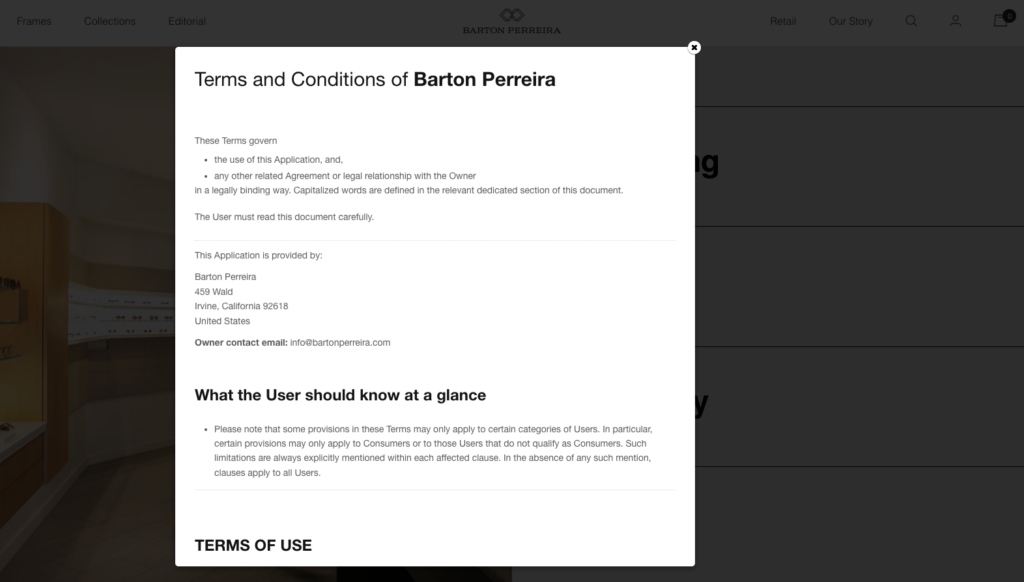
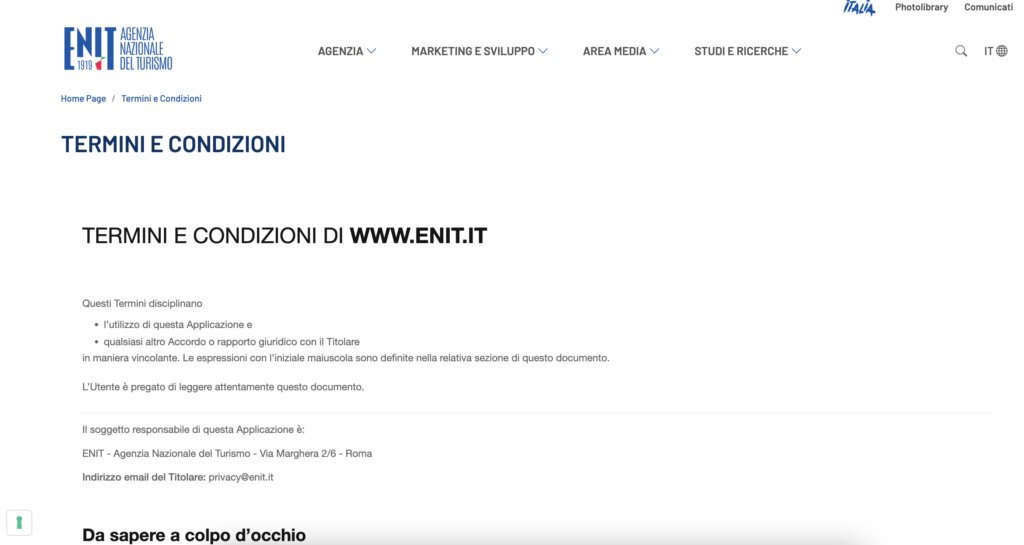
3. ENIT
The Italian National Agency for Tourism has, instead, incorporated their Terms and Conditions directly on the website page. Click here to take a look. You can access them directly from the footer as well.
How to enforce Terms and Conditions agreements
Apart from having access to your Terms and Conditions document at any time from your website’s footer, users will have to be presented with the Terms and Conditions in specific situations and asked to read and accept them. More information here.
Common situations where to enforce Terms and Conditions include when a user:
- signs up for a subscription,
- signs up for an account on your website,
- downloads your mobile app,
- makes a purchase.
You should give your users some way to acknowledge that they’ve seen and have accepted your Terms. Learn more about the widely used clickwrap method.
Download our sample Terms and Conditions template for your website
Is it ok to use a Terms and Conditions template?
Using a basic template is not wrong by default, but it can come with significant risk to you and your business. Should conflict arise or if a lawsuit is filed by a user, your Terms and Conditions document will be your first line of defense. Terms and Conditions are complex legal documents that cover multiple legal scenarios (eg, commercial law, copyright laws, liabilities, etc.), jurisdictions, and must apply to your specific business practices. This is difficult to achieve with a basic template.
Looking for a professional solution to protect your business best?
We recommend looking into tools like iubenda’s Terms and Conditions Generator
How to use the template
- Download the template: get our free Terms and Conditions template in Word Doc or copy and paste the HTML directly into your website.
- Fill in business and contact details: before you publish it, fill in all the [brackets] with your business info and contact details.
- Customize sale and service clauses: the template covers selling physical goods and includes sections for both business-to-business (B2B) and business-to-consumer (B2C) sales, with some clauses addressing only consumers. Make sure these sections match what your business offers.
- Tailor to legal jurisdictions: some sections are specific to certain areas, so make sure they comply with the laws where your customers are.
Terms and Conditions template (HTML text)
Copy and paste the Terms and Conditions Template HTML directly into your website.
<h1>Terms and Conditions of [website name]</h1>
<p>This document governs:</p>
<ul>
<li>the use of our website, and</li>
<li>any other related agreement or legal relationship with us</li>
</ul>
<p>in a legally binding way. You must read this document carefully.</p>
<p>Our website is provided by:<br>
[name/company and full address]<br>
Contact email: [email address]</p>
<h2>TERMS OF USE</h2>
<p>Unless stated otherwise, the terms in this section apply generally when using our website. Specific or additional conditions may apply in certain situations and are noted in this document.</p>
<p>By using our website, you confirm the following:</p>
<ul>
<li>you are older than [number of years of age];</li>
<li>you are not in a country subject to a government embargo, or that has been designated as a “terrorist-supporting” country;</li>
<li>you are not listed on any government list of prohibited or restricted parties.</li>
</ul>
<p><em><strong>Note:</strong> Add any other conditions for use here — for example, rules for account registration, acceptable use, intellectual property rights, and access to third-party content. The correct wording will depend on what your website or service offers.</em></p>
<h2>LIABILITY AND INDEMNIFICATION</h2>
<p><em><strong>Note:</strong> This section covers the limits of your liability, your disclaimer of warranties, and the circumstances under which users agree to indemnify you. The correct wording varies significantly between the EU, the UK, and the US — each jurisdiction has its own requirements, and a clause written for one may not be valid in another. Tailor this section to the jurisdictions where your business operates and where your customers are based.</em></p>
<h2>TERMS AND CONDITIONS OF SALE</h2>
<p><em><strong>Note:</strong> Include this section if you sell products or services. At minimum, cover your prices, accepted payment methods, delivery terms, and the customer’s right of withdrawal. EU and UK consumer law sets specific requirements — including a 14-day withdrawal right and a 2-year legal guarantee on physical goods — that differ from US rules. If you sell across multiple markets, this section will need to reflect each one.</em></p>
<h2>COMMON PROVISIONS</h2>
<h3>No waiver</h3>
<p>Our failure to assert any right or provision under these terms does not waive that right or provision. No waiver will constitute a continuing waiver of such term or any other term.</p>
<h3>Service interruption</h3>
<p>To maintain the best service level, we reserve the right to interrupt the service for maintenance, updates, or other changes, with appropriate notification.</p>
<p>We may suspend or discontinue the service within legal limits. If discontinued, we will assist you in withdrawing personal data and respect your rights regarding continued product use and compensation under applicable law.</p>
<p>The service may be unavailable due to events beyond our reasonable control, such as infrastructure breakdowns or blackouts.</p>
<h3>Service reselling</h3>
<p>You may not reproduce, duplicate, copy, sell, or exploit any part of our website or its service without our express written permission, granted either directly or through a legitimate reselling program.</p>
<h3>Privacy policy</h3>
<p>For information on the use of personal data, you can refer to our website’s privacy policy.</p>
<h3>Changes to the terms</h3>
<p>We reserve the right to modify these terms at any time, informing you of any changes.</p>
<p>Such changes will only affect the relationship with you from the date communicated onwards.</p>
<p>Your continued use of the service will signify your acceptance of the revised terms. If you do not wish to be bound by the changes, you must stop using the service and terminate the agreement.</p>
<p>The applicable previous version will govern the relationship prior to your acceptance. You can obtain any previous version from us.</p>
<p>If legally required, we will notify you in advance of when the modified terms will take effect.</p>
<h3>Governing law and jurisdiction</h3>
<p><em><strong>Note:</strong> Specify the country or state whose law governs these terms, and the courts that will have jurisdiction over any disputes. If you serve consumers in the EU or UK, note that mandatory consumer protection rules in their country of residence may still apply regardless of your chosen governing law.</em></p>
<h2>DISPUTE RESOLUTION</h2>
<p><em><strong>Note:</strong> If you serve European consumers, include a reference to the EU’s online dispute resolution platform (https://ec.europa.eu/consumers/odr). You may also want to specify whether disputes will be resolved through arbitration, mediation, or litigation, and in which jurisdiction.</em></p>
<h2>CONTACT</h2>
<p>All communications regarding the use of our website must be sent using the contact information provided in this document:<br>
[name/company and full address]<br>
[email address]</p>Terms and Conditions are complex legal documents. A generic template is a good starting point, but it often can’t account for your specific business model or the jurisdictions your customers are in. Each Terms and Conditions document serves as a legally binding contract meant to protect you as a business owner, so make it specific to your company and keep it up-to-date with the laws referenced in its contents.
Terms and Conditions template (Word DOCX)
Terms and Conditions template (PDF)
Read these Terms and Conditions template tips
1. Ask yourself these questions to identify missing information
Your document should align with your specific business processes and model, and stay current with the laws referenced in its contents.
Here is a list of questions you can go through when filling out the template. Add what is missing.
| Questions on business model | Is your business mostly concerned with monetizing content? If you run an e-commerce site, do you sell digital products, physical products, or both? Do you sell primarily to other businesses, or only to consumers (B2B vs. B2B)? Can your users sell to other users? |
| Questions on business processes | What are your sign-up processes? What are the different account types (e.g. guest vs logged in)? What roles can users have? Can they up-vote ratings, leave comments, report other users? What are your payment options? (credit card, PayPal, gift cards…) What are your return and shipping policies? |
| Questions on business needs and explicit rules | Are there different user levels (registered vs. non-registered)? How is sensitive data handled when processing payments? What are your expectations for user behavior (including comments), account termination and how your product/service/content may be used? Do you take part in an affiliate program? Can your products/content potentially cause harm if misused? What is your governing law? |
2. Make sure your document is complete and always up-to-date
A Terms and Conditions document is more than a formality. It’s a practical tool that protects you as a business owner. A poorly written or incomplete document can fail to serve its purpose, or worse, create legal exposure.
Laws change regularly. A static template won’t update itself. If your Terms and Conditions reference outdated rules or miss a new requirement, they may not protect you when it matters.
That’s why you should make sure to include all the clauses necessary to limit potential liabilities and update the document whenever something changes (including the law!).
3. Consider using a Terms and Conditions Generator to meet your professional needs
We recommend using a high-quality generator to create a professional, legally binding document.
While nothing beats having a personal lawyer prepare and revise your documents, a quality generator with text written by legal professionals is the next best thing.
TERMS AND CONDITIONS GENERATOR
Easily create your document in minutes
- Save yourself the headache and find what you’re looking for: pick from hundreds of scenario-specific clauses
- Create a strong and precise legal document: clauses have been pre-drafted by lawyers
- Forget the static template: dynamically add, remove, or update clauses at any time
Don’t just take our word for it. Try the generator with our 14-day money-back guarantee