
You’ve probably heard various opinions on server-side tracking: your agency says moving to server-side tracking solves the consent problem. A tagging vendor’s page implies the same. We work in compliance, and we’re here to bring some clarification.
In short
Server-side tracking can run in line with the General Data Protection Regulation (GDPR). Still, it’s important to understand it isn’t compliant by default, and moving your tracking server-side doesn’t remove your obligation to collect consent. Most of the confusion around server side tracking and GDPR comes from one assumption: that the rule follows the data. Instead, the rule follows the device.
In this article
Is server-side tracking GDPR compliant?
Server-side tracking is GDPR compliant only when the setup around it meets the regulation‘s requirements, not because of the architecture itself. Moving tracking to a server changes where data gets processed. It doesn’t change whether you need a legal basis to process it, or whether you need consent to read a visitor’s device in the first place. You’re still collecting and using user data. Just somewhere else.
Client-side or server-side is an architecture decision. Consent and legal basis are obligations that attach to what you do to a visitor’s device (like installing cookies), and to the personal data you handle afterwards. So there’s no blanket answer for server-side tracking as such.
What server-side tracking changes, and what it doesn’t
Server-side tracking sends events from the browser to a tracking server first, which processes them and forwards what’s needed to destinations like Google Analytics 4 or the Meta Conversions API, instead of the browser calling each vendor directly.
Read more
If you need the client-side baseline, start with how website tracking works.
| Server-side tracking: what it changes | What stays the same as client-side tracking |
|---|---|
| Where data is processed: on a tracking server you configure, not in each visitor’s browser | The need for a legal basis under Article 6 of the GDPR |
| Who decides what leaves your site: your container rules, not each vendor’s script | The need for consent before anything reads or writes on a device |
| Cookie lifespan and first-party durability, thanks to the first-party subdomain | What the ePrivacy Directive requires of that first read or write, third-party cookies or not |
| How many third parties reach the browser, and which fields you strip before they do | Your transparency duties: every recipient belongs in your policies |
How does server-side tracking work?
Four steps:
- A visitor’s browser sends an event to a first-party subdomain such as
analytics.yourdomain.com. - The tracking server receives it.
- The server applies your rules for filtering and enrichment.
- The server forwards what’s left to the destinations you’ve connected.
Read more
Our guide to server-side tracking covers each step and the setup work behind it, in depth.

Why moving server-side doesn’t remove the need for consent
The obligation attaches to the device, not the destination
The reason the “server-side avoids consent” claim fails has little to do with the GDPR. It sits in the EU ePrivacy Directive, the law behind cookie banners.
The ePrivacy Directive works through national law, so the text that actually binds you is your country’s implementation of it, for instance: Article 122 of the Italian Privacy Code, PECR in the UK, the TDDDG in Germany. The rule is the same everywhere. The detail, and the authority that enforces it, are not.
Article 5(3) requires that storing information, or gaining access to information already stored, in a user’s terminal equipment can happen only with that user’s consent, after clear and comprehensive information about the purposes. Two narrow exemptions apply: carrying out the transmission of a communication, and what’s strictly necessary for a provider to deliver an online service explicitly requested by the user.
Notice what the provision never mentions: where the information travels afterwards. The obligation attaches to the moment something reads from or writes to the device.
The European Data Protection Board (EDPB) addressed this directly in its Guidelines 2/2023 on the technical scope of Article 5(3). The EDPB confirms that Article 5(3) can apply even where the entity receiving the information is not the entity that instructed the device to send it. In other words, it makes no difference whether a tracking server or an ad platform receives the data.
The guidelines go further. Gaining access includes instructing a browser to send information back, whether through cookies, JavaScript, or an API call, and the same conclusion applies to information processed locally on the device and then sent to a server.
Anonymizing downstream doesn’t settle it either. In Planet49, the Court of Justice of the EU held that the protection covers any information stored in terminal equipment, whether or not it is personal data.
What the GDPR requires for the data you forward
Two obligations run in parallel. The ePrivacy Directive governs the device access, and the GDPR governs what happens to the personal data afterwards.
- Article 6(1) requires a legal basis for processing personal data. Where that basis is consent, it has to be the visitor’s consent to processing for one or more specified purposes. Legitimate interests under Article 6(1)(f) exist as an alternative, but when it comes to forwarding data to advertising platforms, it rarely carries the weight teams hope, because the ePrivacy consent requirement sits upstream of it.
Read more
Our overview of GDPR compliance requirements covers the bases in full.
- Article 7(1) requires the controller to be able to demonstrate that the visitor consented, so you need a record you can actually produce, not an assumption that a banner did its job.
- Article 7(3) requires that withdrawing consent be as easy as giving it, so a withdrawal has to reach the container and stop the forwarding.
Personal data that passes through a tracking server is still personal data and subject to all the requirements above.
Where marketing measurement sits under the GDPR and the ePrivacy Directive
Measurement is the one area with any exemption at all. Some regulators treat pure audience measurement differently from marketing analytics. France’s CNIL, for example, exempts audience measurement trackers that serve only that purpose, work for the publisher’s exclusive account, produce anonymous statistics, and respect limits on tracker lifetime and retention. It’s narrow, and it varies between member states.
Everything else marketers run sits outside it: retargeting, conversion tracking, lookalike audiences, cross-device attribution. For those, the device access needs consent, and the processing needs a basis, whether the request leaves from a browser or from a server.
How the consent signal reaches the tracking server
Knowing consent is required is the easy part. In a server-side setup, that signal has further to travel than it did client-side.
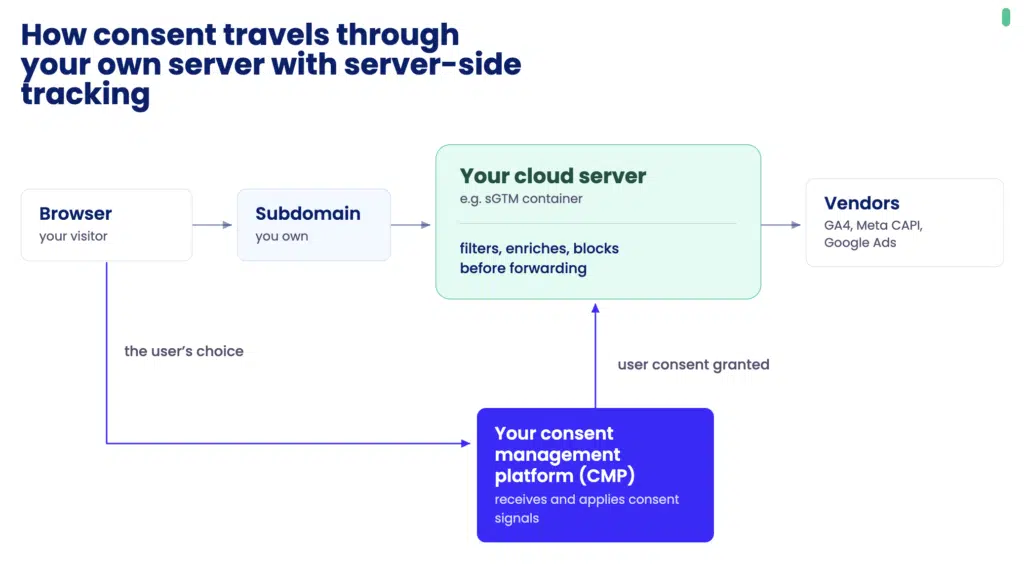
The chain is short. Your consent management platform (CMP) captures the visitor’s choice in the browser, the choice travels with each event to the tracking server, and the container decides per destination whether to forward, strip, or drop.
For Google destinations, Google Consent Mode carries it. Google’s server-side documentation describes the mechanism plainly: the Google tag passes the visitor’s consent state to the server container along with the event, and Google’s product tags in the server adjust what they send based on it. Google is just as clear about who owns the first step: “You are responsible to obtain users’ consent on your website or app”. Most CMPs have Consent Mode built in.
That means you need to make sure your consent setup is strong. A container receiving no consent signal doesn’t become exempt. It keeps forwarding, dashboards keep filling. The first visit is the hardest case, since a visitor’s choice isn’t known yet on their first interaction. Start from a CMP that reliably collects and stores consent, then confirm the server end receives it and acts on it.
Does using server-side tracking have any impact on compliance?
Server-side tracking does affect your compliance posture, and handled well, the effect is a positive one. None of the above makes it a worse choice for privacy. In fact, it can be considered a more privacy-aware tracking method:
- You enforce your rules at the infrastructure level, at one point you own, instead of depending on each vendor’s script to honor them.
- You choose where the tracking server runs, so an EU-hosted setup keeps the first processing step in the EU. Transfers to destinations outside the EEA still need to follow the related GDPR’s Chapter V basis.
- You control which fields leave your site, so you can drop identifiers, or hash them where you can’t. Hashing narrows exposure, but a hashed email or phone number is still personal data, so the same obligations follow it.
- Fewer vendors reach the browser directly, so fewer independent parties read each visitor’s device, and fewer scripts sit in a position to collect information they were never authorized to collect.
- Every flow through the server can be logged, so you can show what was forwarded and why. That’s evidence of enforcement: it sits alongside your consent records under Article 7(1) but doesn’t replace them.
The strongest setups close the loop with their consent management platform: every event gets checked against the visitor’s choice before it moves, counted once, and sent on to every platform downstream from that single verified record.
What a compliant server-side setup looks like
Knowing how to set up server-side tracking is one thing. Here’s how to do that so the compliance side holds.
- Identify the legal basis for each destination, separately. One container can feed six recipients, and they might not all rest on the same basis.
- Collect consent before any device access, not just before forwarding. The trigger is the browser reading or writing, before your server hears anything.
- Propagate consent state into the container with every event. A container that can’t see the choice can’t act on it.
- Drop identifiers before forwarding where you can, like email addresses and phone numbers, and hash them where you can’t. Hashing is minimization, not anonymization: hashed identifiers stay personal data and stay in scope. Treat data minimization as the default.
- Choose hosting with transfer exposure in mind. EU hosting reduces exposure at the container, but each destination outside the EEA still needs its own transfer basis.
- Document every destination in your privacy and cookie policy. A recipient that isn’t in the policy is an undisclosed one.
- Verify what leaves the container, and re-verify after every tag change. Inspect the outbound payload rather than trusting the configuration to describe itself.
Where this leaves you
The final question you need to answer is whether your particular setup does what’s required by the regulations that apply to you, such as: gather consent, have a legal basis, and disclose your activities in your policies.
The strongest setups stop treating measurement and consent as two separate systems. That’s the thinking behind our server-side tracking solution: the tracking pipeline and the consent layer as one system rather than two that you figure out how to wire together yourself.
Events are checked against the visitor’s choice before they move, and the default configuration blocks anything without valid consent.
FAQ
Do I still need a cookie banner if I use server-side tracking?
Yes, you still need a cookie banner if you use server-side tracking, in any setup where something reads from or writes to a visitor’s device for non-exempt purposes. The ePrivacy Directive attaches the consent requirement to that device access, and a server-side container sits downstream of it.
Is consent-free ad tracking possible server-side?
No, consent-free ad tracking isn’t possible server-side. Advertising and cross-site measurement fall outside the ePrivacy Directive’s exemptions, which cover transmission and strict necessity for the provider of an online service the user explicitly requested to deliver it. The EDPB has confirmed Article 5(3) applies regardless of which entity receives the data, so routing events through a tracking server creates no exemption that didn’t exist client-side.
Is server-side tracking better for privacy than client-side?
Server-side tracking can be better for privacy than client-side, but it isn’t automatically. It gives you one checkpoint where you can strip identifiers, limit which vendors receive data, and control where processing happens, which beats each vendor’s script talking straight to the browser.