

In short
Running a small business is exciting, but it also comes with many responsibilities. A key tool to help you protect your business and define the expectations between you and your customers is to have in place a small business terms and conditions template, also known as a terms and conditions document.
This guide will explain why this document is crucial for your business, what details it should include, and how you can easily create one with a template.
That said, terms and conditions are legally binding documents. Simple templates are often not enough to protect your business and intellectual property. They can leave gaps that only surface when something goes wrong. Our Terms and Conditions Generator builds the document around your specific setup, products, and the jurisdictions that apply to you.

Jump to
- Why terms and conditions matter
- Why your small business needs terms and conditions
- Key clauses for your small business terms and conditions
- Terms and conditions for your online store
- How do you create terms and conditions for a small business?
- How do you write good terms and conditions?
- What must be included in terms and conditions?
- Where can I get terms and conditions for my business?
- Comparison chart: how to create terms & conditions for your business
- Download our free small business terms and conditions template
- Tips for filling out the template
- Making your terms and conditions accessible
- What a legally binding business terms and conditions template covers
- Get your legally binding business terms and conditions document
Why terms and conditions matter
Terms and conditions act like a contract between you and your customers. They set the rules for using your services or buying your products. This document can save you from a lot of trouble by explaining payment terms, returns, withdrawals, and what happens if something doesn’t go as planned. Think of it as a safety net that keeps your business safe and your customers informed about their rights and responsibilities.
Why your small business needs terms and conditions
For small businesses, having a clear document of terms and conditions is not just about legal compliance; it’s about establishing a framework within which your business operates. This document sets the rules for using your services or products, helps prevent misunderstandings, and protects your business from potential legal issues. It covers payment policies, returns, user behavior, guarantees, and dispute resolution, acting as a contract between you and your customers.
Key clauses for your small business terms and conditions
- Introduction: Briefly describe your business and what it offers.
- Payment terms: Explain how customers can pay, when payments are due, and what happens if a payment is late.
- Returns and refunds: Outline how you handle returns, exchanges, and refunds. This keeps everything clear and fair. Read our guide to EU, UK, & US return policies.
- User conduct: Describe what behavior is allowed and what isn’t when using your website or buying your products.
- Limitation of liability: Make it clear what you’re responsible for and what you’re not, protecting your business from potential lawsuits.
- Intellectual property: Clarify that your website’s content, products, and logos are yours and protected by law.
- Dispute resolution: Explain how disputes between your business and customers will be resolved. This might include the governing law, venue of jurisdiction, and out-of-court complaint mechanisms.
Are terms and conditions really mandatory for your business?

Find out now, it takes 30 seconds!
Terms and conditions for your online store
If you sell products online, a standard small business T&C document won’t cover everything you need. Terms and conditions for an ecommerce website go further, because consumer protection regulations in the EU, UK, and US require online stores to disclose specific sale conditions before a customer places an order.
In the EU, for example, if you don’t tell customers about their right to return a product before they accept your terms, the withdrawal period can stretch from the standard 14 days up to 1 year and 14 days.
What your ecommerce terms and conditions must include
Beyond the standard clauses above, terms and conditions for an online store should also cover:
- Seller contact details: your business name, physical address, and a contact email.
- Withdrawal rights: customers’ right to return goods, including the 14-day withdrawal period that applies to EU consumers from the day they receive the product.
- Delivery terms: the countries you ship to, estimated delivery times, and what happens if a delivery fails or is refused.
- Payment methods: which methods you accept and whether any carry additional fees.
- Returns and refunds: how to initiate a return, how quickly you process refunds, and who covers return shipping costs.
- Warranty information: EU businesses must provide a minimum 2-year legal guarantee on physical goods.
Where to display your terms and conditions
Place a link in your website footer so it’s visible on every page. Also, add it at key moments in the buying journey:
- During checkout or payment,
- At account creation,
- In any legal notices menu.
How to create terms and conditions for your small business
Given the complexity and legal importance of terms and conditions, investing time and possibly resources into creating a document tailored to your business is crucial.
While free resources provide a valuable starting point, using professional generators or even, for the most complex scenarios, consulting with legal experts helps your terms and conditions meet legal requirements and protect your business and its customers.
How do you create terms and conditions for a small business?
Creating terms and conditions for a small business involves understanding your business model, identifying the key areas that need coverage, and drafting a document that clearly outlines the rights and obligations of both the business and its customers. Start by evaluating your business operations, including sales, services, and online interactions. Consult legal requirements relevant to your industry and consider using a terms and conditions generator or even seeking legal advice to meet your specific needs.
How do you write good terms and conditions?
Writing good terms and conditions requires a balance between legal thoroughness and clear communication. Here’s how to achieve this:
- Understand your business needs: Deeply understand every aspect of your business operations, including how customers interact with your service or product, to identify the specific clauses you need.
- Use clear language: Avoid legal jargon as much as possible. Use straightforward, clear language to ensure your terms are understandable to non-legal readers.
- Be thorough: Cover all the bases, including payment terms, returns, privacy, and user conduct. Missing out on key areas can lead to misunderstandings or legal loopholes.
- Customize your document: While generic templates provide a good starting point, customize your terms to reflect your business’s unique processes, policies, and industry standards.
What must be included in terms and conditions?
The terms and conditions for a business should clearly include key aspects, including an overview of the business, payment terms, information on guarantees, policies on returns, refunds, and cancellations, guidelines for user registration and data protection, details on shipping and delivery, rules for user conduct, a limitation of liability clause, protection of intellectual property rights, methods for dispute resolution, and conditions under which amendments to the terms can occur.
This ensures clarity in transactions, user responsibilities, and business liabilities, while safeguarding both the company and customer interests.
Where can I get terms and conditions for my business?
Creating a terms and conditions document for your business can be approached in several ways, each with its own benefits and limitations:
- Free Terms and Conditions Generator: These tools offer a convenient starting point, providing basic structures and clauses. However, they often come with limitations, as they might not cover all necessary aspects of your specific business model or industry nuances.
- High-quality terms and conditions generator : For a more tailored approach, high-quality generators that feature text written by legal professionals are highly recommended. While they may come at a cost, they offer a more reliable solution for creating a professional, legally-binding document that accurately reflects your business model and complies with current laws.
- Customizable templates: Some platforms and websites offer customizable templates for free. These can be more adaptable to your needs than generic templates, but still may require thorough review and adjustments to ensure they fully cover your business’s operations.
- Competitor analysis: Reviewing terms and conditions from similar businesses can give you insights into industry standards and help you understand what clauses might be essential for your own document. However, ensure your terms are unique to your business to avoid legal issues.
Comparison chart: how to create terms & conditions for your business
| Option | Pros | Cons |
|---|---|---|
| Free terms and conditions generator | Easy to use and free. Gives a basic structure. | Might not cover everything your business needs. |
| High-quality terms and conditions generator | A large range of pre-written clauses by legal professionals, so more reliable and can fit your activities best. | Costs money, but it’s worth it for the quality and peace of mind you get. |
| Customizable templates | Free, can be changed to fit your needs better. | Probably not legal proof. Not customized to your business. Needs editing to be tailored. |
Important advice for crafting your terms and conditions
Crafting the terms and conditions for your small business is a complex task that intersects with multiple areas of law, from consumer rights to copyright protection. It’s highly advisable not just to fill out a template, but to tailor your document to the unique needs and processes of your business. This customization is crucial because even similar business models can have different operations and customer interactions.
Download our free small business terms and conditions template
To support small business owners, we offer a free downloadable terms and conditions template. This template is designed to be customizable to fit the unique needs of your business, providing a solid starting point for establishing your own terms and conditions.
Is it ok to use a terms and conditions template?
Using a basic template is not wrong by default, but it can come with significant risk to you and your business. Should conflict arise or if a lawsuit is filed by a user, your terms and conditions document will be your first line of defense. Terms and Conditions are complex legal documents that cover multiple legal scenarios (eg. commercial law, copyright laws, liabilities etc.), jurisdictions, and must apply to your specific business practices. This is difficult to achieve with a basic template.
Too much to think about?
Using a template is complicated and not worth the risk?
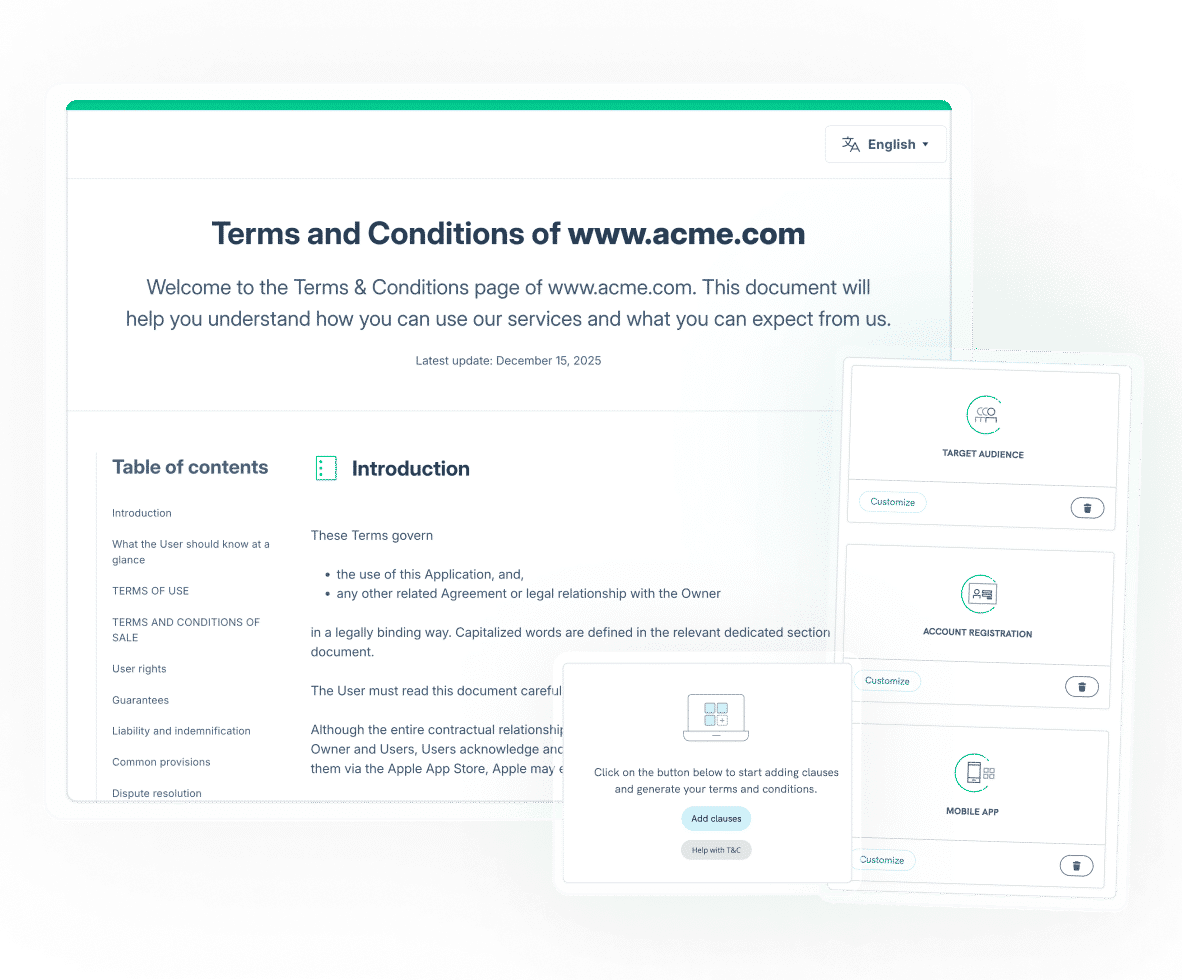
We recommend looking into professional tools like iubenda’s Terms and Conditions Generator
How to use the template
- Download the template: Get our free terms and conditions template in Word Doc, PDF, or copy and paste the HTML directly into your website.
- Fill in business and contact details: Before you publish it, fill in all the [brackets] with your business info and contact details.
- Customize sale and service clauses: This is a basic template to illustrate the structure of a terms and conditions document. It intentionally leaves out complex, jurisdiction-specific clauses. Use it as a reference, not a finished document.
- Tailor to legal jurisdictions: The template includes parts relevant to the EU, the UK, and the US. Some sections are specific to certain areas, so make sure they comply with the laws where your customers are.
Small business terms and conditions template (HTML text)
Copy and paste the Terms and Conditions Template HTML directly into your website.
<h1>Terms and Conditions of [website name]</h1>
<p>This document governs:</p>
<ul>
<li>the use of our website, and</li>
<li>any other related agreement or legal relationship with us</li>
</ul>
<p>in a legally binding way. You must read this document carefully.</p>
<p>Our website is provided by:<br>
[name/company and full address]<br>
Contact email: [email address]</p>
<h2>TERMS OF USE</h2>
<p>Unless stated otherwise, the terms in this section apply generally when using our website. Specific or additional conditions may apply in certain situations and are noted in this document.</p>
<p>By using our website, you confirm the following:</p>
<ul>
<li>you are older than [number of years of age];</li>
<li>you are not in a country subject to a government embargo, or that has been designated as a "terrorist-supporting" country;</li>
<li>you are not listed on any government list of prohibited or restricted parties.</li>
</ul>
<h2>LIABILITY AND INDEMNIFICATION</h2>
<p><em><strong>Note:</strong> This section covers the limits of your liability, your disclaimer of warranties, and the circumstances in which users agree to indemnify you. The correct wording varies significantly between the EU, the UK, and the US — each jurisdiction has its own requirements, and a clause written for one may not be valid in another. We recommend tailoring this section to the jurisdictions where your business operates and where your customers are based.</em></p>
<h2>TERMS AND CONDITIONS OF SALE</h2>
<p><em><strong>Note:</strong> Include this section if you sell products or services. At minimum, cover your prices, accepted payment methods, delivery terms, and the customer's right of withdrawal. EU and UK consumer law sets specific requirements — including a 14-day withdrawal right and a 2-year legal guarantee on physical goods — that differ from US rules. If you sell across multiple markets, this section will need to reflect each one.</em></p>
<h2>COMMON PROVISIONS</h2>
<h3>No waiver</h3>
<p>Our failure to assert any right or provision under these terms does not waive that right or provision. No waiver will constitute a continuing waiver of such term or any other term.</p>
<h3>Service interruption</h3>
<p>To maintain the best service level, we reserve the right to interrupt the service for maintenance, updates, or other changes, with appropriate notification. The service may also be unavailable due to events beyond our reasonable control, such as infrastructure breakdowns or blackouts.</p>
<h3>Service reselling</h3>
<p>You may not reproduce, duplicate, copy, sell, or exploit any part of our website or its service without our express written permission.</p>
<h3>Privacy policy</h3>
<p>For information on the use of personal data, please refer to our website's privacy policy.</p>
<h3>Intellectual property rights</h3>
<p>All intellectual property rights associated with our website, including copyrights, trademarks, and design rights, are exclusively owned by us or our licensors and are protected by applicable laws and international treaties. You may not use them without our written permission.</p>
<h3>Changes to these terms</h3>
<p>We reserve the right to modify these terms at any time and will inform you of any changes. Your continued use of the service after a change signifies your acceptance of the revised terms. If you do not wish to be bound by the changes, you must stop using the service.</p>
<h3>Assignment of contract</h3>
<p>We reserve the right to transfer, assign, or subcontract any or all rights or obligations under these terms, considering your legitimate interests. You may not assign or transfer your rights or obligations under these terms without our written permission.</p>
<h3>Severability</h3>
<p>If any provision of these terms is found invalid or unenforceable under applicable law, the remaining provisions will remain in full force and effect.</p>
<h3>Contact</h3>
<p>All communications regarding the use of our website must be sent using the contact information provided in this document.</p>
<h2>GOVERNING LAW AND DISPUTE RESOLUTION</h2>
<p><em><strong>Note:</strong> State the governing law and venue of jurisdiction that apply to your business. If you sell to consumers in the EU, you should also reference the European Commission's online dispute resolution platform, which EU consumers are entitled to use. Choose carefully based on where your business is incorporated and where your customers are located.</em></p>
Small business terms and conditions template (Word DOCX)
Small business terms and conditions template (PDF)
Where this template stops
The clauses in the template above cover the basics most websites share, and you can use them as a starting point. The three bracketed sections (liability, sale terms, and governing law) carry real legal risk and vary by jurisdiction, products, and customers, which is why we can only provide so much detail in the template for them. We recommend that you research and write those yourself, then keep them current as the law shifts. A terms and conditions generator builds each of them around your actual business, typically in various languages, and flags you when the law changes.
Tips for filling out the template
When filling out the terms and conditions template, keep these tips in mind:
- Customize for your business: Adapt sections to match your specific business operations and policies.
- Be specific: Provide detailed information where necessary, such as return deadlines or payment methods, to avoid ambiguity.
- Use accessible language: Ensure the document is easy to read and understand by using plain language.
- Keep it updated: Regularly review and update your terms to reflect any changes in your business practices or legal requirements.
Making your terms and conditions accessible
Now, having a great small business terms and conditions template is one thing, but making sure your customers read and agree to it is another. Here are some tips:
- Make it easy to find: Place your terms and conditions where they’re easy to see, like your website’s footer or checkout page.
- Use clear language: Write in plain language, this makes your terms more accessible to a wider audience.
- Use accessible language: Ensure the document is easy to read and understand by using plain language.
- Require agreement: Consider having a checkbox that customers must tick to show they agree to your terms before making a purchase, e.g. for an e-commerce shop. This step makes sure they know the rules.
What a legally binding business terms and conditions template covers
Introduction to terms and conditions
Governing the use of our application and any related agreements with the owner.
User requirements
Conditions for account registration, user responsibility, and the handling of account termination, suspension, and deletion.
Content management
Rights and responsibilities concerning content provided by the owner and users, including intellectual property rights and liability for user-provided content.
Access to external resources
Guidelines on how users may access third-party resources through the application.
Acceptable use policy
Specifies the lawful and prohibited uses of the application and the service.
Software license
Terms under which the software associated with the application is licensed to the user.
Terms and conditions of sale
Detailed conditions for purchasing products through the application, including payment methods, product description, purchasing process, and user rights like the right of withdrawal.
Liability and indemnification
Disclaimer of warranties, limitations of liability, and indemnification obligations of users.
Common provisions
Covers service interruption, service reselling, privacy policy, intellectual property rights, amendments to the terms, contract assignment, and contact details.
Governing law and venue of jurisdiction
The legal jurisdiction and governing law applicable to the terms and the dispute resolution process.
TERMS AND CONDITIONS GENERATOR
Get started now with iubenda’s professional online generator
- Easily generate and manage Terms and Conditions for your site.
- Customizable from over 100 clauses, available in 15 languages.
- Drafted by an international legal team.
- Up to date with the main international legislations.
- Optimized for e-commerce, marketplace, SaaS, apps, and more.
Try the generator with our 14-day money-back guarantee