

Usercentrics is an enterprise CMP with detailed consent reporting. Its analytics and A/B testing let teams compare banner designs and track how consent choices affect the data available downstream.
The reasons teams leave are consistent in public reviews: setup complexity, banner reliability, and support. This guide covers those and how five alternatives compare.
Compare the best alternatives to Usercentrics: At a glance
| iubenda | consentmanager | Didomi | OneTrust | Enzuzo | |
|---|---|---|---|---|---|
| Ease of setup | Guided setup, built for non-technical users | Guided setup, with configuration depth available as you need it | Enterprise implementation project, run with the vendor over weeks | Complex, generally needs dedicated ownership | Quick setup, native Shopify plugin |
| Reliability | Dependable across CMSs and custom stacks | Built for high-traffic estates across web, apps, and connected TVs | Reviews mention added page weight | Reviews mention sluggish performance | Reviews mention banner display issues |
| Support | Reviewers consistently rate support highly | Reviewers consistently rate support highly | Reviewers rate support highly | Reviews mention slow response times | Live chat only on most plans |
| Pricing transparency | Plans published openly, paid plans from €4.99/month | Plans published openly, paid plans from €23/month | No published pricing | No published pricing | Plans published openly, paid plans from $9/month |
| Free plan available | Free plan available with everything you need to get started on a basic site | Free plan available | No free plan | No free plan | Free plan available |
| Best for | Businesses of any size that want full compliance coverage in one place, without the enterprise price tag | Enterprises and publishers that want to improve consent rates | Enterprises that want a consent-only platform and can work through a sales-led purchase | Large enterprises with a dedicated privacy function and budget to match | Smaller Shopify stores that want core privacy requirements covered quickly |
Common reasons businesses explore alternatives to Usercentrics
Usercentrics is capable, particularly on analytics. Three themes explain why teams start comparing options.
Setup and day-to-day complexity
A CMP has to handle complex requirements without being complex itself, and plenty of businesses have no in-house privacy or development team. Reviewers describe Usercentrics as difficult to set up and use, and the support documentation does not close the gap.
For a team without someone to own the platform, the analytics depth goes unused.
Banner reliability
A CMP has to show the banner consistently, record preferences correctly, and block or fire scripts according to each choice, without disturbing the rest of the site. Reviewers report banners not displaying consistently, errors appearing on the site, and problems with the scanning tool.
A banner that does not display reliably collects no consent, which undoes the point of the analytics.
Support response times
Slow replies are the most repeated complaint in public reviews, and they compound the setup difficulty: a complex platform with slow support is a difficult combination.
Session limits on lower tiers
Plans are bounded by session counts, so a growing site can be pushed onto a more expensive tier by traffic alone rather than by needing new features.
The cost of fragmentation
Running consent in one product, legal documents in a second, and accessibility or data subject requests in a third means three subscriptions, three logins, and three update cycles. Teams on that setup typically spend more than teams on one integrated platform, and the maintenance load grows every time a regulation changes.
Digital compliance has also stopped being only about privacy. Alongside the General Data Protection Regulation (GDPR) and cookie rules, requirements now reach areas such as accessibility and whistleblowing. Which of them apply depends on your size, sector, and the markets you sell into, and plenty of teams find they are in scope later than they expected. A platform that already covers the wider set turns a new requirement into a setting you switch on rather than another product you have to buy.
What to keep in mind when looking for the best alternative to Usercentrics
Here is what to check before you commit to a consent management platform for your business.
Ease of setup and implementation
Be honest about who will own the platform. If nobody has time to configure it, depth is a liability rather than a feature.
Consistent performance
Ask for INP figures rather than a general claim about speed, and check reviews specifically for banner display problems.
Responsive, reachable support
Check timezone coverage and channels beyond email or chat. Reviews tell you quickly whether a team replies.
Predictable pricing
Check what triggers the next tier. Session or pageview caps mean growth can raise your bill without adding capability.
The 5 best alternatives to Usercentrics in 2026
1) iubenda
iubenda is an all-in-one digital compliance suite used by over 150,000 customers worldwide, from solo founders to enterprises. It brings cookie consent, privacy and cookie policies, terms and conditions, accessibility, data subject rights, and whistleblowing management together on one subscription.
Privacy law keeps moving, and that breadth is the point: one platform covers the areas that would otherwise need three or four separate products, each with its own login, invoice, and update cycle.
The documents are also built from your live setup rather than a form. iubenda scans the site or app, identifies the services actually running on it, and generates the policy from what it finds, then rescans on a schedule to catch what you add later.
It is also built with marketing in mind rather than against it. Consent analytics show you what your consent rate actually is, and consent recovery works to win back consent that would otherwise be lost, which protects the data your campaigns depend on.
Pros
- All-in-one digital compliance suite on one subscription
- An in-house team of lawyers drafts and maintains the clause library
- Policies reflect what your site actually runs: the scanner detects the cookies, trackers, and third-party services in use, and generates the documents from that, rather than from a questionnaire
- Recurring scans flag new services as you add them, so the documents stay in step with the site
- Supports the major global privacy laws
- Google-certified CMP with support for Google Consent Mode v2
- Customizable legal document generation
- Easy integrations with WordPress, Shopify, Webflow, Google Tag Manager, and more
- Consent analytics and consent recovery help you see consent rates and recover consent that would otherwise be lost
- Lightweight script that supports fast page loads
- Flexible pricing based on the solutions you activate, so you don’t pay for more than you need
Cons
- The Terms and Conditions Generator is only available on paid plans
Pricing
- Free plan available with everything you need to get started on a basic site
- Paid plans start from €4.99/month
- Pricing scales with traffic, domains, and the solutions you activate
What people say
iubenda holds 4.7/5 on Capterra. Reviewers mention the peace of mind it gives smaller teams, the customer support, and the hours it saves on manual work.
How does iubenda compare to Usercentrics?
This is the swap for teams that want the obligations covered without a platform to operate. Setup is guided and built for non-technical users, and support is the single most praised thing in iubenda’s reviews, which addresses the two most common reasons for leaving Usercentrics.
It also goes wider: legal documents, accessibility, data subject rights, and whistleblowing on the same subscription. Pricing is published from €4.99/month and scales with traffic, domains, and the solutions you activate, so growth does not silently move you up a tier.
Best for: businesses of any size that want full compliance coverage in one place, without the enterprise price tag.
2) consentmanager
consentmanager is a Google-certified CMP built for enterprises, publishers, and businesses running multiple high-traffic websites. It covers websites, mobile apps, and connected TVs, and adds legal document generation and compliance monitoring alongside consent collection.
Its focus is turning consent into something you can actively improve. Built-in A/B testing and machine learning compare banner layouts, wording, and button positions, then send more visitors to the version that performs best.
Pros
- In-depth scanning identifies and classifies cookies, trackers, and vendors
- Continuous monitoring helps detect consent issues
- Built-in A/B testing and machine-learning optimization improve banner performance over time
- Detailed reporting and benchmark reports
- Over 200 design options for banners
- Works across devices, including desktop, mobile, apps, and connected TVs
- Compliance Monitor scanning spots gaps and gives you clear next steps
Cons
- Takes time to master, given the depth of configuration
Pricing
- Free plan available
- Paid plans start from €23/month
What people say
consentmanager holds 4.1/5 on Capterra. Reviewers describe it as straightforward once configured, good value for the range of solutions, and fast to run.
How does consentmanager compare to Usercentrics?
If you chose Usercentrics for the analytics, this is the closest match without the reliability complaints. consentmanager offers A/B testing, machine-learning optimization, and benchmark reporting, across websites, apps, and connected TVs.
It publishes its pricing, and reviewers rate its support well. The honest caveat is that it is also deep: expect to spend time on configuration, though not the setup difficulty reviewers describe with Usercentrics.
Best for: enterprises and publishers that want to improve consent rates.
3) Didomi
Didomi is an enterprise-grade CMP sold through a sales process, with consent optimization features and no published pricing.
Pros
- Consent rate optimization, including A/B testing
- Integrates with Google Consent Mode v2
- Consent across devices and channels
- Support that reviewers rate highly
Cons
- No published pricing and no free plan, so there is no way to compare cost or trial it without a sales process
- Reviews mention added page weight
- Consent only: no legal documents, and nothing outside privacy
Pricing
- No free plan
- No published pricing, custom quote required
What people say
Didomi holds 4.5/5 on G2, with reviewers highlighting the consent optimization features and the support team.
How does Didomi compare to Usercentrics?
Didomi offers comparable optimization features and a good support reputation, so on capability it is close. The difference is how you buy it and what it covers: no published pricing, no free plan, consent only, and reviewers report the same added page weight you may be leaving over. consentmanager covers the same enterprise ground with published pricing and a free plan to test on.
Best for: enterprises that want a consent-only platform and can work through a sales-led purchase.
4) OneTrust
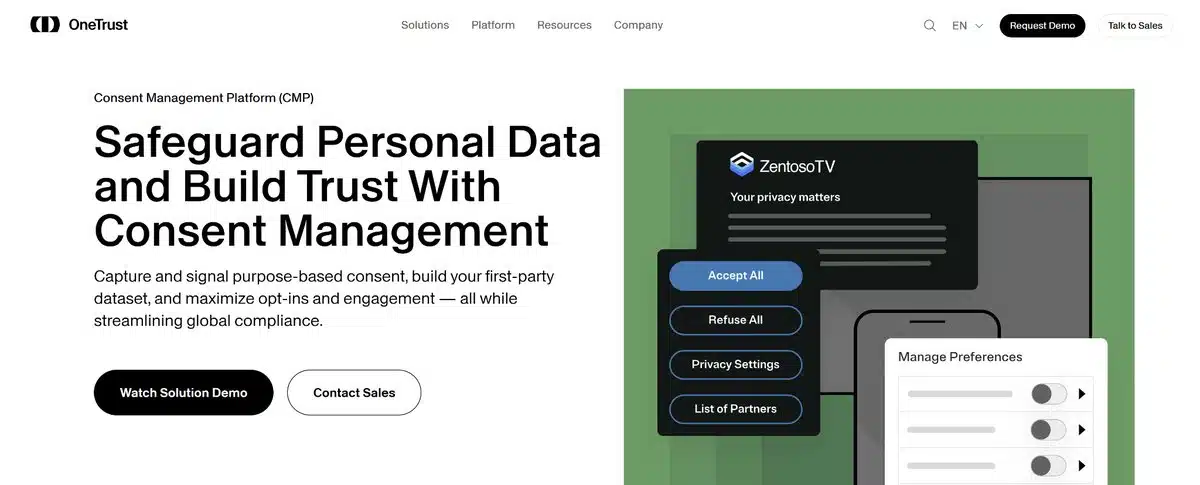
OneTrust is an enterprise platform that pairs consent and preference management with a much wider set of privacy, risk, and data governance tools. It also offers a dedicated AI governance product for inventorying AI systems, assessing their risks, and maintaining compliance documentation.
Pros
- Broad platform covering consent, privacy automation, data governance, and AI governance
- Consent across devices: websites, mobile apps, and connected TVs
- A/B testing to help improve opt-in rates
- Built for large organizations with a dedicated privacy function
Cons
- No published pricing; third-party estimates put it in the tens of thousands per year
- Configuration is complex and generally needs dedicated ownership
- Reviews mention slow support response times
- Reviews describe pressure to move up subscription tiers, and modules priced per regulation
Pricing
- No free plan
- No published pricing, custom quote required
What people say
OneTrust holds 1.4/5 on Trustpilot. Reviewers most often mention support response times and pressure to upgrade tiers.
How does OneTrust compare to Usercentrics?
OneTrust is the broadest platform on this list and the most expensive to run. If you need AI governance, third-party risk, and privacy automation under one roof and have a team to operate it, nothing here matches its scope.
For everyone else the trade is unfavorable: no published pricing, a long configuration project, and modules charged per regulation. Against Usercentrics specifically, OneTrust adds governance breadth but shares the two complaints you may be leaving over, slow support and complex configuration, and it publishes no pricing.
Best for: large enterprises with a dedicated privacy function and budget to match.
5) Enzuzo
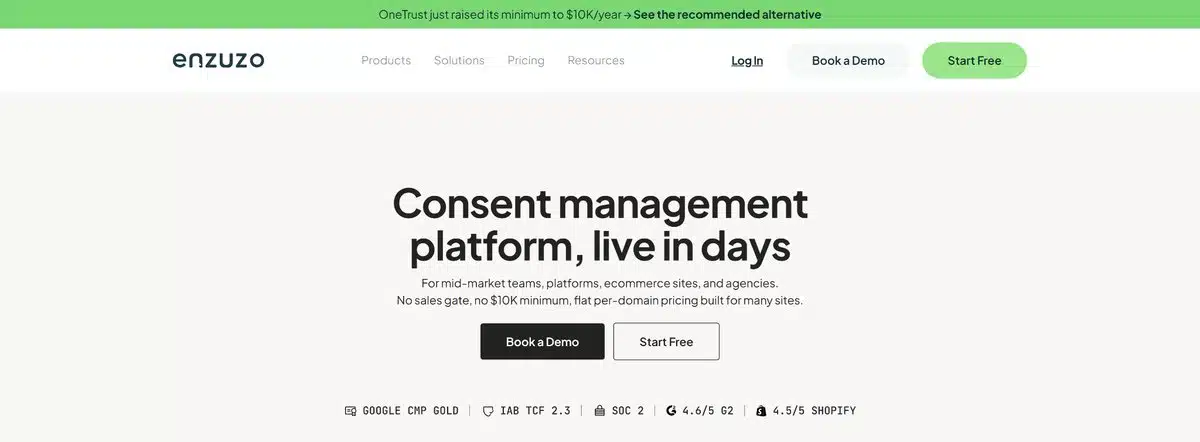
Enzuzo is a CMP aimed at ecommerce, with a native Shopify plugin. It combines cookie consent, legal document generation, website scanning, and data subject request management in a setup that smaller stores can get live quickly.
Pros
- Ecommerce focus, with native Shopify support
- Consent rate optimization and in-depth analytics
- Free plan available, with paid plans published from $9/month
Cons
- Advanced features and customization sit on higher tiers
- Legal document range is narrower than some alternatives
- No coverage beyond privacy, such as accessibility
- Support is limited to live chat on most plans
- Questionnaire-based document generation, which can affect policy accuracy
- Reviews mention banner display and performance issues
Pricing
- Free plan available
- Paid plans start from $9/month
What people say
Enzuzo holds 3.5/5 on the Shopify App Store. Reviewers mention difficulty customizing legal documents, banner display issues, and slow support replies.
How does Enzuzo compare to Usercentrics?
Enzuzo is the simplicity answer rather than the capability one: quick to set up, published pricing from $9/month, and a native Shopify plugin. It does not reach Usercentrics on analytics depth, its documents are questionnaire-based, and reviewers report their own banner display issues.
Best for: smaller Shopify stores that want core privacy requirements covered quickly.
Choosing the right alternative to Usercentrics
Four questions narrow the list quickly.
- Was complexity the problem? iubenda and Enzuzo are the two built to be set up quickly. consentmanager, Didomi and OneTrust all reward time spent.
- Do you need the reporting depth you were paying for? consentmanager matches it and publishes its pricing. Didomi matches it and does not.
- Do you need legal documents, accessibility, or whistleblowing as well? Only an all-in-one suite covers those without a second purchase.
- Do you want to see pricing without a sales call? iubenda, consentmanager and Enzuzo publish their plans. Didomi and OneTrust do not.
The useful question is not which platform has the most features, but which one your team will actually operate. Analytics nobody has time to read is not worth paying for.
Frequently asked questions
What’s the best alternative to Usercentrics?
For enterprise-scale consent with the reporting depth and none of the reliability complaints, consentmanager, which also publishes its pricing. If you want the wider set of obligations covered with a setup a non-technical team can own, iubenda.
Why do businesses look for a Usercentrics alternative?
Three reasons come up most in public reviews: a steep setup and configuration curve, inconsistent banner display alongside added page weight, and slow support responses. Session limits on lower tiers are a fourth.
Do these alternatives support GDPR and Google Consent Mode v2?
All five support the General Data Protection Regulation (GDPR), and iubenda, consentmanager, Didomi, and OneTrust integrate with Google Consent Mode v2. Check the current specification with each provider before you commit, since integrations change.
Is there a free alternative to Usercentrics?
Yes. iubenda, consentmanager, and Enzuzo all offer a free plan. Didomi and OneTrust publish neither a free plan nor a price list.
Everything you need for compliance, in one place
Consent is one piece of digital compliance. Legal documents, accessibility, data subject requests, and whistleblowing are the rest of it, and running them as separate products costs money and attention every time a regulation moves.
iubenda brings them together on one subscription, with a guided setup, published pricing from €4.99/month, and a free plan to start on. Start for free and see how much of your setup one platform can cover.