

No slides. No pitches. Just real experience.
This is the format iubenda takes across Europe with its Growth Sessions: informal meetups where founders who’ve actually built something share what they’ve learned — mistakes included.
The most useful stories aren’t necessarily about success. They’re about what didn’t work, and how people pushed through anyway.
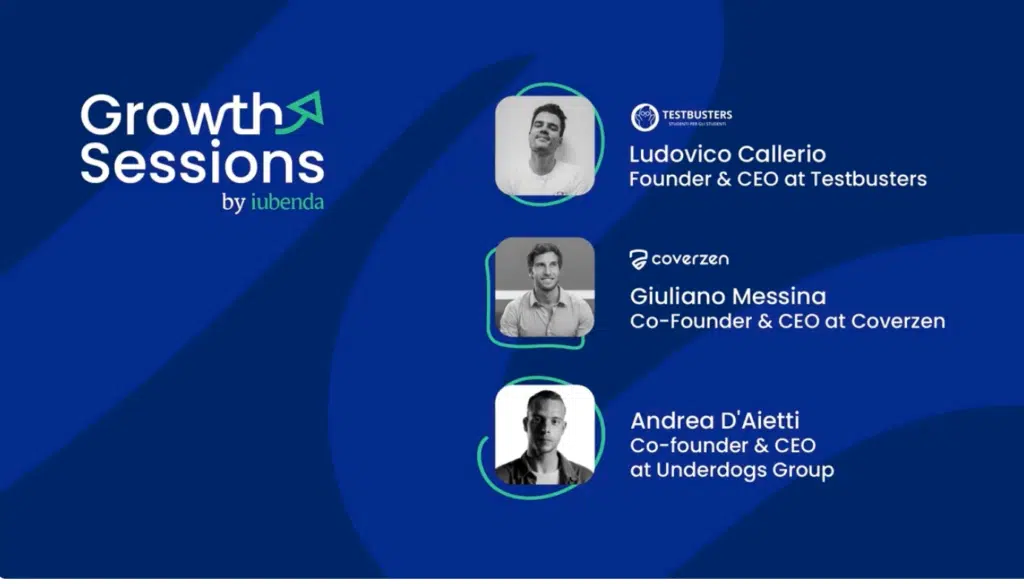
After Berlin and Bologna, the March 2026 edition landed in Milan. On stage:
- Ludovico Callerio, CEO & co-founder of Testbusters (an educational community that helps students pass university entrance exams through peer-to-peer learning),
- Giuliano Messina, chairman & co-founder of Coverzen (a digital broker with a purpose-built platform for issuing policies and managing and growing an insurance portfolio),
- Andrea D’Aietti, CEO & co-founder of Underdogs (an end-to-end MarTech group offering integrated marketing, advertising, and data technology solutions),
- moderating, Paolo Occhipinti, Principal Expert Strategic Accounts Italy at iubenda.
Here’s a recap of the moments worth hearing. To listen to the full session:
The idea always comes from the same place
Three different companies, three different industries, three very different journeys. Yet all three founders started the same way: by solving a problem they had themselves.
- Ludovico founded Testbusters while studying medicine, bored out of his mind in lecture halls.
- Giuliano built his first B2C comparison site out of the expenses he and his partners were trying to cut.
- Andrea left university for three years in Australia, came back, and built the first product of what would become Underdogs because a friend needed help managing some URLs.
The best ideas come from within, not from market research done behind a desk. And often from the frustration of not finding a ready-made solution.
How to find your first customers
None of the three followed a fixed playbook.
Andrea landed his first enterprise client almost by chance, when he met Vodafone’s marketing manager, who opened the door to the Telco world. With that case study in hand, he went to Telecom, then Wind. The real scale-up came later: a launch on AppSumo showed the product had a much bigger market than he’d imagined.
Giuliano did the opposite of what you’d expect from a B2B company. Instead of going straight for the big brokers, he used everything he knew from B2C: digital campaigns, online acquisition, chasing volume. Mass market first, refined product later.
Ludovico found his lever by proposing free orientation events for students to the University of Milan. That partnership drove 10x year-over-year growth.
Three different paths, yet each used what they already had: a network, a skill, direct access to an audience. None of them looked for the “right” path, or the most challenging one. Each one found a gap and filled it.
What didn’t work
Building without understanding the real market. Giuliano invested time and resources in a fully self-service platform, convinced the insurance industry would move online. It didn’t: 90% of policies in Italy still go through a physical intermediary. Understand how the market actually works first, then build.
Delegating without checking skills. Andrea gave management responsibilities to a long-standing team member who didn’t have the skills to handle the role. The result: internal tension and operational damage.
Doing too much alone. Underdogs built many products and launched many companies from scratch. After a few costly failures, Andrea changed his approach: since 2022, he’s been acquiring businesses that already work instead of building them in-house.
Staying in your own niche for too long. Ludovico says it was a mistake to keep going without talking to anyone else. “If I hadn’t started talking to other entrepreneurs, I wouldn’t have realized I needed to change course.”
Company culture: it’s not a manifesto
All three were honest on this topic, and none of them gave easy answers.
Andrea was direct: putting four values in a document isn’t enough. For him, culture is something more visceral — curiosity as an attitude, the drive to improve even outside the company. To try to capture it, he asked frontline staff to describe Underdogs in their own words, not his.
Giuliano bets on transparency: they share numbers, results, and mistakes with the whole team. “A new hire once came up to me and said they’d never worked at a company that shared this kind of thing with everyone.” For him, the point is creating an environment where people feel safe enough to take initiative and make mistakes, without fear of an angry boss.
Ludovico sums it up like this: “Businesses are made of people, and people, in the end, are mostly driven by something else. If there weren’t a real sense of cohesion, a palpable identity, I know for certain that everything would be harder for me, first of all. In the end, it comes down to who wakes up happy to start the day, and who’d rather stay in bed.”
Advice to their past selves
Looking back, all three pieces of advice converge on a single theme: how decisions get made.
Trust your judgment on hard calls, even when you don’t have full control. Don’t overestimate the competition: a strong competitor is often a sign the market is worth it, not that it’s out of reach. And slow down before deciding. Less instinct, more method. The best decisions come when you actually take the time to think them through.
Growth Sessions by iubenda are meetups where founders share the real experience of building a company. No slides, no pitches. Follow us on LinkedIn so you don’t miss the next one.