
In short
What’s the meaning of EULA? Is an EULA the same as Terms of Use or Terms of Service (ToS)? When are EULAs needed? How do you generate an End User License Agreement?
In this post, we answer these questions and show how you can easily prepare an End User License Agreement for your business, website, or app. Plus, we provide a handy template to download and customize as needed.
Jump to:
- What is an EULA?
- Does a EULA provide legal protection?
- When is an EULA needed?
- Is an EULA the same as “Terms of Use” or “Terms of Service” (ToS)?
- What is the difference between SLA and EULA?
- What is the difference between end-user license agreement and license agreement?
- What should be included in an EULA?
- How do you write an EULA?
- Can I use an EULA generator?
- End User License Agreement template
- Where to display an End User License Agreement
- Easily create your EULA in minutes
EULA GENERATOR
Generate your End User License Agreement
Protect your interests, your content and your business overall with complete, professional Terms and Conditions.
Do that in minutes with our Terms and Conditions Generator.
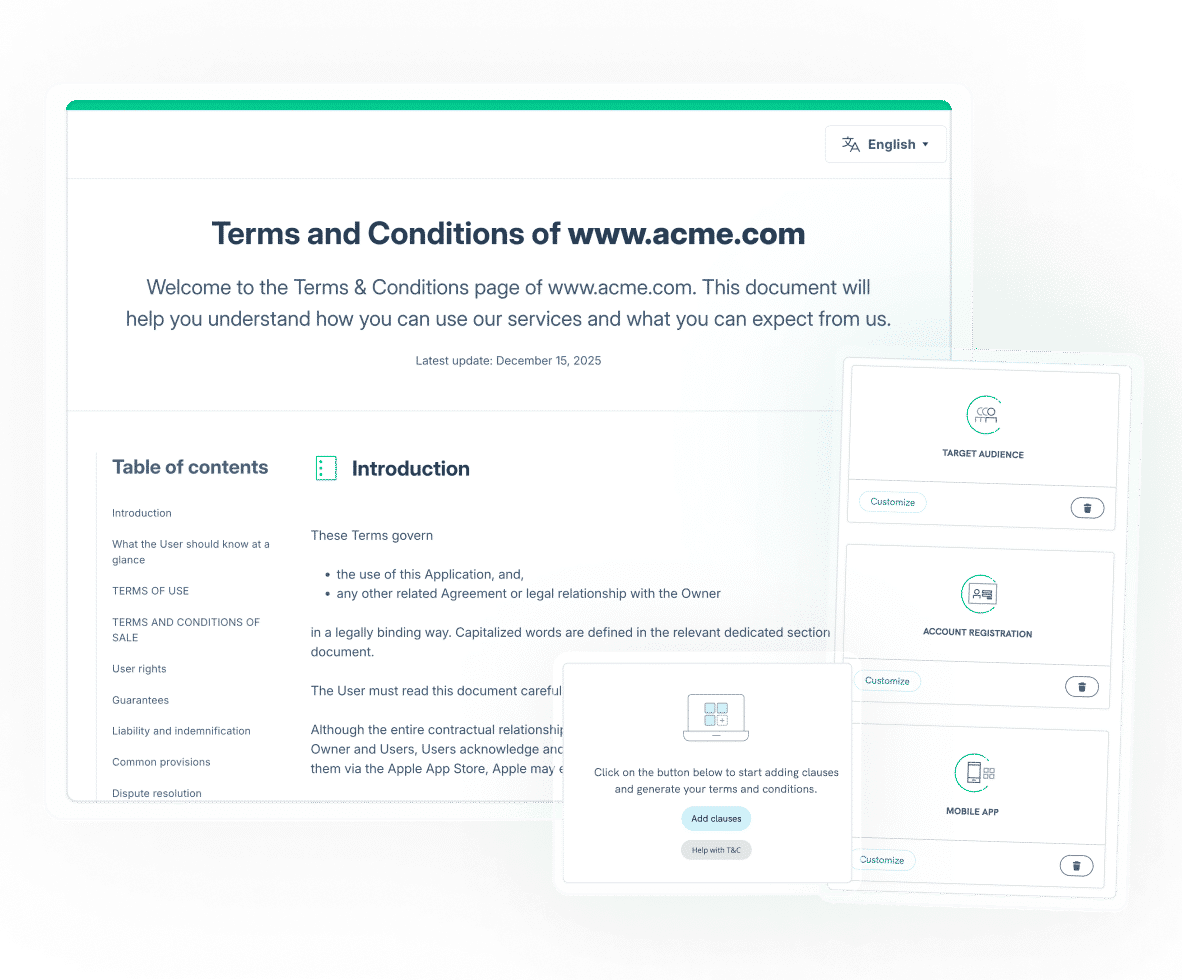
Try our generator with our 14-day money-back guarantee
What is an End-User License Agreement (EULA)?
EULA meaning: An End-User License Agreement is a legally binding agreement between the owner of an application or software, and the end-user. In full, EULA stands for End-User License Agreement. More specifically, it is a contract between the licensor of a product and the licensee (also called Software License Agreement (SLA), or Licensed Application End-User Agreement).
Going into more details, a EULA specifies the rights and restrictions that apply to the software, and it’s typically presented to users during the installation/set-up stage. Like other legal agreements, it is only valid if it’s actually agreed to.
The End User License Agreement (EULA) typically involves two parties:
- The software provider/author or licensor: this is the party that owns the rights to the product and grants the license for use of the software. In many cases, it is a company that acts as the software publisher, but it could also be the individual or author who developed the software.
- The end-user/buyer or licensee: this is the individual or organization that is receiving the license to use the software and agrees to comply with the terms and conditions outlined in the EULA. The end-user could be a person who is installing the software on their personal computer, or it could be a business or other organization that is installing the software for use by its employees or members.
Does a EULA provide legal protection?
Yes, it does. In fact, as mentioned before, End User License Agreement (EULA) is a legally enforceable contract that protects your intellectual property and copyright while governing the relationship between you and the end user.
For a EULA to be binding, parties must give their mutual consent to its terms, which is typically obtained through the user’s acceptance of the agreement. It is crucial to ensure that the language used in the EULA is coherent and understandable, making it clear to the user that they are entering into a contractual agreement with you.
The primary legal protections provided by a EULA include, amongst others:
- ownership rights (intellectual property, etc.),
- user’s rights granted under the software license,
- restrictions on the use of the license,
- disclaimer warranties,
- limitation of liabilities.
An example of a legal protection is what an EULA offers against potential lawsuits from end users who claim that your software caused harm or damage. Through carefully crafted clauses, the EULA can establish clear limitations on your liabilities, potentially minimizing legal risks.
When is an EULA needed?
End User License Agreements are important for protecting the rights of the business owner/licensor and critical for setting the rules of use and managing the expectations of the end-user.
Generally, the EULA will help you to set the conditions of your license agreement with the user – explain what they are and aren’t allowed to do with the software, the conditions under which their access might be limited or terminated, copyright provisions etc.
Some additional instances where you might need a End User License Agreement are where you:
- need to make legally required disclosures related to consumer rights (especially withdrawal and cancellation rights),
- have different user levels (e.g. registered vs non-registered),
- your platform allows users to sell or trade with other users,
- facilitate or otherwise process payments and/or other sensitive user data; want to set the rules for user behavior and state grounds for termination of accounts,
- participate in affiliate programs,
- provide a software or service which can potentially cause harm if misused,
- would like to have some legally enforceable control over, and set rules about, how your website/app/product may be used.
Is an EULA the same as “Terms of Use” or “Terms of Service” (ToS)?
Yes, somewhat. Terms of Use (also called Terms and Conditions and Terms of Service) generally govern the relationship between a business, its services and its users/consumers – this broad scope can include everything from copyright and licensing to consumer rights, to return policies and setting governing law.
An End User License Agreement operates in a similar way, but focuses mostly on the licensing relationship. The titles “Terms and Conditions“, “Terms of Use” and “EULA” mean the same thing in relation to software and apps and are often used interchangeably.
What is the difference between SLA and EULA?
The main difference between a EULA and a SLA (software license agreement) lies in their intended use. A EULA is typically designed for situations where numerous users use the software on an ongoing basis. In contrast, a software license agreement is more commonly employed in business-to-business scenarios, and often for finite engagements.
So for example, an SLA might be used in a situation where the software is downloaded and operated directly on the user’s computer, while a EULA might be used for Software as a Service or an app. Obviously there are other nuances between an SLA and EULA but this is the key distinction.
What is the difference between end-user license agreement and license agreement?
In many cases, the terms “End User License Agreement” (EULA) and “License Agreement” are used interchangeably, and both typically refer to the contract between the licensor (the party who owns the rights to the product) and the licensee (the party who is receiving the rights to use the product under specific terms and conditions)
However, it is worth mentioning that EULAs are typically specific to software and digital goods. They are presented to the end user (the person or entity using the software) during the installation process.
License Agreements, on the other hand, may cover a broader range of products, services, or intellectual property, such as patents, trademarks, and copyrights. A License Agreement might be used when the licensee is another business or entity rather than the end consumer.
What should be included in an EULA?
Although these documents vary, common clauses for End User License Agreements are:
- definitions,
- a grant of license,
- limitations on use,
- a copyright notice,
- a limited warranty.

How do you write an EULA?
When writing a basic End User License Agreement, be sure to at least:
- clearly identify yourself/your business,
- clearly state the rules for user behavior and access to your product/software,
- disclose the copyright/intellectual property license that applies (e.g. open source),
- include other details of the software license including conditions for termination,
- include any disclaimers and limitation of liability statements.
You can see how this all comes together in the EULA template below.
Can I use an EULA generator?
Yes, absolutely. You can use an EULA Generator to create End User License Agreements.
However, it’s important to vet the quality of the generator you use. Remember that EULA’s being a type of Terms and Conditions, they are essentially a legally-binding document. This means that the generator you choose must contain clauses written by actual legal professionals and that it allows you to fully customize your document to match your specific circumstances.
Here is a list of things to look for when choosing a quality EULA generator:
- has clauses written by actual legal professionals,
- provides clear and easy-to-understand instructions,
- allows you to customize the EULA to meet your specific needs,
- provides legal language that is appropriate for your jurisdiction,
- offers ongoing support and updates.
Download our sample EULA template for your website
Is it ok to use an EULA template?
Using a basic template is not wrong by default, but it can come with significant risk to you and your business. Should conflict arise or if a lawsuit is filed by a user, your EULA document will be your first line of defense. EULAs are complex legal documents that cover multiple legal scenarios (eg. commercial law, copyright laws, liabilities etc.), jurisdictions, and must apply to your specific business practices. This is difficult to achieve with a basic template.
Too much to think about? You can create a professional and customizable EULA (End-User License Agreement) with iubenda’s EULA generator.
How to use the template
- Download the template: get our free EULA template in Word, PDF, or copy and paste the HTML directly into your website.
- Fill in business and contact details: before you publish it, fill in all the brackets [with your business info and contact details].
- Customize sale and service clauses: the template covers B2B-B2C scenarios (the clauses for consumers are expressly mentioned) for SaaS, apps, and in general when software is provided. Make sure these sections match what your business offers.
- Tailor to legal jurisdictions: the template includes parts relevant to the EU, UK, and US (with some sections relevant only to consumers or specific territories). Some sections are specific to certain areas, so make sure they comply with the laws where your customers are.
EULA template (HTML text)
Copy and paste the EULA Template HTML directly into your website.
<h1>End User License Agreement of [application name]</h1>
<p>This End User License Agreement governs the use of our application in a legally binding way. You must read this document carefully.</p>
<p>Our application is provided by:</p>
<p>[name/company and full address]</p>
<p><strong>Contact email:</strong> [email address]</p>
<h2>What you should know at a glance</h2>
<p>Please note that some provisions may only apply to certain categories of users. In particular, certain provisions may only apply to consumers or to those users that do not qualify as consumers. Such limitations are always explicitly mentioned within each affected clause. In the absence of any such mention, clauses apply to all users.</p>
<h2>TERMS OF USE</h2>
<p>Unless stated otherwise, the terms in this section apply generally when using our application.</p>
<p>By using our application, you confirm the following:</p>
<ul>
<li>you are older than [number of years of age];</li>
<li>you are not in a country under a U.S. government embargo or designated as a "terrorist-supporting" country;</li>
<li>you are not on any U.S. government list of prohibited or restricted parties.</li>
</ul>
<h3>Account registration</h3>
<p>To use our application, you can register or create an account by providing complete and truthful information. You can also use our application without an account, but this might limit some features.</p>
<p>You are responsible for keeping your login details confidential and must choose passwords that meet the highest standards of strength as allowed by our application.</p>
<p>By registering, you agree to take full responsibility for all activities under your username and password. You must immediately inform us using the contact details in this document if you believe your personal information, account, or login details have been violated, disclosed, or stolen.</p>
<p><em><strong>Note:</strong> set out your account conditions here, for example that accounts cannot be created by bots, that each user may register only one account, and that accounts cannot be shared. You should also explain when you can suspend or delete an account.</em></p>
<h3>Content on this application</h3>
<p>Unless otherwise noted, all content on our application is owned or provided by us or our licensors.</p>
<p>We do our best to ensure the content on our application complies with all laws and respects third-party rights. However, this may not always be achievable. If you believe your rights are being infringed, without prejudice to any legal prerogatives to enforce your rights, please report any issues using the contact details provided in this document.</p>
<h3>Access to external resources</h3>
<p>Through our application, you may access external resources provided by third parties. You acknowledge and accept that we have no control over these resources and are not responsible for their content or availability.</p>
<h3>Acceptable use</h3>
<p>Our application may only be used within the scope of what is provided for, under this document and applicable law.</p>
<p>You are solely responsible for ensuring your use of our application does not violate any laws, regulations, or third-party rights.</p>
<h3>Software license</h3>
<p>Any intellectual or industrial property rights, as well as other exclusive rights on software or technical features related to our application, are owned by us and/or our licensors.</p>
<p>Provided you comply with these terms, we grant you a revocable, non-exclusive, non-sublicensable, and non-transferable license to use the software and other technical features on our application for its intended purposes.</p>
<p>This license does not give you any rights to access, use, or share the original source code. All techniques, algorithms, and procedures in the software and related documentation are the sole property of us or our licensors.</p>
<p>All rights and licenses granted to you will immediately end if the agreement is terminated or expires.</p>
<p><em><strong>Note:</strong> specify how the license works in practice, for example the number of devices it covers, whether updates are required to keep using the software, and how long the software will remain valid and functional.</em></p>
<h3>Purchase via app store</h3>
<p>Our application or specific products available for sale may be purchased via a third-party app store. To access such purchases, you must follow the instructions provided on the relevant online store (such as "Apple App Store" or "Google Play"), which may vary depending on the particular device in use.</p>
<p>Unless otherwise specified, purchases done via third-party online stores are also subject to third parties' terms and conditions, which will always prevail upon these terms in case of conflict.</p>
<h3>Contract duration</h3>
<p><em><strong>Note:</strong> if you offer subscriptions, describe how they work here, including how they renew, how they are billed (for example via an Apple ID), and how a user can cancel or terminate them.</em></p>
<h2>LIABILITY AND INDEMNIFICATION</h2>
<p>We limit our liability as much as legally allowed when executing agreements with you. This means our responsibility for damages is reduced to the maximum extent permitted by law unless explicitly stated otherwise or agreed upon with you.</p>
<p>You agree to indemnify us and our affiliates, officers, directors, and employees from any claims or demands made by third parties due to or in connection with any culpable violation of these terms or third-party rights related to your use of the service to the extent allowed by law.</p>
<p><em><strong>Note:</strong> liability, warranty, and indemnification rules vary widely by jurisdiction. Add the disclaimers and limitations that apply to your business, and include separate clauses for US users where needed (for example an "as is" disclaimer of warranties and a cap on liability).</em></p>
<h2>COMMON PROVISIONS</h2>
<h3>Privacy policy</h3>
<p>For information on the use of personal data, you can refer to our application's privacy policy.</p>
<h3>Intellectual property rights</h3>
<p>Without prejudice to any more specific provisions in these terms, all intellectual property rights associated with our application, including copyrights, trademark rights, patent rights, and design rights, are exclusively owned by us or our licensors. These rights are protected by applicable laws and international treaties concerning intellectual property.</p>
<h3>Changes to the terms</h3>
<p>We reserve the right to modify these terms at any time, informing you of any changes.</p>
<p>Your continued use of the service will signify your acceptance of the revised terms. If you do not wish to be bound by the changes, you must stop using the service and terminate the agreement.</p>
<h3>Contact</h3>
<p>All communications regarding the use of our application must be sent using the contact information provided in this document.</p>
<h3>Governing law and jurisdiction</h3>
<p>These terms are governed by the law of the place where we are based, as outlined in the relevant section of this document, without regard to conflict of laws principles. The jurisdiction over any controversy related to these terms lies with the courts of the place where we are based.</p>
<p><em><strong>Note:</strong> consumers often benefit from the protections of their home country, and some regions (such as the EU, UK, Switzerland, Norway, and Iceland) have specific rules on which courts apply. Add the governing law, venue, and consumer exceptions that fit your users.</em></p>
<h3>Severability</h3>
<p>Invalidity or unenforceability of any provision under applicable law will not affect the validity of other provisions, which will remain in full force and effect.</p>
<h3>Surviving provisions</h3>
<p>Upon termination, the provisions contained in this document that by their context are intended to survive termination or expiration will survive, including the license grant, indemnification obligations, and the disclaimer of warranties and limitation of liability.</p>
EULA template (Word DOCX)
EULA template (PDF)
Where to display an End User License Agreement
There are a few rules to follow for displaying the document:
- Make sure users agree to your End User License Agreement (EULA) before they buy and use your software or app. There are two main points where you can show it: before or after the software is downloaded or installed. Either one works, but keep the EULA easy to find and read at both stages, in case users want to review it later.
- Your EULA should never be optional. If it is, a user could argue they never agreed to the terms, which makes the contract unenforceable. Be clear, precise, and obvious when you ask for consent.
- On your website, place the EULA where users will see it, such as the account login page, checkout screen, or a dedicated legal page. In desktop or mobile apps, add it to your menus for easy access.
By placing your EULA in strategic locations, users can access, read, and accept the terms at any time, providing them with a clear understanding of how to use your product in a legitimate manner.
EULA GENERATOR
Easily create your EULA in minutes
- Save yourself the headache and find what you’re looking for: pick from hundreds of scenario-specific clauses.
- Create a strong and precise legal document: clauses have been pre-drafted by lawyers.
- Forget the static template: dynamically add, remove, or update clauses at any time.
Don’t just take our word for it. Try the generator with our 14-day money-back guarantee