

In short
Looking for a Terms of Service template? You’re in the right place.
A Terms of Service agreement is a legally binding document that lets you set rules users must follow when using your site or mobile app. It protects your business and defines the relationship with your users.
This article covers how important this document is, what to include, where to display it, and a free Terms of Service sample template.
In this article
- 3. Use a professional Terms of Service Generator
- What are Terms of Service?
- Why you need Terms of Service for your website
- Reasons to have a Terms of Service page
- What should I include in my Terms of Service?
- What are the basic Terms of Service?
- What is a generic Terms of Service policy?
- How do I write my own Terms of Service?
- How do I enforce Terms of Service?
- Terms of Service examples
- Download our sample Terms of Service template for your website
- Where to display your Terms of Service agreement
- Website Terms of Service summary in 10 points
- Terms of Service template tips
What are Terms of Service?
Terms of Service, often called Terms and Conditions (T&C) or End User License Agreement (EULA), are a contract between you (the service provider) and your users. It sets the rules for how people can interact with your website, app, or service. For example, you can define how copyrighted content may be used, outline the steps for suspending or closing a user account, and, for e-commerce sites, cover delivery times and returns.
Terms of Service, Terms and Conditions, and User Agreements all usually refer to the same document.
Why you need Terms of Service for your website
Regulations don’t always require a Terms of Service, but having one is strongly recommended. Here’s why:
- Protection: Terms of Service protect you and your business. They help you handle disputes before they escalate and give you a basis for defense if you’re ever legally challenged.
- Best practice: even when it’s not a legal requirement, having a Terms of Service is standard for any business. It builds trust and limits potential liabilities, whether you run a blog or an online shop.
- E-commerce: for e-commerce, Terms of Service are especially important. They cover payment, shipping, delivery, cancellations, and refunds. In many markets, they’re also a legal requirement, including mandated disclosures about warranties, withdrawal rights, and consumer protections.
- Intellectual property: Terms of Service let you maintain control over your content and trademarks.
Whatever your website does, a Terms of Service lets you set your own rules, protect your intellectual property, and limit your responsibilities if something goes wrong.
TERMS OF SERVICE GENERATOR
Generate your Terms of Service
Basic templates are often not enough to protect your business and intellectual property.
Terms of Service are complex legally binding documents, so making sure they are customizable and professional is important.
With our generator, easily set things like disclaimers and limitations of liability.

Try the generator with our 14-day money-back guarantee
Reasons to have a Terms of Service page
Limiting your liability
Terms of Service help limit your liability. They reduce your exposure if a user misuses your product or if your website has a technical issue. They clarify what you are and aren’t responsible for.
Protection from abusive behavior
Your Terms of Service can also protect against unauthorized actions. For example:
- Setting rules: define what users can and cannot post in comment sections or on your platform.
- Protecting intellectual property: prevent unauthorized copying of your logos and original content. This is key from a copyright perspective.
Useful disclaimers
Disclaimers help you be transparent with your users:
- Outlining responsibilities: your Terms define who is responsible for what, covering rights, obligations, and liabilities.
- Setting applicable law: you can specify which jurisdiction’s laws govern the agreement.
- Clarifying accuracy: a standard disclaimer reminds users that information you provide may not always be complete, and that they assume associated risks.
Keep your Terms of Service accessible from your footer at all times. Also show it to users at key moments: when they sign up, subscribe, make a purchase, or download your app.
What are the basic Terms of Service?
Every Terms of Service page looks a little different depending on your business. At a minimum, yours should include:
- Tell users who you are: clearly identify your business.
- Explain your service: describe what your website or app offers.
- Promise and assurance: if relevant, let users know about any warranties or guarantees.
- Rights to withdrawal: if applicable, explain any rights users have to change their mind.
- Who’s responsible: explain how risks, liabilities, and disclaimers are managed.
- Safety information: if applicable, provide instructions for proper use.
- Rights of use: specify any rights of use if they apply.
- How to use: if you have specific rules, like age requirements or location-based restrictions, spell them out.
- What happens if…? explain how refunds, exchanges, and service termination work.
- Order delivery: if you’re delivering products, describe how that works.
- Payment options: provide information about payment methods.
- Extra information: add any other important details that apply.
What should I include in my Terms of Service?
In short, your Terms of Service should cover:
- an introduction and how the terms may change,
- a link to your Privacy Policy,
- rules for user behavior,
- copyright rules,
- limitations on your liability and disclaimers,
- payment and refund details,
- how to settle disagreements,
- your contact information.
Keep your Terms of Service current with relevant laws and aligned with your business model. Review and update it whenever your processes or applicable regulations change.
What is a generic Terms of Service policy?
A generic Terms of Service policy is a ready-made starting point. It covers the basics, but it’s not built for any particular business type, product, or service. Review it carefully for gaps or clauses that don’t apply to your situation.
You’ll also need to fill in missing information and tailor it to your specific service and business model. If you use a generic template, have a legal professional review it before you publish.
The whole point of a Terms of Service is to protect your business against potential issues, including legal ones. A generic document may not do that well enough.
How do I write my own Terms of Service?
You can write your own Terms of Service, but it takes a solid understanding of legal language, applicable laws, and how they apply to your business. It’s time-consuming, and if you’re not familiar with legal matters, you risk missing important protections or failing to meet regulatory requirements.
Using a template can look cost-effective at first. But templates aren’t built for your specific business. Clauses may be missing, and the document won’t update when laws change. You’ll likely need legal input anyway.
Hiring a lawyer gives you the most thorough result: a document built for your business and jurisdiction. The downside is cost. Every time a law changes or you need an update, you go back to them.
A practical option is a professional Terms of Service Generator. iubenda’s generator is built by legal experts and covers a wide range of clauses. It creates a customized agreement based on your inputs, which you can publish directly on your site and update at any time.
How do I enforce Terms of Service?
Keep your Terms of Service accessible from your footer at all times. But also show it to users at key moments: when they sign up, comment, or make a payment. That’s how you get informed acceptance.
There are typical situations where users should see the Terms of Service:
- When they’re creating an account on your website.
- If they’re signing up for a subscription.
- When they’re making a purchase.
- If they’re downloading your mobile app.
To confirm users have read and accepted your Terms, use clickwrap. It’s the most widely used approach.
Terms of Service example
Looking for Terms of Service examples for business? Here’s how some websites handle it.
Linkbuilder
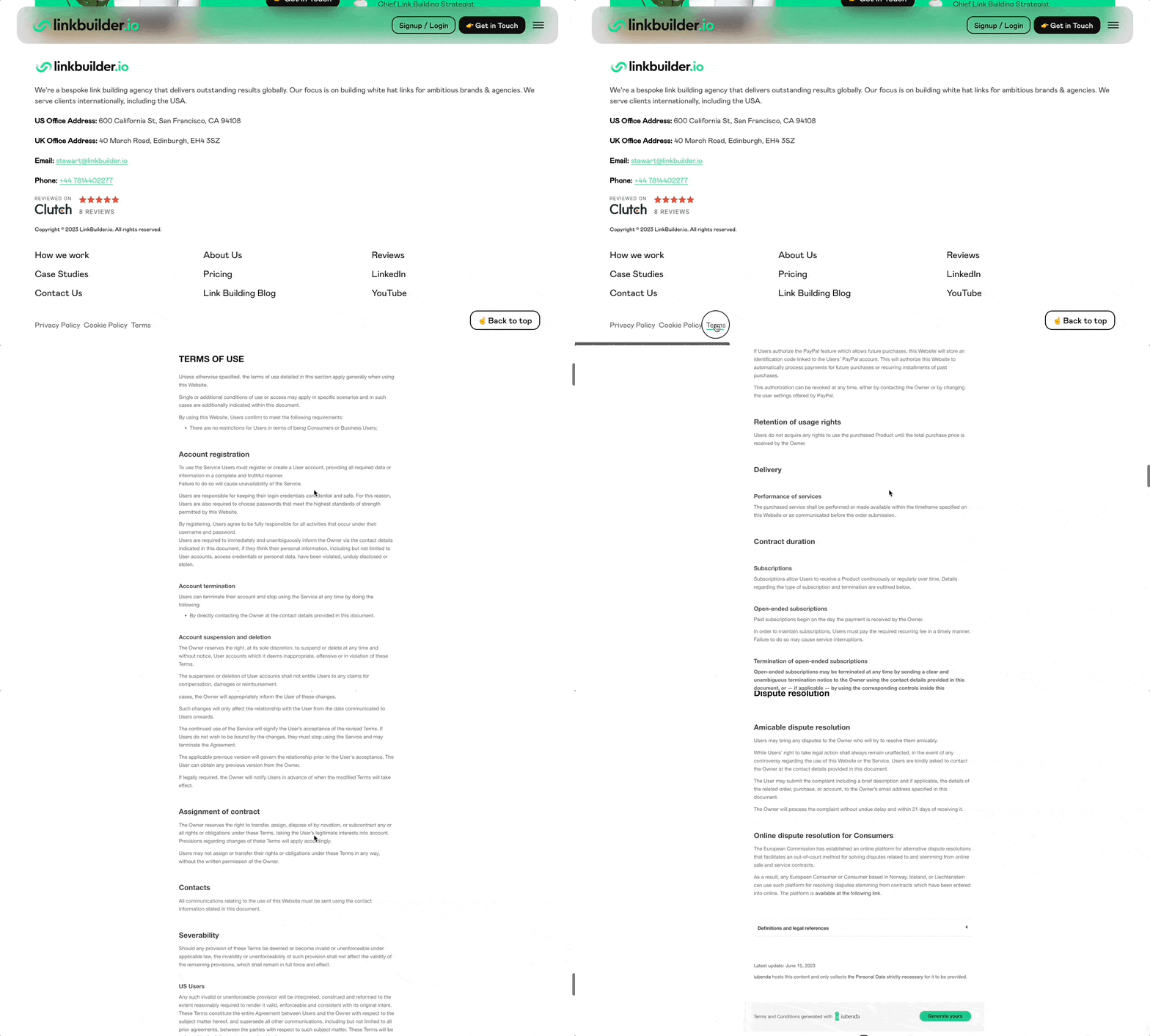
Here, you can see how Linkbuilder displays the terms of service in full screen when users click on the button at the bottom of the page:
iubenda
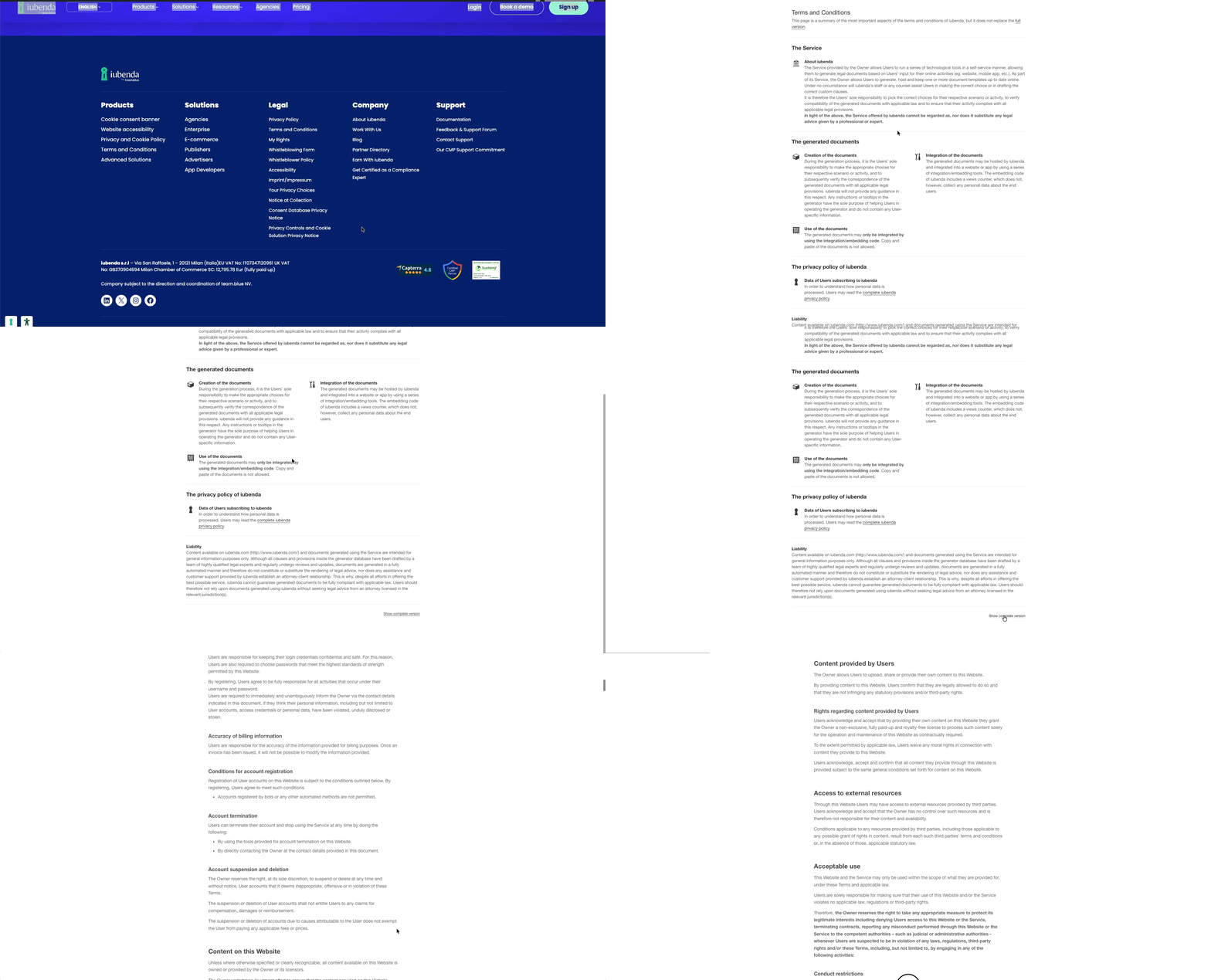
iubenda shows their terms and conditions in a shorter version (easier to read for users) after users click on the button at the bottom of the page. Later on, there’s a link to the longer version.
Download our sample Terms of Service template for your website
Using a basic template isn’t wrong, but it carries real risk. If a conflict arises or a user files a claim, your Terms of Service is your first line of defense. It needs to cover your specific business practices, applicable jurisdictions, and multiple legal scenarios, including commercial law, copyright, and liability.
A basic template rarely does all of that. If that concerns you, the iubenda Terms and Conditions Generator lets you build a document tailored to your business, drafted by legal experts.
How to use the template
- Download the template: get our free Terms of Service template in Word Doc or copy and paste the HTML directly into your website.
- Fill in business and contact details: before you publish it, fill in all the [brackets] with your business info and contact details.
- Customize sale and service clauses: the template covers selling physical goods and includes sections for both business-to-business (B2B) and business-to-consumer (B2C) sales, with some clauses addressing only consumers. Make sure these sections match what your business offers.
- Tailor to legal jurisdictions: review the notes in the template and tailor the document to comply with the laws where your customers are based.
Terms of Service template (HTML text)
Copy and paste the Terms of Service Template HTML directly into your website.
<h1>Terms of Service of [website name]</h1>
<p>This document governs:</p>
<ul>
<li>the use of our website, and</li>
<li>any other related agreement or legal relationship with us</li>
</ul>
<p>in a legally binding way. You must read this document carefully.</p>
<p>Our website is provided by:<br>
[name/company and full address]<br>
Contact email: [email address]</p>
<h2>TERMS OF USE</h2>
<p>Unless stated otherwise, the terms in this section apply generally when using our website. Specific or additional conditions may apply in certain situations and are noted in this document.</p>
<p>By using our website, you confirm the following:</p>
<ul>
<li>you are older than [number of years of age];</li>
<li>you are not in a country subject to a government embargo, or that has been designated as a “terrorist-supporting” country;</li>
<li>you are not listed on any government list of prohibited or restricted parties.</li>
</ul>
<h3>Account registration</h3>
<p>To use the service, you may register an account by providing complete and truthful information. You are responsible for keeping your login credentials confidential and for all activities under your account. Notify us immediately if you believe your account has been compromised. We reserve the right to suspend or delete accounts that are inappropriate, offensive, or in violation of these terms.</p>
<h3>Content and intellectual property</h3>
<p>All content on our website is owned by us or our licensors. You may not copy, modify, sell, or create derivative works from it without our written permission. Exceptions apply where explicitly stated or permitted by law.</p>
<h3>Acceptable use</h3>
<p>Our website may only be used within the scope of what these terms and applicable law permit. You are solely responsible for ensuring your use does not violate any laws, regulations, or third-party rights.</p>
<p><em><strong>Note:</strong> Add any other conditions here — for example, specific rules for user-generated content, affiliate programs, or age verification requirements.</em></p>
<h2>TERMS AND CONDITIONS OF SALE</h2>
<p><em><strong>Note:</strong> Include this section only if you sell products or services.</em></p>
<p>Prices, descriptions, and availability of products are detailed on our website and may change without notice. During checkout, you will see all charges, including fees, taxes, and delivery costs, before submitting your order. Accepted payment methods are provided during the purchasing process.</p>
<p>Products are delivered to the address you provide. Delivery times are outlined on our website or during the purchasing process.</p>
<p><em><strong>Note:</strong> Add your specific purchasing process, payment methods, delivery countries, and any other sale conditions here.</em></p>
<h2>USER RIGHTS</h2>
<h3>Right of withdrawal</h3>
<p>Unless exceptions apply, if you qualify as a European consumer, you have the right to withdraw from a contract within 14 days, without giving any reason.</p>
<p>To withdraw, notify us clearly before the withdrawal period ends. If you correctly withdraw, we will reimburse all payments made, including standard delivery costs, within 14 days of receiving your notification, using the same payment method you used.</p>
<p>For physical goods: you must return them within 14 days of notifying us. You bear the return costs and are responsible for any diminished value from handling beyond what is necessary to assess the goods.</p>
<p><strong>UK users:</strong> The same 14-day cancellation right applies. Contact us using the details in this document to exercise it.</p>
<h2>GUARANTEES</h2>
<p>EU consumers: we guarantee the conformity of goods for at least 2 years from delivery, in accordance with applicable law.</p>
<p>UK consumers: you have the right to receive goods that conform to the contract.</p>
<h2>LIABILITY AND INDEMNIFICATION</h2>
<p>We limit our liability to the maximum extent permitted by applicable law.</p>
<p>You agree to indemnify us from any claims arising from your culpable violation of these terms or third-party rights related to your use of the service, to the extent allowed by law.</p>
<p>Unless explicitly stated otherwise, you cannot claim damages against us except where damages affect life, health, or physical integrity, arise from breach of significant contractual obligations, or result from intentional or gross negligence.</p>
<p><em><strong>Note:</strong> If your business operates in the US, this section requires additional provisions covering disclaimers of warranties and limitations of liability specific to US law. These vary by state and are not covered by the clauses above.</em></p>
<h2>COMMON PROVISIONS</h2>
<h3>No waiver</h3>
<p>Our failure to assert any right or provision under these terms does not waive that right or provision. No waiver will constitute a continuing waiver of such term or any other term.</p>
<h3>Service interruption</h3>
<p>To maintain the best service level, we reserve the right to interrupt the service for maintenance, updates, or other changes, with appropriate notification.</p>
<p>We may suspend or discontinue the service within legal limits. If discontinued, we will assist you in withdrawing personal data and respect your rights regarding continued product use and compensation under applicable law.</p>
<p>The service may be unavailable due to events beyond our reasonable control, such as infrastructure breakdowns or blackouts.</p>
<h3>Service reselling</h3>
<p>You may not reproduce, duplicate, copy, sell, or exploit any part of our website or its service without our express written permission, granted either directly or through a legitimate reselling program.</p>
<h3>Privacy policy</h3>
<p>For information on the use of personal data, you can refer to our website’s privacy policy.</p>
<h3>Changes to the terms</h3>
<p>We reserve the right to modify these terms at any time, informing you of any changes. Such changes will only affect the relationship with you from the date communicated onwards.</p>
<p>Your continued use of the service will signify your acceptance of the revised terms. If you do not wish to be bound by the changes, you must stop using the service and terminate the agreement. The applicable previous version will govern the relationship prior to your acceptance. You can obtain any previous version from us.</p>
<p>If legally required, we will notify you in advance of when the modified terms will take effect.</p>
<h3>Governing law and jurisdiction</h3>
<p><em><strong>Note:</strong> Specify the country or state whose law governs these terms, and the courts that will have jurisdiction over any disputes. If you serve consumers in the EU or UK, mandatory consumer protection rules in their country of residence may still apply regardless of your chosen governing law.</em></p>
<h2>DISPUTE RESOLUTION</h2>
<p>The European Commission provides an online platform for alternative dispute resolution for disputes arising from online contracts. European consumers or consumers based in Norway, Iceland, or Liechtenstein can use this platform via the following link: https://ec.europa.eu/consumers/odr</p>
<p><em><strong>Note:</strong> Specify whether disputes will be resolved through arbitration, mediation, or litigation, and in which jurisdiction. US businesses should also add a jury trial waiver and class action waiver if applicable.</em></p>
<h2>CONTACT</h2>
<p>All communications regarding the use of our website must be sent using the contact information provided in this document:<br>
[name/company and full address]<br>
[email address]</p>
Terms of Service template (Word DOCX)
Terms of Service template (PDF)
Where to display your Terms of Service agreement
Having a well-crafted ToS document is great, but it won’t be helpful if no one can find it!
You must ensure that users can easily access it whenever they need.
This means you should place it in a noticeable spot on your website:
- [Recommended] Include a static link in your site’s footer to ensure it’s always visible.
- Put it in a menu, especially for mobile apps, under sections like “About” or “Legal.”
- Integrate it into the account creation process, within a sign-up form or on a “Create Account” page.
- Display it on checkout forms.
Website Terms of Service summary in 10 points
- Terms of Service (T&C) agreements form contracts between service providers and users, allowing the provider to set rules within the law. They are meant to protect businesses.
- Terms of Service, Terms and Conditions or Terms of Use are just different names that refer to the same document.
- Having a Terms of Service document is essential for businesses as it helps manage disputes, protect against liabilities, and comply with legal requirements.
- It can be mandatory for e-commerce to have detailed Terms and Conditions that cover sales conditions, payment methods, shipping, delivery, withdrawal, and cancellation procedures.
- Limitations of liability, protection from abusive behavior, and disclaimers are important elements to include in a Terms of Service document.
- Terms of Service agreements should include identification of the business, service descriptions, warranty information, withdrawal rights, payment details, and other relevant clauses.
- It is crucial to enforce Terms of Service by presenting them to users during account creation, subscriptions, purchases, and app downloads.
- Terms of Service should be displayed prominently on websites, such as in the footer, menus, or during the account creation and checkout processes.
- Ensure your document covers all your business processes and is always up-to-date.
- Since a Terms of Service document is legally binding and should protect your business, make sure it is professional and customized. For this, we recommend using a Terms of Service Generator to easily create your own.
Terms of Service template tips
Before using a website terms of service template, consider the following.
1. Identify missing information
Keep your document current with applicable laws and your own business processes. Review what it covers, check for gaps, and update it whenever something changes.
Start by going through each of the following areas and their questions:
Business Model
- Is your business mainly focused on making money from content?
- If you have an online store, do you sell digital items, physical items, or both?
- Do you mainly sell to other companies, or only to individual customers (B2B vs. B2C)?
- Do your users have the ability to sell to other users?
Business Processes
- What are your methods for signing up?
- What are the various types of accounts (e.g., guest vs logged in)?
- What user roles are there? Can they up-vote ratings, comment, or report others?
- What payment options do you offer? (Credit card, PayPal, gift cards…)
- What are your policies for returns and shipping?
Business Needs and Explicit Rules
- Do you have different user levels (registered vs. non-registered)?
- How do you handle sensitive data when processing payments?
- What do you expect from users in terms of behavior (including comments), account termination, and the use of your product/service/content?
- Do you participate in an affiliate program?
- Can your products/content potentially be harmful if used incorrectly?
- What is your governing law?
2. Ensure your document is complete and keep it up-to-date
Include all the clauses you need to limit potential liabilities. An incomplete or outdated Terms of Service may not protect you when it counts.
This step can be quite tedious. If you are using custom legal services, you may need to go back to them to get your document updated, and it could get costly.
3. Use a professional Terms of Service Generator
A lawyer gives you the best coverage. A professional Terms of Service generator is the practical alternative. iubenda’s generator, built by legal experts, lets you pick from hundreds of scenario-specific clauses. You can update your document at any time from your dashboard.
TERMS OF SERVICE GENERATOR
Easily create your Terms of Service document in minutes
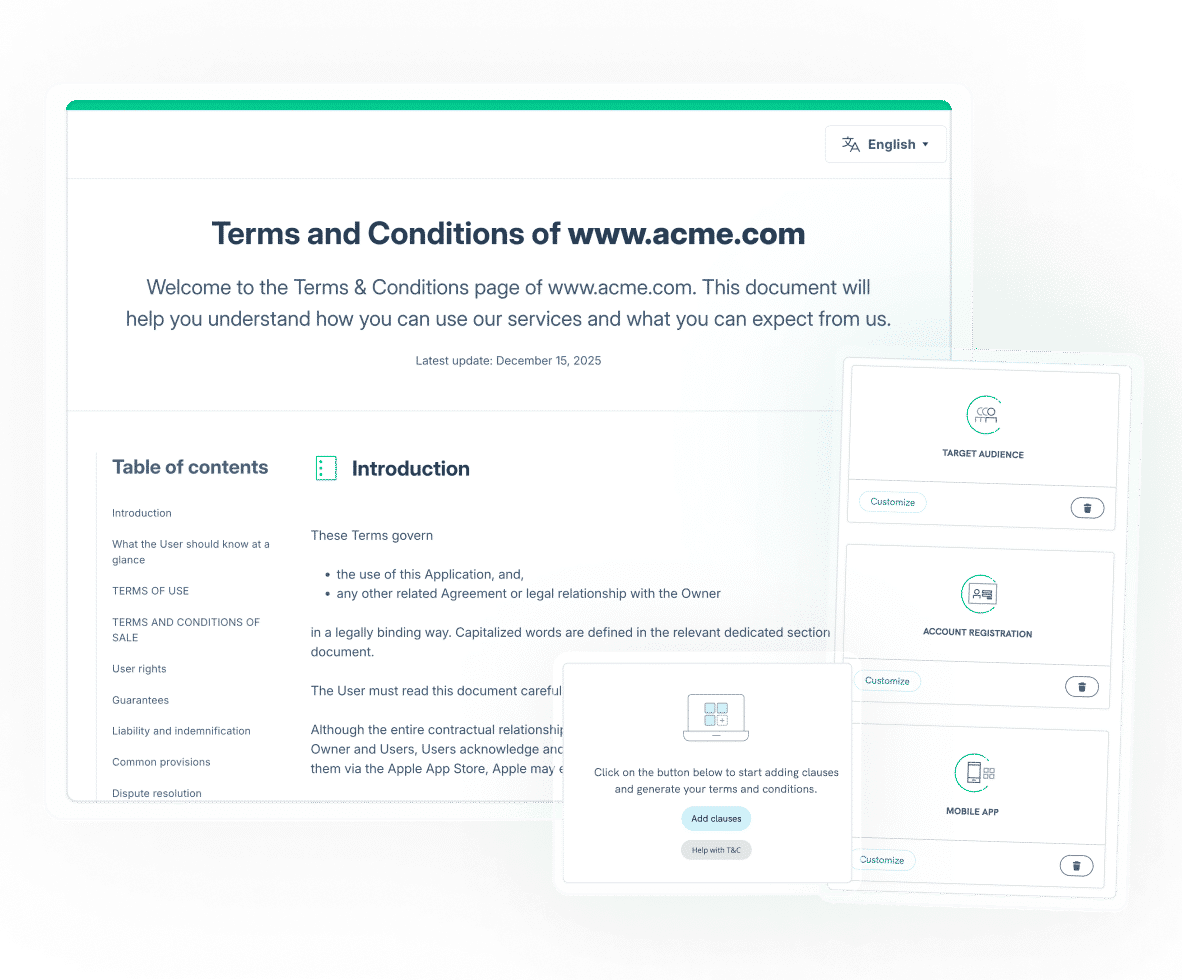
- Save yourself the headache and find what you’re looking for: pick from hundreds of scenario-specific clauses
- Create a strong and precise legal document: clauses have been pre-drafted by lawyers
- Give up the static template: add, remove, or update your document at any time from your own dashboard
Don’t just take our word for it. Try the generator with our 14-day money-back guarantee