

Skip the template: ask Claude or ChatGPT to generate your privacy policy from a scan of your live site. See how it works
In short
Do you sell products or services online? Do you collect users’ personal data like payment information during checkout? Then your online store must include an up-to-date, clear, and easily accessible privacy policy document. Luckily, we’ve got what you need. Keep reading for the key points, plus a free ecommerce privacy policy template.
In this article, we answer some common questions about privacy policies for ecommerce stores. Are they legally required? What’s the best way to generate one? What should it include? We also provide some examples of ecommerce privacy policies. Let’s get started!
Jump to…
- What are some examples of privacy policies?
- Does an online store need a privacy policy?
- Is it legal to have an online store without a privacy policy?
- How do I create a privacy policy for my ecommerce website?
- What to include in your online store privacy policy
- Ecommerce privacy policy examples
- Download our free ecommerce privacy policy template
- Where to display your privacy policy for online store
- Easily create your ecommerce privacy policy in minutes
Looking for an easy way to build your ecommerce privacy policy?

If you want a dynamic online document that you trust more than a template and can update any time (as required by law), try a privacy policy generator: it covers multiple laws at once and is backed by an expert data privacy team.
What are some examples of privacy policies?
Some examples of privacy policies include:
- Ecommerce privacy policy for online store: it typically outlines how an online store collects, uses, shares, and protects customer data, including delivery and payment information. It emphasizes transparency in data handling practices and ensures compliance with data protection regulations to build trust with customers.
- Mobile app privacy policy: it describes the collection, use, and sharing of user data by the app, emphasizing data like location, device specifics, and in-app behavior. It focuses on informing users about their data privacy in a mobile context and the specific permissions required by app stores like Apple.
- SaaS platform privacy policy: it details how the service collects, uses, safeguards, and shares user data, focusing on account information, usage data, and security measures. It addresses the unique aspects of software as a service, including data storage, processing, and the rights of users to manage their information.
Does an online store need a privacy policy?
Yes, an online store typically needs a privacy policy because it very likely collects personal data. Let’s break this down.
A privacy policy is a document in which the data owner (the person or entity that runs the website) outlines the methods and purposes of its data processing to users, i.e. individuals who visit or use the online store.
Under most privacy laws like the GDPR, if the online store collects personal data, the owner must inform users of this fact by way of a privacy policy: it’s required by law and by third-party services it may use.
As you can imagine, it is very probable that your online store collects personal data, during check-out for example. Users are asked to insert things like their home or email address for delivery, as well as their payment information. Furthermore, the need for a privacy policy can be triggered by the presence of a simple contact form, Google Analytics, a cookie or even a social widget on the online store.
Is it legal to have an online store without a privacy policy?
The legality of having an online store without a privacy policy largely depends on the jurisdiction in which the store operates and of its customers. Typically, a privacy policy for online store will be legally required when handling the personal data of users in regions with data protection laws like Europe or the United States.
🇪🇺🇬🇧 General Data Protection Regulation (GDPR): applies to businesses that handle user data in Europe. It requires the inclusion of a privacy policy that discloses the methods of collecting, processing, and storing personal data, along with users’ rights.
🇺🇸 California Privacy Laws (CPRA), Virginia Privacy Laws (VCDPA) and other US State Laws: they apply to businesses that collect data from residents of these States. It requires the inclusion of a privacy policy that mentions personal information collected, how it’s used, with whom it’s shared, if it’s sold, among other things.
Non-compliance with these regulations can result in fines or reputational damage.
Not sure which data privacy laws apply to you?

Find out now with this 1-min free quiz!
How do I create a privacy policy for my ecommerce website?
You can create a privacy policy for your ecommerce website by writing it yourself, using an online ecommerce privacy policy template, a Privacy Policy Generator or plugin, or consulting a legal expert. While you should always pick the option that best fits your business, make sure it is a valid way to write such a legal document. Let’s take a look at each of them.
- Do-It-Yourself approach: at first sight, this approach can be appealing due to its immediate and cost-effective nature. However, we strongly advise against it because of the risk of non-compliance due to potential gaps in legal knowledge. Without specialized legal expertise, drafting a complex and comprehensive legal document, ensuring it complies with all applicable laws, can be challenging and time-consuming. There are other relevant methods that won’t require you to divert valuable resources from other aspects of your business.
- Ecommerce privacy policy template: you can find plenty online, and for free. Take a look at our own template here. Overall, it’s a great starting point and basic framework that you can customize according to your business’s specific needs. Be careful though as a sample ecommerce privacy policy is ususally designed to be a one-size-fits-all, which means it will not fully cover the unique aspects of your operations or the specific regulations you need to adhere to. It also might not be updated to reflect the latest legal requirements.
- [⭐ Recommended] Privacy policy generator: among the options, a Privacy Policy Generator like iubenda stands out for its balance of quality, customization, ease of use, and compliance capabilities. These tools are specifically designed by legal experts to generate high-quality documents that meet the requirements of major data protection laws. They offer a more personalized approach than templates, allowing you to choose all the clauses related to your business operations and data handling practices. These tools do work on a paid subscription-basis but are much more affordable than hiring a legal expert and are generally updated over time following changes to your online store or the law. Also know these tools are available through easy-to-use plugins for online store platforms like Shopify.
- Legal consultation: this option can be relevant for businesses that require the highest level of customization and professionalism. Of course, the costs associated are very high, even for one single consultation. The policy created is not a dynamic document like with automated solutions, this means you’ll likely need extra legal advice any time your data practices or global protection laws change.
Drafting the clauses of a privacy agreement is best handled by professionals. We suggest either hiring a good lawyer or using a professional online generator like iubenda. It allows you to customize from over 2000 lawyer-crafted clauses and offers much more than a static privacy policy template. This way, you can still do it yourself, drawing on the expertise of an international legal team who built and constantly maintain the generator.
What to include in your online store privacy policy
To meet legal requirements, your policy must at the very least mention:
- the types of data you collect, such as names, physical or email address, login, IP address, payment information,
- why you collect this data like for marketing purposes, for the delivery of the service,
- who you share the data with, or any third party like a payment provider or Google Analytics,
- use of cookies or other trackers, see what to include in detail here,
- users’ rights in relation to their data, e.g. the right to request the deletion of their personal data,
- contact information with the identity of the data controller (in practice who establishes “why” and “how” the personal data collected must be processed, usually the site/app owner), so name/company, full address and contact email.
Ecommerce privacy policy examples
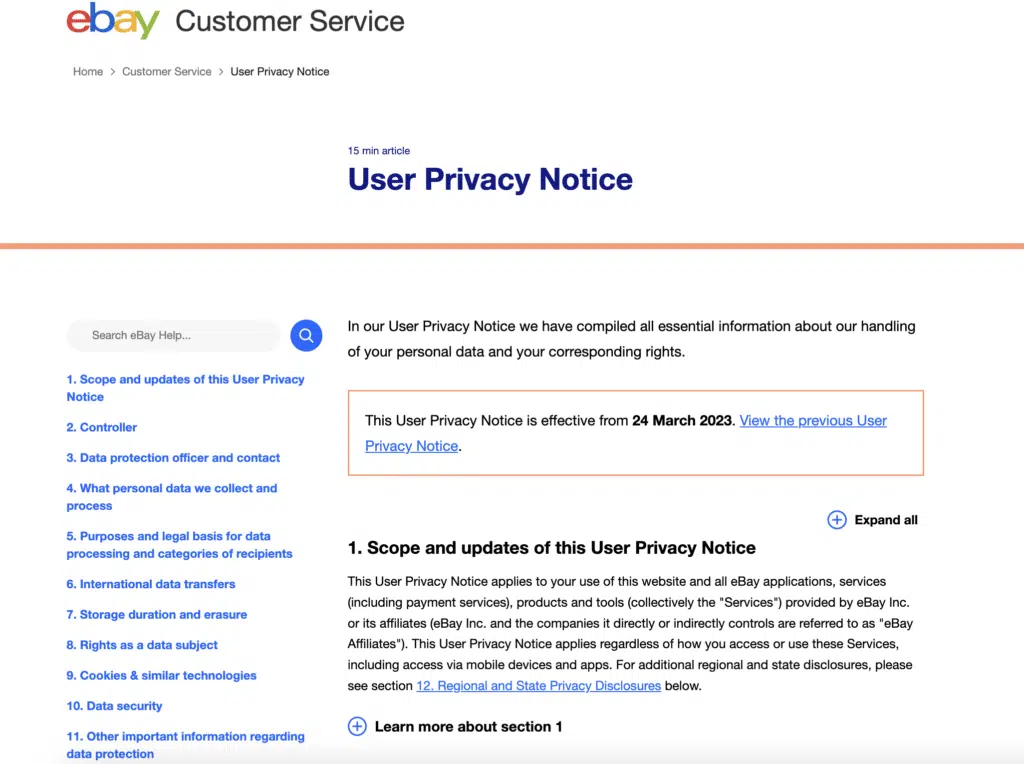
1. eBay ecommerce privacy policy example for online store
eBay’s privacy documents are all available from their website’s footer, at all times (including when browsing products). It is quite concise for clarity, but users can expand sections for more detail if they wish to. This is a great way to have both a simplified and detailed version of the document, to meet GDPR’s requirements for information to be concise, transparent and intelligible.
You can access the policy page at this link.
2. iubenda privacy policy example
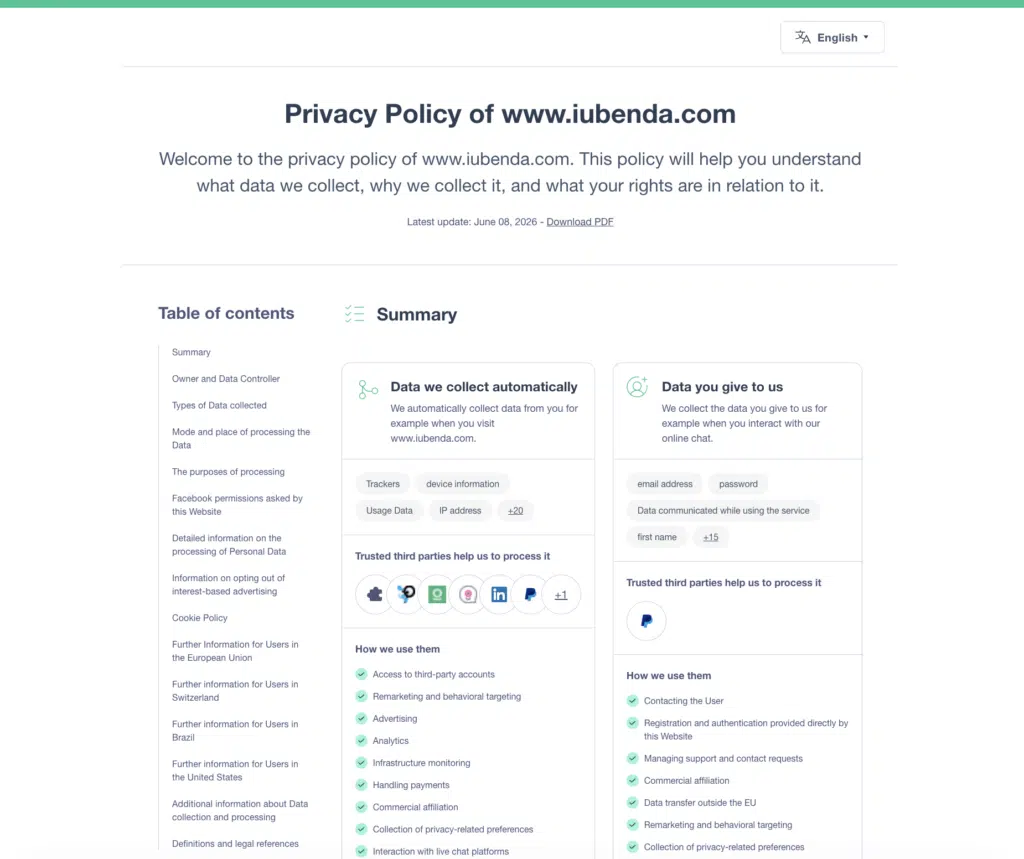
See this GDPR compliant privacy policy created with the iubenda generator for an example of how the elements listed above come together. You can see that the format is very user-friendly.
Download our free ecommerce privacy policy template
Our privacy policy template is just an example, and the legal text is customized to generic data processes and laws. Remember that privacy policies are legal documents. It is mandatory that they contain truthful information, or you could be putting yourself at risk. They need to be tailored specifically to align with your business and website. The sample privacy policy for ecommerce website we provide below serves as a solid foundation to familiarize yourself with the privacy disclosures generally mandated by legislation such as GDPR. Your best option yet, however, would be to use a privacy policy generator. You can try ours for free (14-day money-back guarantee).
How to use the template
- Download the template: get our free e-commerce privacy policy template in Word doc format, copy and paste the HTML directly into your website, or generate your ready-to-use template with our guided setup.
- Fill in company/site and contact details: before publishing, fill in all [brackets] with your company/site info and contact details. Remember also to add the effective date.
- Customize data processing: the template simply provides examples of data collection. Customize the different sections.
- Use of cookies and other trackers: add information about the cookies you use or a link to your complete cookie policy.
- Address legal obligations: the template includes provisions for GDPR. Check which privacy laws apply to you and customize your privacy policy according to your location and your users’ locations to meet legal requirements.
Online store privacy policy template (HTML text)
Copy and paste the E-commerce Privacy Policy Template HTML directly into your website.
<h1><strong>Privacy Policy of [Your E-commerce Store Name]</strong></h1>
<p><strong>Effective Date</strong>: [Insert Date]<br /><br />We are committed to protecting the privacy and security of our customers and site visitors. This Privacy Policy outlines how we collect, use, share, and safeguard your personal information when you visit our website, [Insert your website URL], and use our services.</p>
<h3><strong>Data Controller, DPO, and Contact</strong></h3>
<p>[Insert here the contact detail of whoever is responsible for the collection and processing of user personal data at your company. E.g.</p>
<ul>
<li><strong>Data Controller</strong>: [Your Company Name]</li>
<li><strong>Data Protection Officer (DPO)</strong>: [Name and Contact Information, if applicable]</li>
<li><strong>Address</strong>: [Your Business Address]</li>
<li><strong>Email</strong>: [Email Address]</li>
<li><strong>Phone Number</strong>: [Phone Number]</li>
</ul>
<h3><strong>Types of Data We Collect</strong></h3>
<p>We collect personal information that you provide to us when you use our services or interact with us. This includes:</p>
<ol>
<li><strong>Personal Identification Information</strong>: Name, email address, physical address, and telephone number.</li>
<li><strong>Account Details</strong>: Username, password, and purchase history.</li>
<li><strong>Payment Information</strong>: Credit/debit card details, billing address, and other payment-related information.</li>
<li><strong>Technical Data</strong>: IP address, browser type and version, time zone setting, location, browser plug-in types and versions, operating system and platform, and other technology on the devices you use to access this website.</li>
<li><strong>Usage Data</strong>: Information about how you use our website, products, and services.</li>
</ol>
<h3><strong>Why We Collect This Data</strong></h3>
<p>We collect your data to:</p>
<ul>
<li>Process your orders and manage your account</li>
<li>Improve and personalize your shopping experience</li>
<li>Communicate with you about our products, services, and promotional offers</li>
<li>Conduct market research and analysis</li>
</ul>
<h3><strong>Legal Basis for Processing</strong></h3>
<p>We process your personal data based on the following legal grounds:</p>
<ol>
<li><strong>Your consent</strong></li>
<li><strong>The need to fulfill a contract with you</strong></li>
<li><strong>Our legitimate business interests</strong></li>
<li><strong>Legal requirements</strong></li>
</ol>
<h3><strong>Data Storage, Erasure, and Security</strong></h3>
<p>We and our service providers store personal data in accordance with applicable data protection laws to the extent necessary for the processing purposes outlined in this privacy policy document.</p>
<p>We will delete personal data [in accordance with our data retention and deletion policy] or take steps to properly render the data anonymous unless we are legally obliged or permitted to keep it longer.<br />We ensure the security of your personal information by employing both technical and organizational measures. These measures are put in place to reduce the risks related to data loss, misuse, unauthorized access, disclosure, or alteration.</p>
<h3><strong>Data Transfer Outside the EU</strong></h3>
<p>In some cases, we may need to transfer your personal data to countries outside the European Union (EU) or the European Economic Area (EEA). These transfers may occur when our service providers or partners are located in countries outside of the EU/EEA or when we need to store or process data in global data centers. We ensure that any such transfer of your personal data is carried out in compliance with applicable data protection laws, including the General Data Protection Regulation (GDPR). To safeguard your data during these transfers, we rely on standard contractual clauses or other appropriate safeguards, ensuring that your data is protected in accordance with GDPR standards.</p>
<h3><strong>Use of Cookies and Other Trackers</strong></h3>
<p>Our website uses cookies and similar tracking technologies to improve your browsing experience, understand how you use our site, and show you personalized advertising. You can manage your cookie preferences through your browser settings.</p>
<p>You can access our full cookie policy [here].</p>
<h3><strong>Your Rights</strong></h3>
<p>You have the right to access, correct, delete, or restrict the use of your personal information. You can also object to the processing of your data in certain circumstances, including for marketing purposes.</p>
<ul>
<li><strong>Access your personal data</strong></li>
<li><strong>Rectify incorrect data</strong></li>
<li><strong>Erase your data in certain circumstances</strong></li>
<li><strong>Restrict or object to processing</strong></li>
<li><strong>Data portability</strong></li>
</ul>
<p>To exercise these rights, please contact us using the details below.</p>
<h3><strong>Contact Information</strong></h3>
<p>If you have any questions about this Privacy Policy or our privacy practices, please contact us at:</p>
<ul>
<li><strong>Data Controller</strong>: [Your Company Name]</li>
<li><strong>Address</strong>: [Your Full Address]</li>
<li><strong>Email</strong>: [Email Address]</li>
<li><strong>Phone Number</strong>: [Phone Number]</li>
</ul>
<p>We reserve the right to make changes to this Privacy Policy at any time. Any changes will be posted on this page with an updated effective date.</p>
Online store privacy policy template (Word DOCX)
Online store privacy policy template (PDF)
Where to display your privacy policy for online store
When adding a privacy policy to your online store, make sure it’s easy to find wherever you collect customer data to comply with legal requirements.
A website’s footer is a commonly used place to put your privacy policy link, as visitors can easily spot it and can go back to it at any time. You can also include the link in pop-ups or banners that show up when people first interact with your website for better visibility.
When people sign up for newsletters or updates, put the privacy policy link in a prominent spot since they’re providing personal information like their names and email addresses.
The checkout process is another important place to have a policy link, but it shouldn’t be the only location because not everyone will make a purchase.
Consider adding the link to informational menus or sections to make it more visible, and you can also link other legal documents like Terms and Conditions.
ECOMMERCE PRIVACY POLICY GENERATOR
Easily create your ecommerce privacy policy in minutes
- Our legal team has already done most of the work, handling all the legal documents and texts.
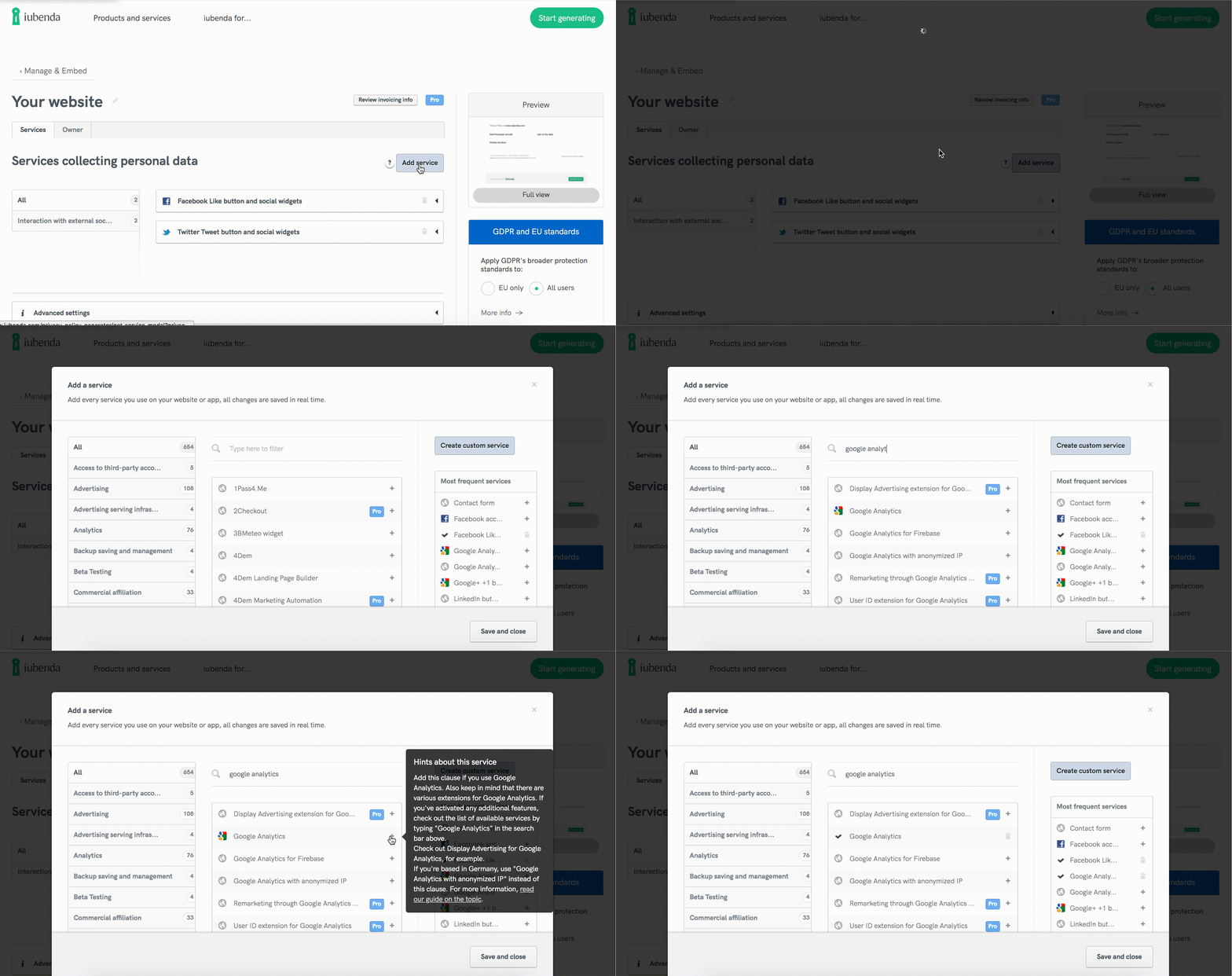
- Choose from 2000+ pre-written clauses for various services like Google Analytics.
- Scan your site to identify what you need, customize, and embed your privacy policy on your site!
- We host the document for you and recommend updates when the law changes.
Try the generator with our 14-day money-back guarantee