

Running an online store comes with legal responsibilities, especially around returns and refunds.
This article will provide a complete guide to writing a return policy that aligns with regulations in the EU, UK, and the US.
In short
What is a return policy?
A return policy is a set of guidelines that helps a business to manage returns or refunds. It defines when a customer can return an item, the timeframe within which returns are accepted, the process to request a return or refund, etc.
Having a clear return policy helps simplify the return process and gives your customers an exact idea of what they can expect when they buy from you.
Is a return policy legally required?
If you sell online, a return and refund policy is a must-have: most countries’ industry regulations require stores (even digital ones) to have an agreement to inform users about their policy on returns and refunds.
For example, in the EU not having a return policy can expand the right of withdrawal from 14 days to 1 year and 14 days. Also, you’ll have to pay the return shipping costs for EU customers.
In the US, not having a clear return policy can result in legal complications and damage your brand reputation.
What to include in a return policy
Your return and refund policy should include at least the following sections:
- Timeframe for return: how long do your clients have to return the products? This usually falls between 14 and 30 days.
- Condition of return: what condition the products should be in when they’re returned. As a general rule, products should be unused, in their original packaging, and with all tags attached.
- Shipping cost: let your clients know who’s responsible for the shipping costs.
- Refund method: how you’ll issue refunds, whether through the original payment method, as store credit, or as an exchange.
- Exceptions and exclusions: what items aren’t eligible for return, like final sale items, custom-made products, or perishable goods.
- Contact information: this is so customers can reach out with any questions or issues related to their return.
How to write a return policy
To write a return policy, cover the essentials your customers need to know: the timeframe for returns, the condition items must be in, who pays return shipping, how you issue refunds, any exceptions (like final-sale or custom items), and how customers can reach you. Keep the language clear and specific to your business. Our free return policy template below is a good starting point. To best protect your business, we recommend generating a complete Terms and Conditions document with your return terms built in.
Where to put a return policy
Make sure that your return and refund policy is easy to find on your website so that customers see it before they buy. A few key places to list this policy include:
- your website footer,
- FAQ page,
- product page,
- cart,
- checkout.
Please note that you could add the return policy in your Terms and Conditions rather than having a separate agreement.
TERMS AND CONDITIONS GENERATOR
Generate your Terms and return policy
A return policy is usually mentioned in your T&Cs.
If you want to protect your e-commerce business best and comply with commercial law, a simple template often isn’t enough.
Terms and Conditions are legally binding. So a customizable, professional document is worth having. You can easily do that with our Terms and Conditions Generator.
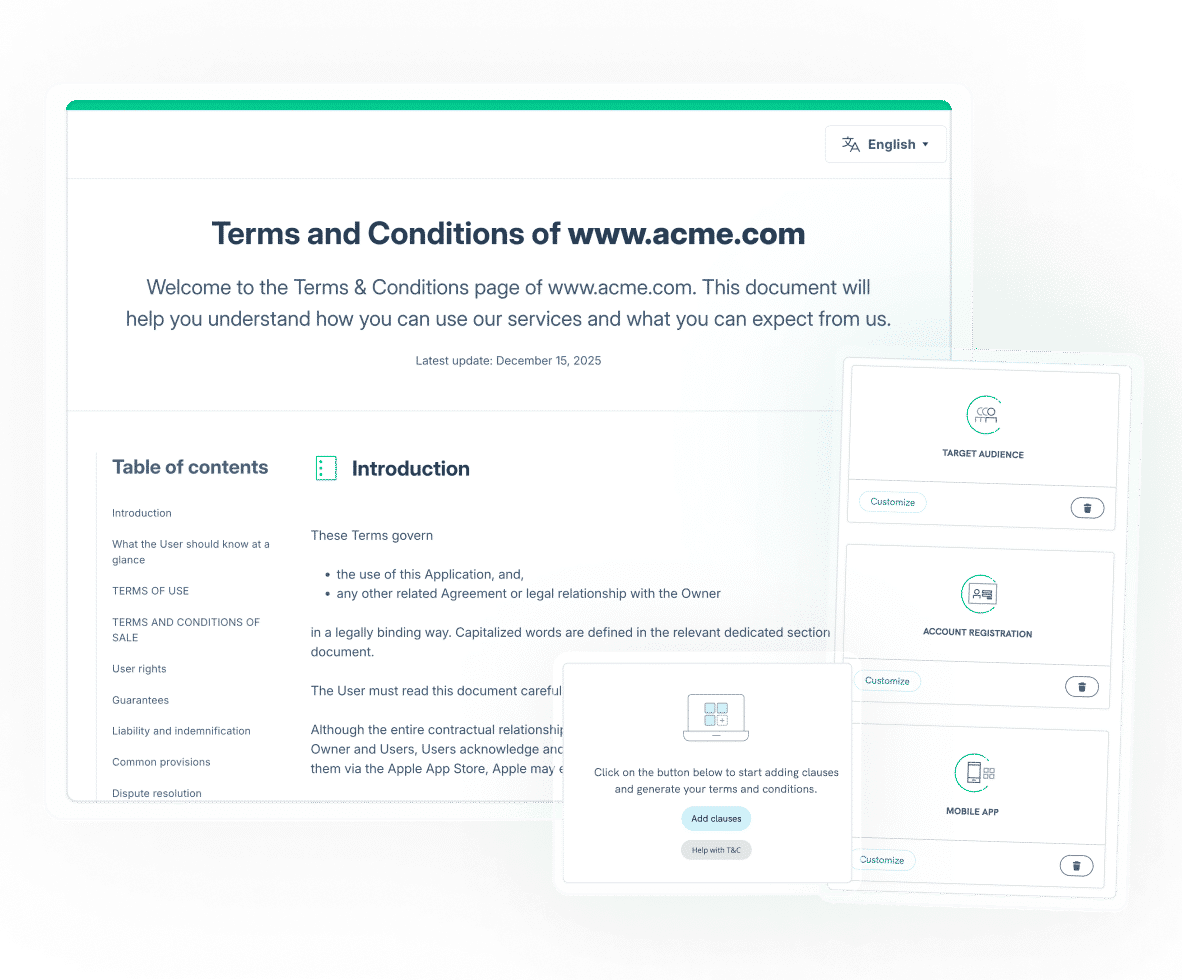
Try our generator with our 14-day money-back guarantee
Return policy template
Please be aware that what we provide is a standard template structure. Depending on your business structure, the product you offer, and your location, you may need to modify clauses or include additional details to comply with legal standards.
Read before using a return policy template
Return policies are shaped by consumer protection laws that differ from one market to the next. A generic template is a good starting point, but it often can’t account for your specific business model or the jurisdictions your customers are in. Your return policy sets out the terms customers rely on when they buy from you and can be legally binding, so make it specific to your business and keep it up to date with the laws referenced in its contents.
Keep in mind that a return policy is merely one section of a terms & conditions document. It is HIGHLY recommended that you provide your customers with a complete Terms document to fulfill legal obligations and safeguard your interests.
Return Policy of [Your Store]
Thank you for shopping at [Your Store]. We are committed to ensuring your satisfaction. If, however, you find yourself dissatisfied with your purchase, we are here to assist you.
- United Kingdom (UK): [ e.g., Consumers have 14 calendar days to return an item from the date received, as per the Consumer Contracts Regulations.]
- European Union (EU): [ e.g., Buyers typically have 14 calendar days to return an item, following the EU Consumer Rights Directive, unless the member state has implemented longer periods.]
- United States (US): [ e.g., Our standard return policy allows for returns within 30 calendar days from the receipt date.
- Conditions for Return:
- Please adhere to our return conditions, ensuring they align with applicable consumer law, which may vary by country.]
Refunds:
- Upon receipt of your item, we will conduct an inspection and inform you that we have received the returned item.
- Post-inspection, you will be promptly notified regarding the status of your refund.
- If approved, the refund will be processed to your original payment method.
- The credit will appear within a number of days, subject to your card issuer’s policies.
Shipping:
- Return shipping costs are the responsibility of the customer and are non-refundable.
- Should you receive a refund, the cost of return shipping will be deducted from it.
Exceptions:
Certain items are non-returnable, including but not limited to:
- Items on sale
- Perishable goods
- Gift cards
- Downloadable software products
- Personal care items
Damaged or Defective Products:
[e.g., If you receive a damaged or defective product, please contact us promptly to organize a replacement or refund.]
Contact Us:
For queries regarding item returns, please contact us at:
Email: [support@yourstore.com]
Phone: [Your Store Phone Number]
Examples of return policies
Looking for return policy examples? Below are return policy examples from different types of business, showing how the essentials come together.

Small business return policy example
The return policy of a small business can vary a lot depending on what kind of business it is, what products it sells, and who its customers are. Use the sample return policy for small business below as a starting point, then adapt it into your own template.
For instance, a small e-commerce business might let you return items within 30 days for a full refund, while a local artisanal shop might only offer exchanges or store credit. Sometimes, small businesses might also have a no return, no refund policy (also called a “final sale” policy) on their products, meaning that items can’t be returned.
These policies are designed to protect the business from potential losses while still offering customers a fair and reasonable way to address any issues with their purchases.
Boutique return policy example
A boutique return policy usually reflects the personalized and customer-focused nature of small, independent shops.
In a boutique setting, the return policy is often flexible and customer-focused, while also protecting the business from excessive returns. For example, a boutique might let you return items within 14 to 30 days of purchase, as long as they’re in their original condition and packaging with tags attached. The policy might also include options like store credit or exchanges instead of full refunds, especially for items on sale or custom orders.
This approach balances the need to keep customers happy with the financial realities of running a smaller business.
SaaS business return policy example
SaaS businesses usually have a return policy based on subscription terms and refunds for digital products.
Since SaaS products are often delivered instantly and used immediately, some companies have a limited refund period, like offering refunds within the first 7 days of a subscription if the customer is unsatisfied. Some SaaS companies might also have rules about trial periods, cancellations, and things like setup fees or custom integrations.
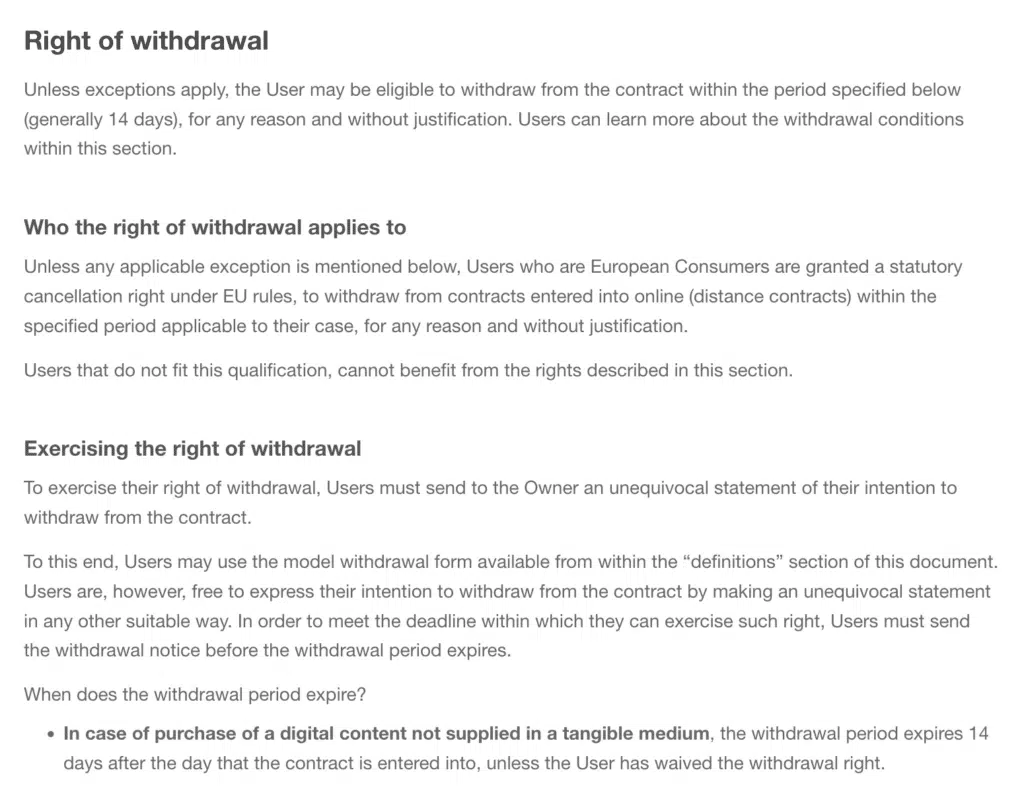
The document below is an example of Terms and Conditions created with iubenda’s Terms and Conditions Generator.
Click on the button to open the document and scroll to “Guarantees” for a return clause example:
Returns and refunds in the EU and UK
Online, mail and telephone order customers have the right to cancel their order for a limited time even if the goods are not faulty. Here are the rules:
- You must offer a refund to customers if they’ve told you within 14 days of receiving their goods that they want to cancel. They don’t have to give any reason.
- Customers have another 14 days to return the goods once they’ve told you.
- You must refund the customer within 14 days of receiving the goods back.
Returns and refunds in the US
In the United States, laws surrounding return and refund policies can vary by state. However, it’s a good practice to offer a clear and concise policy. A 30-day return policy is often considered standard.
Return shipping costs
- Usually, EU consumers have to pay for the return shipping costs, but this is something you must inform them about before the purchase.
- In the UK, return shipping costs are borne by consumers, unless sellers have stated otherwise. Also, you must take back at your own expense the goods that, by their nature, cannot normally be returned by post.
- In the US, it’s common for customers to pay for return shipping unless the item is defective or the wrong item was sent.
Exceptions to refund policies
Common exceptions vary by region. In the EU and UK, some purchases are excluded from the legal right to cancel; in the US, retailers commonly exclude:
| EU and UK | US |
|---|---|
| Perishable goods | Perishable items |
| Personalized items and custom-made items | Gift cards |
| Services that have been fully performed | Downloadable software |
| Newspapers and magazines | Health and personal care items |
| Culture and sports events | |
| Trips and accommodations |
Return policy FAQ
What is a return policy?
A return policy is a set of guidelines that helps a business manage returns and refunds. It defines when a customer can return an item, the timeframe for returns, and the process to request a return or refund. A clear return policy simplifies the whole process and tells your customers exactly what to expect when they buy from you.
How do I create a return policy?
The quickest way to create a return policy is to start from a template and adapt it to your business. Make sure it spells out your return window, the condition items must be in, who covers return shipping, your refund method, any exclusions, and your contact details. For a document that also protects the rest of your business, generate Terms and Conditions and include your return terms inside it. If you have the right budget, a legal professional can help with that. If not, your best option is probably an online generator like iubenda.
When does a 30-day return policy start?
A 30-day return window usually starts from the day the customer receives the item, not the order date, though some businesses count from the purchase date instead. Whichever you choose, state it clearly in your policy so customers know exactly when their window opens and closes. Keep in mind that in the EU and UK, the statutory right to cancel runs for at least 14 days from delivery, separate from any longer return window you offer.
TERMS AND CONDITIONS GENERATOR
Easily create your Terms in minutes
- Professional and customizable document from over 100 clauses pre-drafted by an international legal team
- Available in +15 languages
- Guided setup and pre-set scenarios for apps, marketplaces, SaaS, affiliate programs, e-commerce, mobile, etc.
- Up-to-date with the main international legislations
- Integrations with platforms like Shopify or WooCommerce
Try the generator with our 14-day money-back guarantee